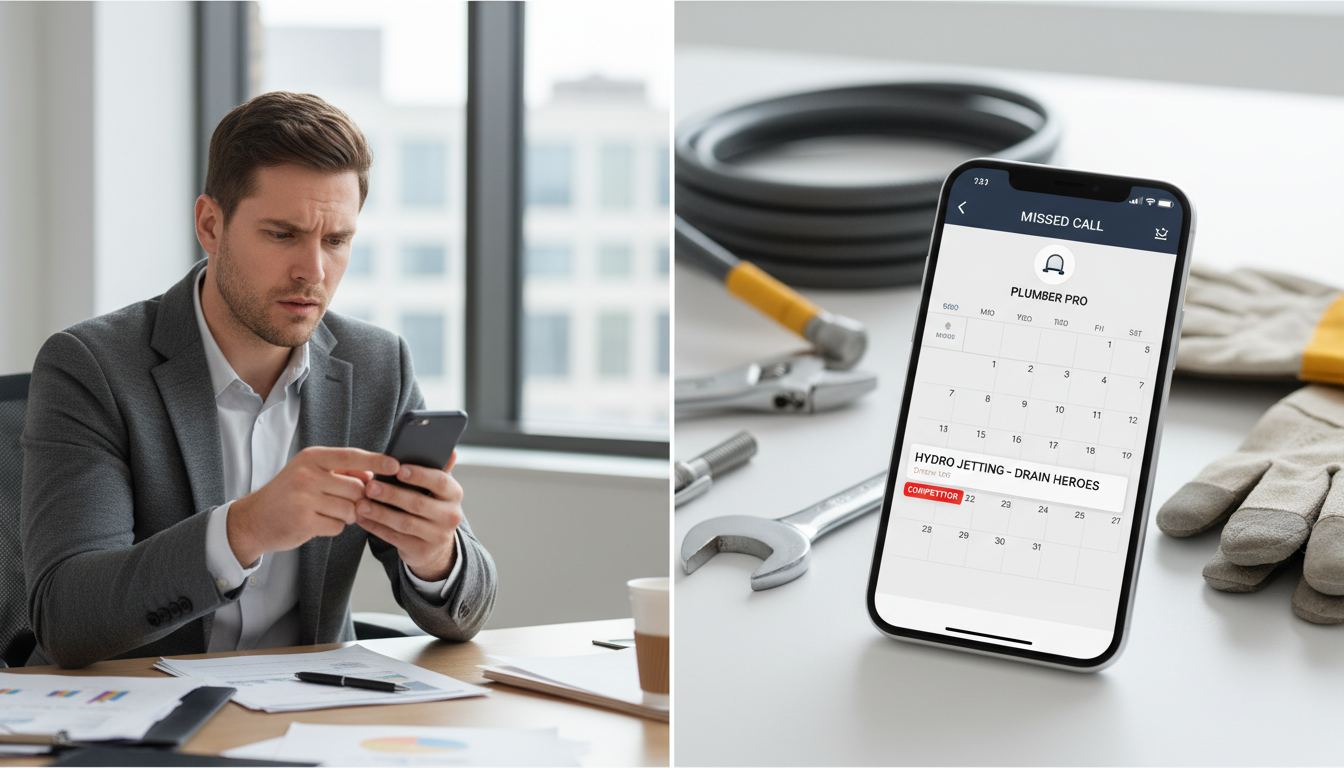
Plumbing hydro jetting leads die in the first five minutes. When a property manager calls three plumbers about a severely clogged main line, the job goes to whoever picks up the phone, asks the right questions, and quotes a price before the customer hangs up to dial the next number. Most plumbing companies lose these high-ticket jobs not because their price is wrong or their service is inferior, but because they take too long to respond—and hydro jetting customers won't wait.
Why Speed Matters More for Hydro Jetting Than Basic Drain Calls
Hydro jetting jobs are fundamentally different from your standard drain snake call. The customer already knows they have a serious problem—tree roots, grease buildup, or a collapsed section—and they're comparing specialists, not just looking for the cheapest fix. According to Vendasta, leads contacted within five minutes are 21 times more likely to convert than those contacted after 30 minutes. For hydro jetting sales specifically, that window is even tighter because the customer is often dealing with an urgent situation and has already decided to spend money—they're just choosing who gets it.
The property manager with a backed-up commercial building can't wait until tomorrow. The homeowner who just had their third snake-out this year knows it's time for the real solution. These aren't price shoppers browsing Yelp for fun. They're ready buyers who will book with the first qualified plumber who demonstrates competence and availability.
Here's what most articles won't tell you: The plumber who answers fastest doesn't always win—the plumber who quotes fastest does. A callback that says "I'll send someone out to assess it" loses to the competitor who asks three diagnostic questions over the phone and says "Based on what you're describing, this is a $650-$850 job and we can be there Thursday at 2 PM." The customer hears confidence and closure. Your callback sounds like another step in an already frustrating process.
Why Hydro Jetting Leads Call Multiple Companies Immediately
Unlike a leaking faucet, hydro jetting is a service most customers have never purchased before. They don't have "their hydro jetting guy." They're starting fresh, which means they're doing what every buyer does when making an unfamiliar purchase: they're gathering multiple quotes quickly. The National Association of Plumbing-Heating-Cooling Contractors reports that commercial plumbing jobs average three competitive bids, and hydro jetting falls squarely in that category—it's specialized enough to warrant comparison shopping, expensive enough to justify the effort.
The customer doesn't call you, then wait patiently for your callback, then call the next plumber. They open Google, tap the first three plumbers with good reviews, and call all three within 90 seconds. The race starts the moment their first call goes to voicemail.
The Hidden Cost of "I'll Call Them Back After This Job"
Every hour you delay responding to a hydro jetting lead costs you approximately 10% of your conversion probability. By the time you finish the drain snake job you're on, grab lunch, and return the morning's voicemails, that lead has already booked with someone else. The math is brutal: if you're averaging $1,200 per hydro jetting job and you're missing half your inbound leads due to slow response, you're leaving $30,000+ on the table annually on just five leads per month.
The problem isn't laziness—it's logistics. You're underground running a camera line. You're elbow-deep in a water heater replacement. You're driving between jobs. The phone rings, you can't answer, and you genuinely intend to call back. But "later" in the plumbing business often means "too late" for high-ticket plumbing jobs that move fast.
Here's the pattern most plumbing company owners recognize immediately: You see a missed call at 9:47 AM. You call back at 11:20 AM. The customer sounds distant, says they're "still getting quotes," and will "let you know." Translation: they already booked someone else and they're being polite. You've lost the job and you don't even realize it yet because the customer hasn't explicitly said no.
What Happens to Leads Between Minute 5 and Minute 60
Research from InsideSales.com shows that response times longer than five minutes see conversion rates drop by up to 80% in service industries. But the real damage happens in how the customer perceives your business before you even speak to them. When your competitor answers on ring two, asks smart questions, and provides a ballpark quote, they're not just faster—they're positioning themselves as the professional who has their act together. When you call back 90 minutes later, you're the plumber who's disorganized, too busy, or not hungry for the work.
The customer doesn't know you were replacing a water heater for a 92-year-old woman who needed help moving boxes out of the way. They don't know your apprentice called in sick and you're doing two jobs solo. They just know that ABC Plumbing answered immediately and you didn't. First impressions form in seconds, and missed calls scream "I'm not reliable."
Why Voicemail Doesn't Work for Hydro Jetting Quotes
Leaving a professional voicemail message ("You've reached Mike's Plumbing, we can't take your call right now...") doesn't solve the problem—it confirms to the customer that they need to keep calling down their list. According to service industry benchmarks, fewer than 15% of first-time callers leave voicemails, and even fewer wait for a callback before continuing their search. For urgent issues like severely clogged lines, that number drops even further.
The customer who needs hydro jetting isn't browsing—they're hunting. Voicemail is a dead end that sends them to the next name on the list. Even if they do leave a message, they're not sitting by the phone waiting. They're calling your competitor while your outgoing message is still playing.
How Top-Performing Plumbers Handle Hydro Jetting Leads Differently
The plumbing companies that consistently win hydro jetting jobs don't have better trucks, lower prices, or flashier websites. They have someone who answers the phone every single time it rings and can quote the job without a site visit in 70% of cases. That "someone" is either a dedicated front office person (which most 2-15 person plumbing companies can't justify hiring full-time) or a fully managed team that handles calls, qualifying, quoting, and booking as if they worked in your office.
BookAllLeads provides exactly that: a full front office team of six specialized roles—call answering, qualification, quoting, scheduling, payment collection, and follow-up—working 24/7 for plumbing companies that are too busy in the field to answer every call. No software to learn, no complicated setup. Your inbound calls get answered by a real person who knows plumbing, knows your pricing, and can book the job or schedule the estimate before the customer dials the next plumber. Live in five days, no contracts, and you only pay for results.
This solves the core problem: you can't be in a crawl space and on the phone simultaneously, but you also can't afford to miss the hydro jetting lead that just called three of your competitors in the past two minutes. The solution isn't working harder—it's having people in place whose only job is answering and converting those calls while you do the work you're actually good at.
What to Say in the First 60 Seconds to Win the Hydro Jetting Job
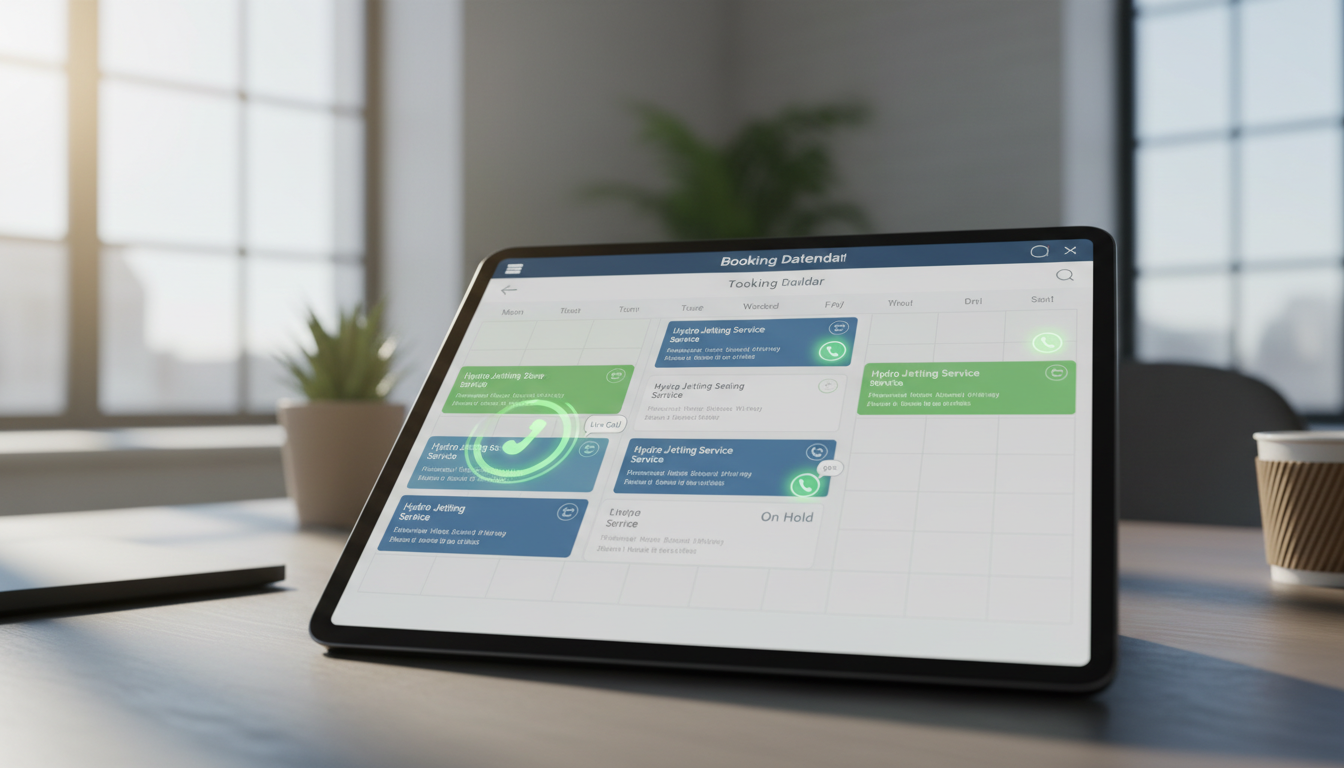
Speed gets you in the conversation. The right questions win the job. When you (or your front office team) answer a hydro jetting inquiry, the first 60 seconds determine whether you're getting a booked appointment or a polite brush-off. The goal isn't to sell—it's to demonstrate expertise and provide clarity faster than the competition.
Start with diagnosis, not pricing. Ask: "What have you already tried?" and "Is this a recurring clog or the first major backup?" These questions do two things: they show you know what you're doing, and they give you the information you need to quote accurately without a site visit. A first-time main line backup in a 30-year-old house is a different job than a restaurant with chronic grease buildup.
Then provide a realistic range, not a vague estimate. "For what you're describing, hydro jetting typically runs $600-$900 depending on access and line length. I can get you on the schedule for Thursday afternoon or Friday morning—which works better?" That specificity closes the loop. The customer doesn't need to keep calling around because you've already answered their core question: how much and how soon.
The Three Questions That Qualify or Disqualify a Hydro Jetting Lead
Not every inquiry is a real buyer, and wasting time on unqualified leads costs you real opportunities. Ask these three questions within the first two minutes:
- "Have you had this line camera-inspected, or are we diagnosing from symptoms?" This separates informed buyers from people who might just need a $150 snake-out.
- "Are you the property owner or the decision-maker on repairs?" Tenants and property managers often need owner approval—knowing this upfront prevents scheduling appointments that won't close.
- "What's your timeline—is this an emergency or planned maintenance?" Emergency calls book immediately at premium rates. Planned maintenance can be scheduled strategically but also means the customer is likely getting multiple bids.
These questions take 90 seconds and prevent you from chasing leads that were never going to convert or quoting jobs that aren't ready to move forward.
Why "I Need to See It First" Loses You Hydro Jetting Jobs
The instinct to say "I really need to see it before I can give you a price" is understandable—hydro jetting jobs vary based on access, line length, and severity. But that answer kills momentum and sends the customer back to shopping mode. Your competitor who says "Typically $650-$850, and I can confirm once we're on-site" has given the customer what they need to move forward. You've given them homework.
The customer interprets "I need to see it" as "I can't help you yet" or worse, "I'm not confident enough to estimate my own services." It adds a step (scheduling a free estimate, waiting for you to show up, waiting for the quote, then deciding) when the competitor has already collapsed that into one phone call and a booked job.
Here's the fix: Develop pricing ranges based on common scenarios. Residential main line, 50-100 feet, standard access: $600-$800. Commercial kitchen grease line with difficult access: $900-$1,400. Root intrusion with camera inspection included: $850-$1,200. You're not locked into these prices—you can adjust on-site if conditions warrant—but you've given the customer enough information to say yes to the appointment, which is the only goal of the first call.
The Real Reason Your Hydro Jetting Leads Go Cold
It's not that customers choose cheaper competitors. It's that they choose responsive competitors, and by the time you call back, the decision is already made. According to Forbes, 78% of customers say speed of service is a primary factor in choosing a service provider, outranking price for non-emergency professional services. Hydro jetting sits in that sweet spot: it's urgent enough that customers want it handled quickly, but expensive enough that they'll comparison shop—meaning the first plumber who combines speed and professionalism wins.
The jobs you're losing aren't going to plumbers with better Yelp reviews or fancier trucks. They're going to plumbers whose phone gets answered, whose front office asks the right questions, and who book the appointment before the customer moves to the next call. If you calculate your losses based on even three missed hydro jetting leads per month at an average ticket of $1,100, you're leaving $39,600 on the table annually. That's not revenue you failed to generate—it's revenue you generated for your competitor by being unavailable when the customer called.

What Happens When You Finally Get Quote Speed Right
When your inbound hydro jetting leads get answered in under 30 seconds, qualified with smart questions, and quoted with specific ranges before the customer hangs up, three things change immediately. First, your conversion rate on leads jumps from 15-20% (industry average for slow-response plumbing companies) to 40-60%. Second, your average ticket increases because you're not competing solely on price—you're competing on professionalism and availability, which commands premium positioning. Third, you stop feeling like you're constantly chasing work and start operating from a position of abundance, with a calendar that fills predictably instead of sporadically.
One plumbing company owner in Phoenix tracked this precisely. Before implementing a dedicated front office team, he closed 18% of hydro jetting inquiries and averaged $780 per job. After ensuring every call was answered and quoted within the first conversation, his close rate jumped to 47% and his average ticket rose to $1,150—because he stopped sounding desperate for the work and started sounding like the expert the customer was hoping to find. Over six months, that translated to an additional $43,000 in hydro jetting revenue alone, not counting the upsells and repeat customers those jobs generated.
The Compounding Effect of Fast Response on Referrals
Customers who get fast, professional service don't just book the job—they tell other people about the experience. According to Harvard Business Review, customers acquired through referrals have a 16% higher lifetime value than those acquired through other channels. When a property manager calls about hydro jetting, gets an immediate answer, and has the job completed professionally, they don't just use you again—they recommend you to other property managers. Fast response creates a referral loop that builds over time, compounding your lead volume without increasing your marketing spend.
Slow response does the opposite. The customer who had to call you three times, leave two voicemails, and finally book someone else doesn't just give that job to a competitor—they remember the frustration. They don't refer you. They don't call you next time. You've lost not just one $900 job but the next five jobs that would have come from that relationship.
How to Fix Your Hydro Jetting Lead Response Without Hiring Full-Time Staff
The obvious solution—hire a full-time office manager or receptionist—doesn't pencil out for most plumbing companies under 15 employees. You're paying $35,000-$50,000 annually plus benefits for someone who's only busy during peak call times, and you're still not covered nights, weekends, or when they're sick or on vacation. The math only works if you're doing $2M+ in revenue, which most owner-operators haven't hit yet.
The alternative is a fully managed front office team that works like an extension of your business, not a call center reading scripts. This model gives you six specialized roles—call answering, lead qualification, quoting, appointment scheduling, payment collection, and follow-up—at a fraction of the cost of one full-time employee. You're covered 24/7, there's no training burden, and you only pay for performance, not payroll. For plumbing companies in that 2-15 employee range, this is the only way to compete with larger companies on responsiveness without the overhead that kills profitability. See how the economics work for plumbing-specific businesses.
Frequently Asked Questions
How quickly do I need to respond to hydro jetting leads to stay competitive?
Ideally within five minutes, but certainly within 15 minutes. Research shows that leads contacted within five minutes are 21 times more likely to convert than those contacted after 30 minutes. For high-ticket plumbing jobs like hydro jetting, customers are calling multiple plumbers within the same hour, so speed is the primary competitive advantage—more important than price or brand recognition for customers who don't already know you.
Can I quote hydro jetting over the phone without seeing the job first?
Yes, with proper qualification questions. Ask about the property type, previous attempts to clear the line, symptoms, and access points. Based on this information, provide a realistic range (e.g., $650-$900 for residential main lines, $900-$1,400 for commercial with difficult access). Make it clear the final price will be confirmed on-site, but give enough information for the customer to make a booking decision. Competitors who provide ranges win more jobs than those who refuse to discuss pricing until after a site visit.
What's the average conversion rate for hydro jetting leads in the plumbing industry?
Industry benchmarks show 15-25% conversion for plumbing companies with slow response times (over 30 minutes), and 40-60% for those who answer immediately and quote confidently on the first call. The difference comes down to speed and qualification—customers who get immediate answers stop calling other plumbers, while those who reach voicemail continue shopping.
Why do hydro jetting customers shop around more than customers calling for basic repairs?
Hydro jetting is an unfamiliar service for most customers, typically costs $600-$1,500, and isn't an impulse decision. Unlike a leaking faucet where the customer just wants it fixed quickly, hydro jetting leads have usually tried cheaper solutions first and are now committed to solving the problem permanently. They're comparing specialists and expertise, not just looking for the lowest price, which means they'll call 2-4 plumbers before deciding. The first plumber who demonstrates competence and availability typically wins.
What should I do if a hydro jetting lead says they're "getting other quotes"?
Provide your quote immediately and book a specific appointment time. Saying "I understand—for what you've described, we're typically $700-$900 and I have availability Thursday at 1 PM or Friday morning. Does either of those work?" This demonstrates confidence and moves the conversation from "maybe" to a concrete decision point. If they're truly shopping, you've made it easy to choose you. If they've already mentally committed to another plumber, you'll know quickly and can move on instead of chasing a dead lead.
How much revenue do plumbing companies typically lose from missed hydro jetting calls?
If you're averaging 5 hydro jetting inquiries per month with a $1,100 average ticket and missing 50% due to slow response (industry-typical for owner-operators who answer their own phones while on jobs), you're losing approximately $33,000 annually. That's conservative—many plumbing companies in metro areas see 8-12 hydro jetting inquiries monthly during peak season. The revenue loss isn't just the immediate job but also the repeat business and referrals those customers would have generated.
Stop Losing High-Ticket Plumbing Jobs to Faster Competitors
Every hydro jetting lead you miss because your phone went to voicemail is revenue you're handing directly to a competitor who was simply available when you weren't. You're not losing on price, quality, or reputation—you're losing on logistics. The fix isn't working longer hours or obsessively checking your phone between jobs. It's putting a real front office team in place that answers every call, qualifies every lead, and books jobs while you're doing the work that actually requires your expertise.
Plumbing hydro jetting leads move too fast for callback culture. The companies that win these jobs consistently aren't the cheapest or the flashiest—they're the ones who answer the phone and close the deal before the customer dials the next number. If you're tired of finding out days later that the "quote request" you missed booked with someone else, it's time to fix your front office. See how a fully managed team can start answering and booking your hydro jetting leads in under five days—no contracts, no software to learn, just a team that works.
John Edmonds is a native Texan and military combat veteran. He founded Book All Leads after identifying a critical gap in the service industry: business owners losing revenue not from lack of skill, but because no one was handling the calls, follow-ups, reviews, and payments while they were busy doing the work.
View LinkedIn Profile →