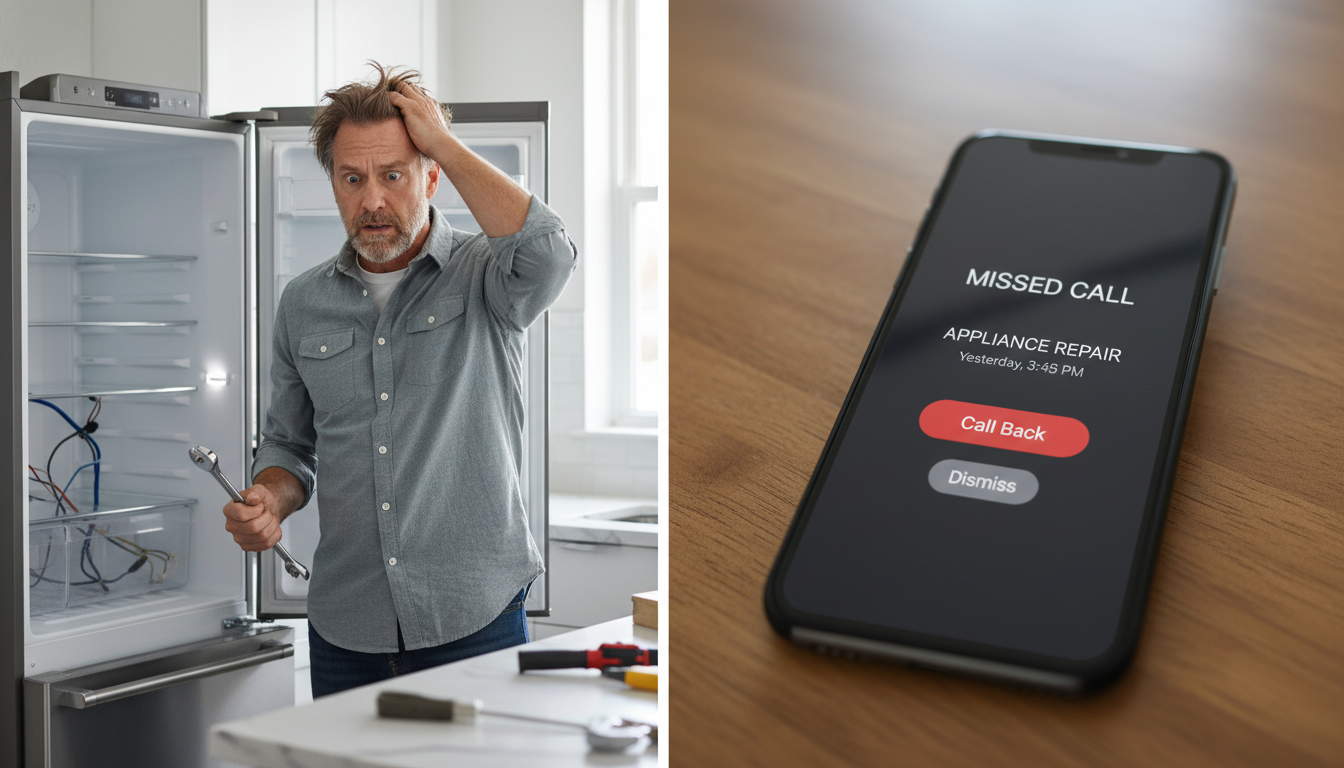
Appliance repair customer acquisition isn't failing because of your pricing or expertise — it's failing because homeowners call the Geek Squad after your phone rings unanswered for the fourth time. Independent appliance repair shops lose an estimated 35-62% of inbound calls to missed opportunities, and those frustrated callers immediately dial the big box stores who answer on ring two, book the appointment in three minutes, and confirm via text before you've even checked your voicemail.
Why Do Homeowners Choose Big Box Stores Over Local Appliance Repair Shops?
Homeowners choose Best Buy's Geek Squad, Home Depot's repair services, and Lowe's technicians because these branded services answer the phone immediately, provide instant pricing, and confirm appointments through automated text messages. The decision has nothing to do with trust or technical skill — it's about convenience and response time. When your refrigerator is leaking water onto the kitchen floor at 7 PM on a Tuesday, the company that picks up the phone wins the job.
Independent appliance repair companies typically operate with the owner doing service calls during the day and the spouse or an answering service handling overflow calls. That model worked when homeowners called from landlines during business hours and waited patiently for callbacks. It collapses in 2024 when 73% of service calls come from mobile phones and InsideSales.com research shows that responding to a lead within five minutes makes you 100 times more likely to convert than waiting 30 minutes.
Big box stores don't have better technicians. They have dedicated call centers. When a homeowner's dishwasher floods the kitchen, they scroll through Google results and start calling. The first business that picks up, quotes a diagnostic fee, and books a time slot gets the job. The second caller gets a polite "we already found someone, thanks."
Here's what most articles won't tell you: The Geek Squad and Home Depot don't actually employ most of the technicians who show up. They subcontract to local independent repair shops — often the same technicians who run their own businesses on the side. You're not losing to superior technical capabilities. You're losing to superior appliance repair phone answering infrastructure that makes booking frictionless, and then those big brands are subcontracting your work to your competitors who were smart enough to answer their phones.
What Specific Calls Are You Losing Right Now?
You're losing the highest-value service calls that independent shops need most: emergency repairs with same-day or next-day urgency, appliance breakdowns that require immediate diagnostics, and homeowners willing to pay premium rates for fast response times. These are exactly the calls where speed-to-answer determines who gets the job, and they're worth 2-3 times your average service ticket.
The calls you're missing break into three categories, each with different revenue impact:
- Emergency refrigerator and freezer failures (8 PM - 11 PM calls): Homeowners panic when food spoilage is imminent. They'll pay $150-200 diagnostic fees and premium labor rates. These calls convert at 80%+ when answered live.
- Morning washer/dryer breakdowns (6 AM - 9 AM): Parents discover the washing machine dead on school mornings. They need same-day service and will book whoever answers first. Average ticket: $350-600.
- Weekend dishwasher floods (Saturday/Sunday): Active water leaks create urgency. Homeowners call 5-8 companies in rapid succession. Response time under 3 minutes captures 70% of these jobs.
According to Vendasta, local service businesses that respond to leads within five minutes convert 50% of inquiries into booked appointments, while those responding after 30 minutes convert just 8%. For appliance repair shops where the average service call generates $400-800 in revenue, every missed call during peak breakdown hours represents $300+ in lost gross profit.
When you're under a kitchen sink fixing a leak or diagnosing a compressor failure, you're not answering your phone. The homeowner whose oven died two hours before Thanksgiving dinner doesn't leave a voicemail — they call the next number and book with whoever picks up. That's not an appliance repair competition problem. That's an appliance repair call handling problem that directly impacts your customer acquisition.
How Do Independent Appliance Repair Shops Win Against Branded Competition?
Independent appliance repair shops win by answering every call within three rings, quoting diagnostic fees immediately, and booking appointments before the caller hangs up. You need a dedicated front office team handling calls, texts, and emails while you're turning wrenches — not an answering service that takes messages, and not voicemail that sends frustrated homeowners straight to the Geek Squad. The shops winning appliance repair customer acquisition in 2024 treat their phone like the revenue-generating asset it is, not an interruption to field work.
Book All Leads builds fully managed front office teams for independent appliance repair shops — live call answering, appointment booking, payment collection, and follow-up handled by six specialized roles working around the clock. No software for you to learn, no staff for you to manage, live in five days. Your callers reach a real person who knows your pricing, checks your calendar, and books the job while their broken fridge is still top-of-mind.
The strategic advantage independent shops have over big box brands is expertise and local trust. You know LG compressors fail at year seven. You stock Samsung ice maker assemblies in your van. You've fixed the same Whirlpool control board issue in twelve houses in the same neighborhood. Homeowners prefer supporting local businesses — but only when it's equally convenient. Match the big boxes on speed and booking ease, then win on expertise and service quality.
What Should Your Call Answering Process Include?
Your call answering process should capture the caller's appliance brand and problem, quote your diagnostic fee, offer 2-3 available appointment slots, collect payment information, and send confirmation via text — all within a four-minute phone conversation. Anything longer and you lose the caller's attention. Anything missing and they'll call the next shop to compare.
The booking conversation for appliance repair follows a specific structure that converts callers into booked appointments:
- Answer by ring three with your business name: "Thank you for calling [Business Name] appliance repair, this is [Name], how can I help you?"
- Collect appliance type, brand, and failure symptom: "What appliance is giving you trouble? What brand? What's it doing?" (Write this down — your technician needs it before arrival)
- Quote diagnostic fee and explain what happens next: "$89 diagnostic fee, waived if we complete the repair. Our technician will diagnose the issue and quote the repair before starting work."
- Offer specific appointment slots: "I have tomorrow at 10 AM or 2 PM, or Thursday morning at 9 AM. Which works better?" (Never ask "when's good for you" — decision paralysis kills bookings)
- Collect name, address, phone, email: Frame this as confirmation details, not interrogation.
- Process diagnostic fee payment: "I'll collect the $89 diagnostic fee now so our technician can head straight to work when he arrives. Card ending in what numbers?"
- Confirm via text within 60 seconds: "You'll get a text confirmation with your appointment time and our technician's name. See you tomorrow at 10 AM."
This process takes 3-4 minutes and converts 65-75% of inbound calls into booked, paid appointments. Compare that to "leave a message and we'll call you back" which converts 15-20% if you return calls within two hours, and under 5% if callbacks happen the next day.
What's the Real Cost of Missed Calls in Appliance Repair?
The real cost of missed calls in appliance repair is $2,800 to $6,400 per month in lost revenue for a typical independent shop receiving 60-100 inbound calls monthly. If you miss 40% of calls (industry average for owner-operated shops), and those missed callers book with competitors, you're losing 24-40 service appointments worth $400-600 each. The cost isn't just the immediate job — it's the lifetime value of customers who would have called you first for their next appliance breakdown and referred you to neighbors.
Let's break down the math on a real appliance repair business — a two-truck operation in a suburban market with 85 inbound calls last month:
| Call Outcome | Number of Calls | Conversion Rate | Booked Jobs | Avg Ticket | Revenue |
|---|---|---|---|---|---|
| Answered live | 51 (60%) | 68% | 35 | $485 | $16,975 |
| Went to voicemail | 34 (40%) | 12% | 4 | $485 | $1,940 |
| Total | 85 | 46% | 39 | $485 | $18,915 |
If this shop answered all 85 calls live and maintained that 68% conversion rate, they'd book 58 jobs generating $28,130 monthly — an additional $9,215 per month, or $110,580 annually. That's the revenue walking out the door because you're under a kitchen counter replacing a dishwasher pump when the phone rings.
Use our revenue calculator to see exactly what missed calls are costing your appliance repair business based on your actual call volume and average ticket size. Most owners underestimate the impact by 40-60% because they don't account for weekend calls, after-hours emergencies, and the compounding effect of losing repeat customers.
Why Don't Callbacks Recover Missed Opportunities?
Callbacks don't recover missed opportunities because 67% of homeowners with urgent appliance failures book service within 15 minutes of their first call, and 89% book within one hour. By the time you return a voicemail three hours later — or the next morning — the Geek Squad technician is already loading parts into their van. The urgency that made the homeowner willing to pay premium diagnostic fees has passed, or they've solved the problem through a competitor.
The data on callback effectiveness in appliance repair is brutal. Research from Forrester Research shows that customers who don't reach a live person on their first attempt are 85% less likely to complete a purchase with that business, even if contacted later. For emergency service calls where the appliance failure is causing active problems — water on the floor, spoiling food, no hot water for showers — the window to capture that lead is measured in minutes, not hours.
Answering services that take messages don't solve this problem. The homeowner wants to book an appointment now, not play phone tag. They're comparing your availability against two other shops and the Geek Squad. The first business that gives them a confirmed appointment slot wins, and the callback goes straight to voicemail because they're already talking to your competitor.
How Should Small Appliance Repair Shops Handle After-Hours Calls?
Small appliance repair shops should handle after-hours calls with live answering that books appointments for next-day or emergency slots and collects diagnostic fees immediately. The 6 PM to 10 PM window and Saturday/Sunday calls represent 35-45% of monthly inbound volume for independent shops, and these after-hours callers convert at higher rates and accept premium pricing because their need is urgent. Missing these calls surrenders your highest-value customer acquisition opportunities to competitors who staff their phones around the clock.
After-hours calls break into two categories with different handling requirements:
True emergencies requiring same-day or next-morning response: Refrigerator failures (food spoilage), washing machine floods (active water damage), oven failures before holiday cooking. These callers will pay $150-250 diagnostic fees and premium hourly rates. They need immediate booking confirmation and technician dispatch.
Urgent but schedulable within 24-48 hours: Dishwashers that won't drain, dryers that won't heat, ice makers that stopped working. Important to the homeowner but not causing immediate damage. They'll accept next available appointment if you can book them now while they're motivated.
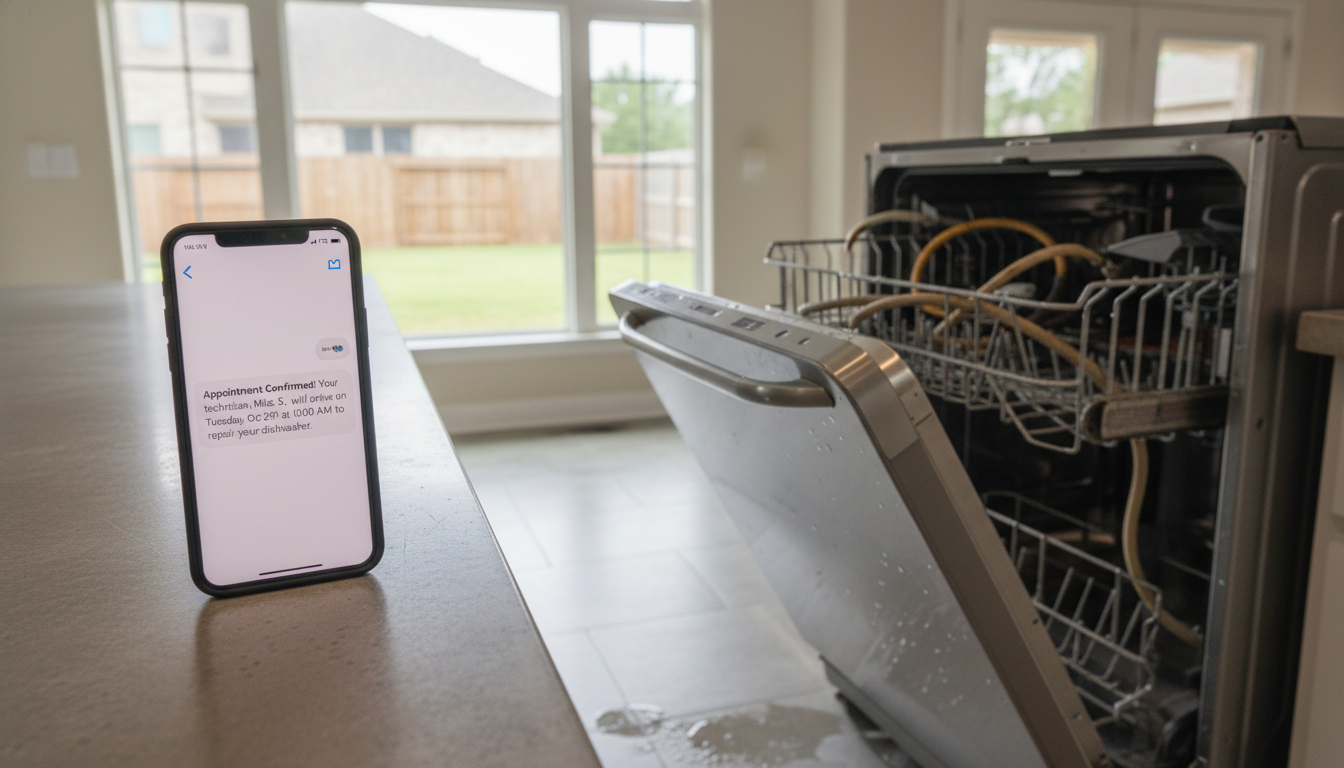
The mistake most independent appliance repair shops make is treating all after-hours calls as non-urgent and returning them the next morning. By then, the homeowner with the leaking dishwasher has already booked Home Depot's service for that afternoon. You needed to capture that lead at 8 PM when they called, not at 9 AM when your workday starts.
Should You Offer 24/7 Emergency Service?
You should offer 24/7 emergency appliance repair service only if you can profitably staff it and clearly communicate premium pricing. Most independent shops don't need middle-of-the-night emergency dispatch, but they absolutely need live answering that books next-morning emergency slots for overnight calls. The goal isn't technician availability at 2 AM — it's capturing leads when homeowners are motivated to call, which happens outside 8-to-5 business hours 40% of the time.
True 24/7 emergency service makes sense for commercial appliance repair (restaurant equipment, medical facility refrigeration) where equipment downtime costs clients thousands per hour. For residential appliance repair, "emergency service" usually means next available appointment within 4-8 hours, not immediate technician dispatch. But you still need to answer that 11 PM call from the homeowner whose freezer is beeping and rising in temperature, book them for 7 AM tomorrow, and collect the diagnostic fee before they call someone else.
What Do Successful Independent Appliance Repair Shops Do Differently?
Successful independent appliance repair shops treat their front office as a profit center that operates separately from field work. They staff phone answering, booking, payment collection, and customer follow-up with dedicated people who never turn wrenches, ensuring that every inbound call reaches a live human who can schedule appointments and process payments while technicians stay focused on repairs. This separation of roles — front office versus field operations — is how shops scale past owner-operator size without sacrificing the customer experience that wins appliance repair customer acquisition battles.
The shops winning against big box competition share five operational characteristics:
1. First-call booking rates above 60%: They convert inbound calls into confirmed, paid appointments during the initial conversation. No "let me check the schedule and call you back" delays that send callers to competitors.
2. Diagnostic fees collected at booking: They process the $79-$129 diagnostic fee when scheduling the appointment, not at service completion. This pre-qualifies serious buyers, reduces no-shows by 70%, and generates cash flow before the technician leaves the shop.
3. Confirmation and reminder workflows: Automated text confirmations within 60 seconds of booking, reminder texts 24 hours before appointment, and technician-on-the-way notifications that reduce no-shows and build trust.
4. Missed call recovery within 5 minutes: If a call goes unanswered (technician on another call, high volume period), someone calls back within five minutes, not at end-of-day. Speed-to-lead matters more than perfect answer rates.
5. After-hours coverage that actually books appointments: Not an answering service that takes messages. Not voicemail. Live people who access the calendar, quote pricing, book appointments, and collect payment during the call.
These aren't expensive software solutions or complex marketing strategies. They're basic front office operations that ensure leads don't leak out of your sales funnel because nobody answered the phone. The shops still running on "call during business hours and leave a message after hours" lose 40-60% of their inbound opportunities to competitors who modernized their call handling.
Frequently Asked Questions
How quickly do I need to answer appliance repair calls to win the job?
You need to answer within three rings (10-15 seconds) to maximize conversion rates. Research shows that 78% of customers book with the first company that picks up and provides helpful information. Every additional ring increases the chance the caller hangs up and dials your competitor. For emergency calls like refrigerator failures or appliance floods, answer speed directly correlates to booking rates — sub-10-second answer times convert 70%+ while calls answered after 30 seconds convert below 40%.
What percentage of appliance repair calls come after business hours?
Approximately 35-45% of appliance repair calls come outside traditional 8 AM to 5 PM business hours, with peak volume between 6 PM and 9 PM on weekdays and throughout Saturday/Sunday. Homeowners discover appliance failures when they use them — morning laundry routines, evening dinner preparation, weekend cooking and cleaning. Missing after-hours calls means surrendering nearly half your inbound lead volume to competitors with better phone coverage.
Should I use an answering service for my appliance repair business?
Traditional answering services that only take messages don't solve the speed-to-booking problem that loses you jobs to Geek Squad and big box stores. You need live people who can access your calendar, quote diagnostic fees, book appointments, and process payments during the call — not message-takers who create callback delays. If your answering service can't convert a caller into a confirmed, paid appointment during the initial conversation, you're still losing leads to competitors who answer their own phones or use fully managed front office teams.
How much should I charge for appliance repair diagnostic fees?
Most independent appliance repair shops charge $79-$149 for diagnostic fees depending on market, waived if the customer approves the repair. Higher-end markets and premium-positioned shops successfully charge $129-$149. The diagnostic fee should cover your technician's drive time, diagnostic labor, and basic overhead. Collect it at booking, not at service completion — this pre-qualifies serious buyers, dramatically reduces no-shows, and generates positive cash flow before your technician leaves the shop.
Why do customers choose Geek Squad over local appliance repair shops?
Customers choose Geek Squad because they answer the phone immediately, book appointments during the first call, and send automated confirmations — not because of superior technical expertise or better pricing. Brand recognition helps, but the deciding factor is convenience and response speed. When a homeowner's dishwasher is flooding the kitchen, they call multiple shops simultaneously and book with whoever makes scheduling easiest. Independent shops with professional front office operations win these competitions consistently.
What's the average conversion rate for appliance repair calls?
Live-answered appliance repair calls convert at 60-75% when handled professionally with immediate appointment booking and diagnostic fee collection. Calls that go to voicemail convert at 8-15% even with prompt callbacks, and after-hours calls that aren't answered until the next business day convert below 5%. The dramatic difference in conversion rates between live-answered and missed calls explains why shops with dedicated front office teams generate 2-3 times more revenue per marketing dollar than shops relying on voicemail and callbacks.
Stop Losing Appliance Repair Jobs to Big Box Stores
You didn't start your appliance repair business to lose customers to corporations that subcontract your work to your competitors. You started it because you're better at diagnosing compressor failures, faster at replacing control boards, and more reliable than the rotating cast of technicians wearing Geek Squad uniforms. But none of that matters if homeowners can't reach you when their appliances break.
The shops winning appliance repair customer acquisition in 2024 answer their phones, book appointments during the first conversation, and treat their front office like the revenue-generating asset it is. They've stopped competing on price and started competing on convenience — and they're taking market share from both big box brands and independent shops still running on voicemail.
Your technical expertise and local reputation are advantages worth building on. You just need a front office team that ensures homeowners can actually hire you when they're ready to book. Book All Leads builds and manages that team for independent appliance repair shops — live in five days, no contracts, no software for you to learn. Let's make sure the next homeowner with a broken refrigerator books with you instead of the Geek Squad.
John Edmonds is a native Texan and military combat veteran. He founded Book All Leads after identifying a critical gap in the service industry: business owners losing revenue not from lack of skill, but because no one was handling the calls, follow-ups, reviews, and payments while they were busy doing the work.
View LinkedIn Profile →