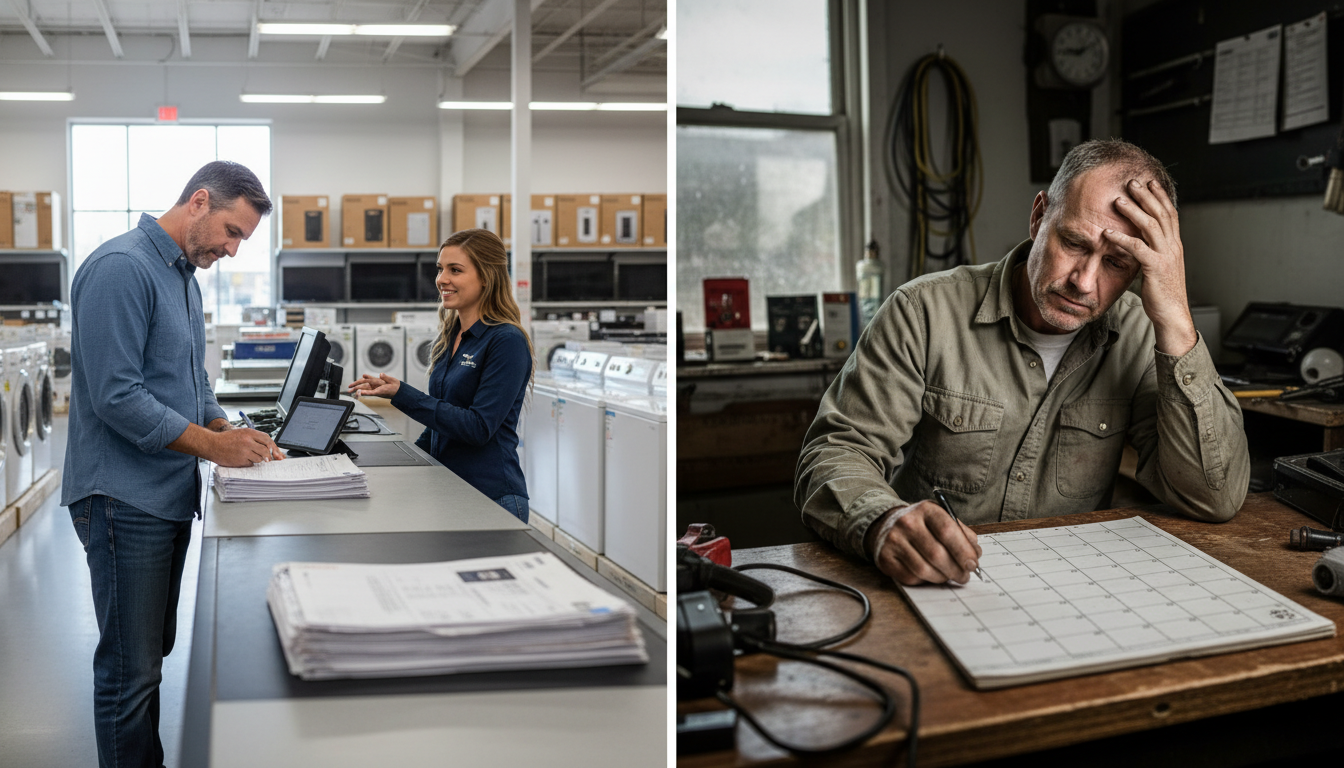
Appliance repair marketing fails most independent shops because big box stores—Home Depot, Lowe's, Costco—lock customers into service plans at checkout, before the appliance ever breaks. By the time a homeowner searches for a repair tech, they've already been sold a warranty that routes them to national call centers and dispatch networks. Independent appliance repair companies lose calls they never had a chance to win, not because their service is worse, but because they weren't in the room when the purchase happened.
The Problem: You're Competing Against Warranties Sold Before the Appliance Breaks
The average homeowner buying a refrigerator at Home Depot hears about extended service plans three times: at the display, in the online cart, and again at checkout. According to Forrester Research, service plan attachment rates at major retailers reach 15-25% for appliances over $500. That's one in four appliances walking out the door with a pre-paid repair contract that explicitly excludes independent shops.
When that dishwasher floods the kitchen two years later, the homeowner doesn't Google "appliance repair near me"—they dig through the junk drawer for warranty paperwork. You never get the call. The job goes to whichever contractor the warranty company dispatches, often at a rate so low you wouldn't take it even if they called.
Here's what most articles won't tell you: The warranty plans aren't even the biggest threat. The real problem is brand capture at the moment of panic. When a fridge dies and spoils $200 in groceries, homeowners don't shop around—they call the first number they see. If that number is on a magnet from Home Depot's install crew or printed on the appliance itself, you lost before you started.
Why Search Traffic Isn't Enough Anymore
Ten years ago, ranking on Google for "appliance repair [city]" meant consistent work. Now, even top-ranked independent shops report call volume declines. The appliance repair industry generates approximately $4.5 billion annually according to Bureau of Labor Statistics data, but an increasing share flows through manufacturer networks and retailer service plans rather than independent operators.
Homeowners who do search online face another obstacle: they're comparing you against Angi, Thumbtack, and Amazon Home Services—platforms that charge you 15-30% per lead, often for jobs you can't even win because four other contractors got the same lead.
Why Independent Shops Keep Losing This Fight
Independent appliance repair companies lose market share because they rely on inbound marketing in a market where purchasing decisions happen weeks or years before the service need arises. Big box stores own the relationship at purchase. They capture customer data, payment methods, and urgency moments that independent shops can't access without fundamental changes to their customer acquisition strategy.
The traditional appliance repair marketing playbook—Google Ads, Yelp reviews, vehicle wraps—assumes customers are actively shopping. But most aren't. They're reacting to an emergency with whatever solution feels fastest and least risky. That "feels fastest" part is critical. Even if you can arrive in two hours, if you don't answer the phone in two minutes, they've already called someone else.
The Real Cost of Missed Calls
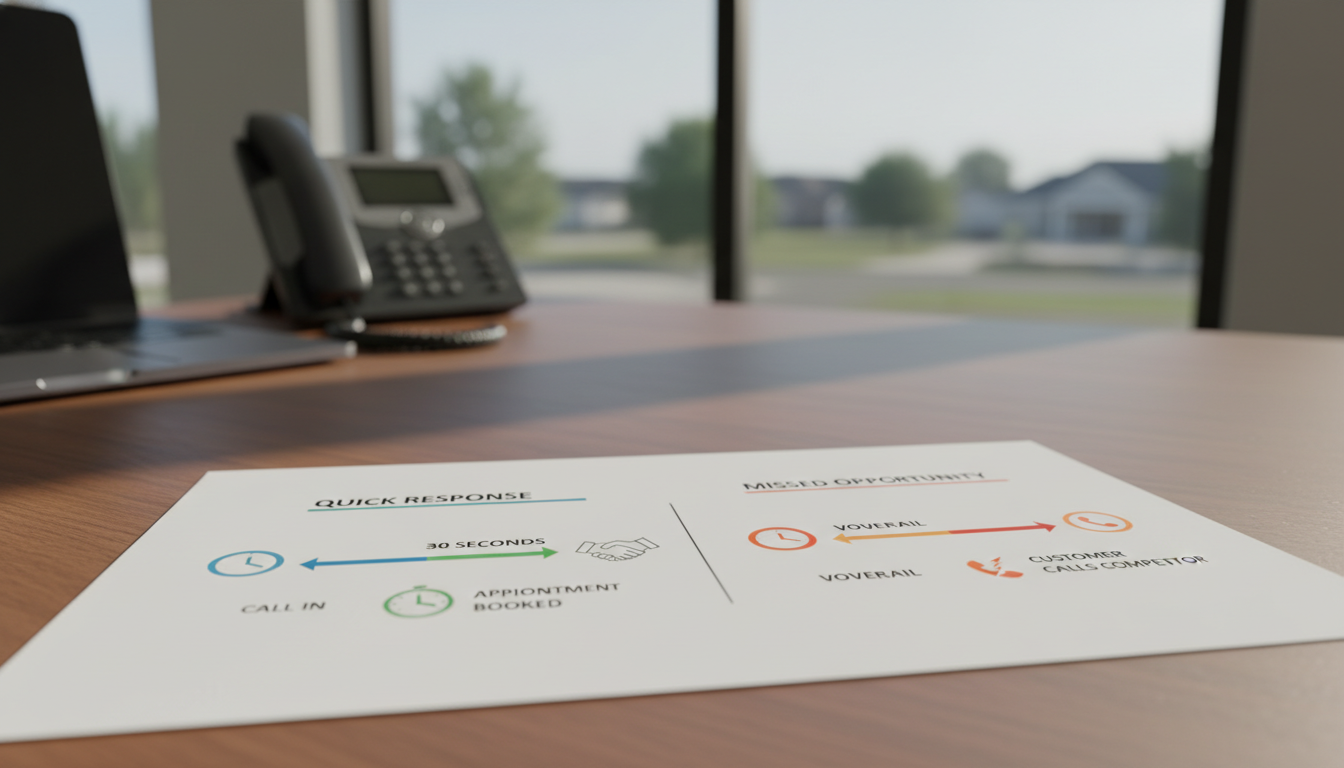
According to InsideSales.com, leads contacted within five minutes are 21 times more likely to convert than those contacted after 30 minutes. For appliance repair, that window is even tighter. When a homeowner calls about a broken refrigerator, they're not building a list of quotes—they're booking the first tech who answers and sounds competent.
If you're on a service call when that phone rings, and it goes to voicemail, you just lost $250-400 in revenue. Multiply that by the three to five calls you miss every week, and you're leaving $60,000-100,000 on the table annually. Most shop owners know this. They just don't know how to fix it without hiring a full-time receptionist they can't afford or justify.

How to Compete When You Can't Outspend the Big Boxes
Independent appliance repair companies win by owning speed and personalization—the two things national service plans can't deliver. When a warranty company dispatches a repair, the customer waits 3-7 days for an appointment window, talks to three different people, and never gets the same tech twice. You can beat that, but only if you answer every call immediately, book the job on the spot, and show up when you promised.
That responsiveness requires a front office that actually functions like a front office. Not voicemail. Not "text us and we'll get back to you." A real person who answers by the third ring, knows your schedule, can quote pricing, and books the job before the caller moves to the next Google result.
Most appliance repair shops can't afford to hire that person. A full-time receptionist costs $35,000-45,000 annually plus benefits, and they're only available 40 hours a week. Book All Leads offers a different approach: a full front office team—six roles working 24/7 to answer calls, book jobs, and collect payments. No software to learn, live in five days, no contracts. It's the outcome of having an office manager without the overhead of hiring one.
The Three Fights You Can Actually Win
You won't out-advertise Home Depot, but you can out-execute them on the things homeowners care about once the appliance breaks:
- Speed to appointment: National service plans average 4-6 days to first visit. If you can commit to same-day or next-day, you immediately separate from the pack.
- Transparent pricing: Warranty customers often discover their "covered" repair has $150 in exclusions and fees. If you can quote a flat diagnostic fee and honest repair estimates upfront, you build trust before arrival.
- Relationship continuity: Big box contracts send whoever's available. You can become the homeowner's "appliance guy"—the person they call first and refer to neighbors.
None of these advantages matter if you don't answer the phone. A customer who gets your voicemail doesn't experience your speed, pricing clarity, or relationship value. They experience silence, and they move on.
What Appliance Repair Business Growth Actually Requires
Sustainable appliance repair business growth comes from converting a higher percentage of inbound calls, not generating more traffic. Most shops focus on getting more leads—better SEO, more ads, Nextdoor posts. Those tactics help, but they're pouring water into a leaky bucket if you're missing 30-40% of calls.
The math is straightforward. If you currently book 60% of inbound calls and average $320 per job, every 10-point improvement in answer rate adds approximately $32,000 in annual revenue per 100 monthly calls. Fixing calculate your losses from missed calls is the fastest ROI in your business.
The Hidden Advantage of Appliance Repair Customer Acquisition
Appliance repair has a structural advantage most trades don't: recurring need across multiple appliances. A homeowner with a broken fridge likely owns a dishwasher, range, microwave, washer, and dryer—five future repair opportunities. If you deliver excellent service on the first call, you become the default for all future breakdowns.
According to research from Harvard Business Review, increasing customer retention rates by 5% can increase profits by 25-95%, depending on the industry. For appliance repair, retention is even more valuable because the average household generates 1.8 service calls across appliances every three years. The first job is customer acquisition. Every job after is pure profit margin expansion.
But retention starts with acquisition, and acquisition starts with answering the phone. If you miss the first call, you never get the chance to build that relationship.
Why Appliance Repair Phone Answering Determines Your Market Position
Effective appliance repair phone answering isn't about being polite—it's about capturing urgency before it dissipates. When a homeowner calls about a broken appliance, they're in problem-solving mode for approximately 15-20 minutes. During that window, they'll make three to five calls. Whoever answers first and books confidently wins. Whoever sends them to voicemail loses.
This creates a compounding advantage. The shop that answers immediately books more jobs, generates more revenue, builds more reviews, and ranks higher in local search—which generates more calls to answer. The shop that misses calls spirals the other direction: fewer bookings, thinner margins, worse reviews, lower rankings, and even fewer calls worth missing.
What "Answering Every Call" Actually Means
Answering every call doesn't mean you personally hold the phone 24/7. It means every caller reaches a human who can:
- Understand the appliance problem and urgency level
- Access your real-time schedule to book appointments
- Quote your diagnostic fee and ballpark repair ranges
- Collect payment details to secure the booking
- Send confirmation texts and reminders automatically
That's not a receptionist—that's a front office team. And for most appliance repair shops, building that team in-house is financially impossible. The alternative is missing calls, which is financially devastating.
The One Strategy That Consistently Beats Big Box Plans
The most effective counter to big box service plans is positioning yourself as the "second opinion" and "out-of-warranty specialist." Homeowners with warranty plans still Google for independent repair when the warranty experience frustrates them—long wait times, unexpected fees, poor communication. If your marketing explicitly addresses "frustrated with your home warranty?" you capture high-intent customers the big boxes already spent money acquiring.
This requires content and messaging that speak directly to warranty fatigue. Your website, Google Business Profile, and ad copy should include phrases like:
- "Same-day appointments—no 7-day warranty wait"
- "Transparent pricing—no hidden exclusions"
- "We fix what warranties won't cover"
You're not competing for the initial purchase anymore. You're competing for the second chance—when the warranty fails to deliver. That's a fight you can win, because you control the two things that matter most in that moment: speed and clarity.
Real-World Example: How One Shop Stopped Losing to Costco
Mike runs a two-truck appliance repair company in suburban Phoenix. For three years, he watched call volume decline as more customers bought Costco warranties. His Google ranking stayed strong, but inbound calls dropped 30%. The calls he did get, he missed 40% of the time because he was on-site and his part-time office person only worked mornings.
He tried hiring a full-time receptionist, but couldn't justify the cost with inconsistent call volume. He tried call forwarding to his cell, but booking jobs while diagnosing a compressor was impossible. He was stuck.
He made two changes. First, he repositioned his messaging to target warranty frustration—ads and website copy explicitly calling out "tired of waiting a week for Costco service?" Second, he implemented a front office team that answered 24/7, booked jobs in real-time, and followed up with no-shows automatically. Within 90 days, his booking rate jumped from 58% to 89%, and revenue increased 34% without spending more on marketing.
The difference wasn't the leads. It was capturing the leads he already had.
What This Means for Your Appliance Repair Marketing Strategy
Your appliance repair marketing strategy should prioritize conversion over traffic. Ranking #1 on Google is worthless if you miss half the calls. Facebook ads are expensive if leads go to voicemail. Every dollar spent generating leads is wasted if your front office can't close them.
Start by auditing your current performance. For the next two weeks, track:
- Total inbound calls (check your phone provider's records, not just voicemail count)
- Calls answered by a human within 60 seconds
- Calls that resulted in a booked appointment
- Appointments that showed and paid
Most shop owners are shocked when they see the real numbers. You might think you're missing 10% of calls. The data usually shows 30-40%. That gap is your biggest growth opportunity, and fixing it doesn't require more marketing spend—it requires operational change.
Frequently Asked Questions
How do I compete with Home Depot's appliance repair service plans?
You compete by targeting customers after the warranty experience disappoints them. Position yourself as the fast, transparent alternative for frustrated warranty customers who've waited too long or encountered unexpected fees. Use messaging like "same-day service" and "no hidden exclusions" to capture that audience. Focus on speed and personalization—the two things national plans can't deliver consistently.
What's the biggest reason independent appliance repair shops lose customers?
Missed calls are the single biggest revenue leak. When a homeowner calls about a broken appliance, they're booking the first qualified tech who answers. If you don't answer within minutes, they've moved to the next result. Most shops miss 30-40% of inbound calls, which translates to $60,000-100,000 in lost annual revenue for a typical two-truck operation.
Should I spend more on Google Ads or fix my phone answering first?
Fix phone answering first. Spending more on ads when you're missing 40% of calls is like buying a bigger funnel for a leaky bucket. Increase your booking rate from 60% to 90% before increasing lead volume. The ROI on converting existing calls is always higher than paying for new ones.
How quickly do I need to answer appliance repair calls to win the job?
Answer within 60 seconds to maximize conversion. Research shows leads contacted within five minutes convert 21 times better than those contacted after 30 minutes. For emergency appliance repairs, that window is even tighter. Homeowners call three to five companies and book with whoever answers first and sounds competent.
Can I really compete without offering service plans like the big boxes?
Yes, because most homeowners don't want ongoing plans—they want their immediate problem solved quickly and honestly. Service plans are sold at appliance purchase, not at breakdown. By the time they're calling you, they want fast service and clear pricing, not another contract. Win the immediate job, deliver excellent service, and you become their default for all future appliance issues.
What's the best way to get repeat customers in appliance repair?
Deliver fast, professional service on the first call, then stay top-of-mind through occasional follow-up. The average household has five to seven appliances that will need service over time. If you solve their fridge problem well, you're the first call when the dishwasher breaks. Simple follow-up—a "how's it running?" text three months later—keeps you front-of-mind without being pushy.
Stop Losing Calls You're Already Paying For
Appliance repair marketing isn't broken—your front office is. The leads are there. Homeowners are calling. You're just not answering fast enough, and by the time you call back, they've booked someone else. Big box service plans win because they answer immediately, even if their service is slower and worse. You can beat them on service quality, but only if you match their responsiveness.
The solution isn't working longer hours or hiring expensive staff you can't afford. It's recognizing that customer acquisition happens in the first 60 seconds of the first call, and building a front office that treats every ring like the revenue opportunity it actually is.
If you're ready to stop losing calls to voicemail and start converting the leads you're already generating, Book All Leads can have your front office running in five days. No software to learn, no long-term contracts, just a team that answers, books, and collects—so you can focus on the work that actually requires your expertise.
John Edmonds is a native Texan and military combat veteran. He founded Book All Leads after identifying a critical gap in the service industry: business owners losing revenue not from lack of skill, but because no one was handling the calls, follow-ups, reviews, and payments while they were busy doing the work.
View LinkedIn Profile →