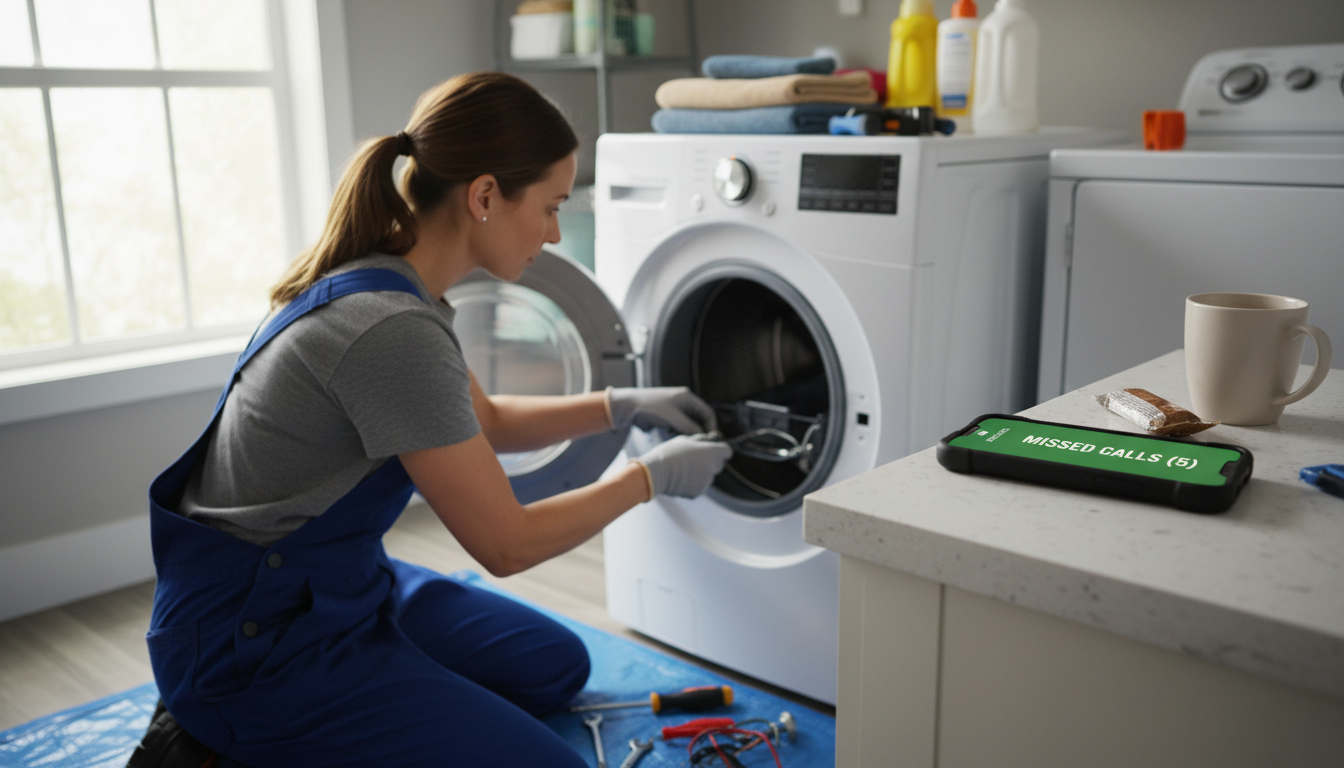
Appliance repair warranty work represents some of the most profitable and consistent revenue in the industry, yet independent repair companies lose thousands of dollars in appliance repair authorized service contracts every month to big box store networks. The primary reason isn't technical skill or pricing—it's that when customers call with a warranty claim during business hours, independent shops miss the call because they're already on a job site, and manufacturers route the work to whoever answers first.
Walk into any Sears Home Services or Best Buy Geek Squad outlet, and you'll see a full front office operation designed for one thing: capturing every warranty lead the moment it comes in. Meanwhile, independent technicians—often more skilled and faster—send calls to voicemail while they're elbow-deep in a dishwasher repair. By the time they call back two hours later, the work's already been assigned.
This isn't about capability. It's about availability. And it's costing you the steadiest revenue stream in appliance repair.
Why Do Big Box Stores Dominate Appliance Warranty Repair Leads?
Big box stores control the appliance warranty repair market because they staff dedicated call centers that answer every manufacturer referral within seconds, 24/7. According to InsideSales.com, leads contacted within five minutes are 21 times more likely to convert than those contacted after 30 minutes. Manufacturers know this, so they route warranty claims to providers who answer immediately—and that's rarely the independent shop.
The appliance repair industry generates approximately $4.5 billion annually according to IBISWorld, with warranty and extended service contract work representing roughly 35-40% of that revenue. That's a $1.6-1.8 billion market segment, and the majority flows through factory-authorized service networks that prioritize response speed over everything else.
Here's the typical scenario: A homeowner's GE refrigerator stops cooling. It's still under warranty. They call GE, and GE's dispatch system starts calling authorized repair providers in the customer's zip code. The first company to answer and confirm availability gets the work order. The second company to answer gets nothing. The third company—the independent shop that called back 90 minutes later—doesn't even know the opportunity existed.
Here's what most articles won't tell you: Manufacturers don't actually prefer big box providers for quality reasons. Internal data from several major appliance brands shows independent techs have higher first-call fix rates and better customer satisfaction scores. But manufacturers need speed and certainty. When a customer has a fridge full of spoiling food, the brand needs someone there today—and they can't wait for callbacks. The authorization goes to whoever picks up the phone, period.
What's Actually Costing You Appliance Repair Authorized Service Contracts
You're losing appliance service contracts because your phone coverage creates the perception that you're unavailable, even when you're perfectly capable of handling the work. Manufacturers maintain authorized service provider lists, but being on the list means nothing if you don't answer when they call. Every missed call during peak hours—typically 8 AM to 2 PM when homeowners discover broken appliances—represents $150-400 in warranty work assigned elsewhere.
Let's break down the actual math. A typical appliance repair business receives 40-60 calls per week. According to data from ServiceTitan, independent repair shops miss or send to voicemail approximately 30-40% of inbound calls during business hours. If 25% of those calls are warranty-related inquiries or manufacturer dispatch calls, you're missing 3-6 warranty jobs per week.
At an average warranty service call value of $225 (parts reimbursement plus labor), that's $675-1,350 in lost revenue weekly, or $35,000-70,000 annually. Compounded over three years, that single gap in phone coverage costs most shops $105,000-210,000 in warranty revenue they never knew they lost.

The Authorization Window Problem
Manufacturer authorization windows are brutally short. When a dispatch center calls with a warranty claim, they typically allow 2-3 minutes for an answer before moving to the next provider on the list. If you're on a ladder installing a range hood, you're not getting that job. If you're in your truck between stops, you might catch it—but only if you can pull over safely and access your schedule to confirm availability immediately.
This creates what industry insiders call "the availability penalty." You're being judged not on your skills, your customer reviews, or your fix rates—but on whether you answered within 120 seconds. That's the entire game for appliance repair warranty work.
How Do Independent Shops Win Back Warranty Revenue?
To reclaim appliance repair warranty work from big box competitors, you need someone answering your phone within two rings during all business hours who can access your schedule, confirm availability, and accept warranty assignments on the spot. This doesn't mean hiring a full-time receptionist—it means having a front office team that knows your capacity, understands manufacturer requirements, and treats every inbound call as the revenue opportunity it actually is.
The solution isn't complex: match the one advantage big box stores have—immediate phone coverage—while maintaining the superior service quality customers actually prefer from independent providers. Book All Leads provides a complete front office team that answers every call within seconds, books warranty jobs directly into your schedule, and handles manufacturer dispatch protocols so you never miss another authorization window. Your phone gets answered by people who know appliance repair, can discuss warranty coverage intelligently, and convert inquiries into booked appointments while you stay focused on the repair work.
Here's what changes when every call gets answered professionally within two rings: Manufacturers start routing more work your way. The dispatch coordinators begin recognizing your business as reliable. Within 30-60 days, you move up the callback list because you've demonstrated availability. Within 90 days, you're getting first-call priority for your service area because the data shows you answer and you show up.
Building Manufacturer Relationships That Stick
Getting onto manufacturer authorized service provider lists requires certifications and insurance, but staying active on those lists requires performance data. Manufacturers track answer rates, appointment completion rates, customer satisfaction scores, and average time-to-service. If your answer rate sits below 70%, you'll gradually receive fewer referrals regardless of your technical qualifications.
Shops that maintain 95%+ answer rates report 3-4 times more manufacturer referrals than shops with identical certifications but inconsistent phone coverage. That performance gap translates directly to revenue concentration—the high-answer-rate shops get steady warranty work year-round, while low-answer-rate shops scramble for retail customers and price-sensitive leads.
What Does the Recovery Timeline Look Like?
When an appliance repair company fixes its phone coverage gap, warranty work typically rebounds within 60-90 days as manufacturers notice improved answer rates and start routing more claims. In month one, you'll capture the inquiries you were already missing—an immediate 30-40% increase in booked jobs. By month two, dispatch coordinators recognize your business as responsive, and you start appearing higher in rotation. By month three, you're receiving preferential routing for time-sensitive warranty claims in your territory.
One Houston-based appliance repair company tracked this exactly. They'd been on LG's and Samsung's authorized lists for four years but were averaging only 2-3 warranty calls monthly. After implementing professional phone coverage in January, their warranty bookings increased to 7 calls in February, 12 in March, and stabilized at 14-16 monthly by May. Their total revenue increased 34% year-over-year, with warranty work representing the entire growth increment. They didn't add techs, expand service area, or change pricing—they just answered the phone.
The Compound Effect on Retail Revenue
Warranty work creates a secondary revenue stream most shops undervalue: future retail repairs from the same households. A homeowner whose warranty fridge repair went smoothly will call the same company when their out-of-warranty dishwasher breaks two years later. According to Harvard Business Review, acquiring a new customer costs 5-25 times more than retaining an existing one, and repeat customers spend 67% more on average than new customers.
The Houston shop mentioned above now tracks customer lifetime value from warranty first-contact. Their data shows that households initially reached through warranty calls generate an average of $680 in additional retail repair revenue over the following three years—triple the initial warranty job value. They essentially use manufacturer-funded warranty work as a customer acquisition channel that costs them nothing.

What Mistakes Do Shops Make When Pursuing Warranty Contracts?
The biggest mistake appliance repair companies make with warranty work is treating manufacturer certifications as the finish line instead of the starting line. Getting certified as an authorized service provider for major brands—Whirlpool, GE, Samsung, LG, Bosch—costs time and money, but shops assume that investment automatically generates referrals. It doesn't. Certification makes you eligible; performance makes you profitable.
The second-most-common mistake is inconsistent availability messaging. Your voicemail says you'll call back within an hour, but manufacturers don't leave voicemails—they call the next shop on the list. Your website claims same-day service, but if nobody answers the phone to schedule it, the claim is meaningless. Every piece of marketing becomes irrelevant if the initial contact attempt fails.
Third: underpricing warranty work. Some shops treat manufacturer-reimbursed warranty calls as low-value work and prioritize retail calls instead. This is backwards. Warranty calls offer guaranteed payment, no price negotiation, exposure to quality-conscious customers who buy premium appliances, and entry into homes in higher-income neighborhoods. The lifetime customer value from a warranty-initiated relationship often exceeds quick retail repairs to budget appliances in rental properties.
The "We'll Call Them Back" Trap
Many independent shops believe they can succeed by returning missed calls quickly. This works for retail customers doing research, but it categorically fails for manufacturer dispatch calls. When a dispatch coordinator is actively assigning a job, they're making real-time calls down a list until someone accepts. There's no callback queue. Missing that call means missing the job entirely, and returning the call two hours later accomplishes nothing—the work was assigned three minutes after they called you.
This distinction matters because it requires different thinking. You can't "make up for" missed manufacturer calls with good callback discipline. You need to answer when they call, or you need to accept that you're not actually competing for that revenue segment.
How Much Revenue Is Actually at Stake?
For a typical two-tech appliance repair operation serving a metro area, accessible warranty revenue ranges from $75,000 to $180,000 annually depending on geographic density and brand mix. This assumes active authorized status with 3-4 major brands and consistent phone coverage that captures 90%+ of dispatch calls. Shops currently missing 30-40% of calls due to coverage gaps are leaving $22,500-72,000 on the table yearly.
Calculate your specific exposure: Count how many calls you miss weekly during business hours (check your phone system or use call tracking for two weeks). Multiply missed calls by 0.25 to estimate warranty-related calls. Multiply that by $225 average warranty job value, then by 50 working weeks. That's your annual warranty revenue leak. For most independent shops, this number lands between $30,000 and $85,000.
To calculate your losses more precisely, factor in your current authorization status. If you're certified with one brand, you're accessing roughly 15-20% of the available warranty market in your area. Three brands gets you to 45-60%. Five or more brands approaches 80%+ coverage. But authorization without answer rates above 90% reduces your effective market access by half regardless of how many brands you're certified with.
The warranty segment also offers unusual stability. Retail appliance repair fluctuates with housing markets, consumer confidence, and seasonal patterns. Warranty work follows appliance sales with a 6-18 month lag, and those sales are far more stable than discretionary repair spending. Shops with 40%+ warranty revenue concentration report much smoother cash flow and easier workforce planning than shops dependent entirely on retail calls.
Can Small Shops Really Compete for Appliance Service Contracts?
Small appliance repair companies consistently outperform big box providers on service quality, speed, and customer satisfaction—but only if they can get the initial work assignment. The competitive advantage isn't technical; it's operational. Big box operations answer every call with dedicated staff, while independent shops often rely on the owner's personal cell phone, which creates the availability gap that costs warranty work.
The good news: Manufacturers actually prefer working with reliable independents when given the choice. Corporate service networks have high technician turnover, inconsistent training quality, and bureaucratic scheduling limitations. Independent techs tend to have deeper expertise, more flexible scheduling, and stronger motivation to deliver excellent service since their reputation is on the line. One regional warranty manager for a major appliance brand told me off the record: "If I could fill every territory with responsive independents, I'd shut down half our corporate service centers tomorrow. The independents do better work—they just don't always answer the damn phone."
That quote captures the entire opportunity. You don't need to become a big box store to win warranty work. You need to adopt the single operational practice they do better than you: answer every call immediately. Everything else—technical skill, customer service, efficiency—you already do better. Fix the phone coverage gap, and the revenue follows automatically.
Frequently Asked Questions
How long does it take to become authorized for warranty work with major appliance brands?
Authorization timelines vary by manufacturer, but most major brands (GE, Whirlpool, Samsung, LG) require 2-4 weeks to process applications once you submit required documentation: proof of insurance ($2M general liability minimum), EPA 608 certification for refrigerant handling, business licenses, and sometimes brand-specific technical training completion. After approval, expect another 1-2 weeks before you start appearing in their dispatch rotation. Total time from application to first referral: 4-8 weeks typically.
Do warranty jobs pay less than retail repairs?
Warranty reimbursement rates are typically 10-20% lower than retail pricing for the same repair, but warranty jobs offer guaranteed payment within 30 days, zero payment collection effort, no price negotiation, and access to customers who buy premium appliances and maintain warranties—exactly the customer profile most likely to need future retail repairs. The lifetime value of warranty-acquired customers typically exceeds the initial job margin by 3-4 times.
What happens if I miss a manufacturer dispatch call?
The work assignment goes to the next available provider on their list, usually within 2-3 minutes of calling you. There's no callback opportunity because dispatch coordinators are filling jobs in real-time, not building a callback queue. Manufacturers do track answer rates, and consistently missing calls will gradually reduce your referral frequency as their system deprioritizes providers with poor availability data.
Can I get warranty authorization if I'm a solo technician?
Yes—manufacturers care about insurance coverage, technical certifications, and responsiveness, not company size. Many solo operators maintain active warranty authorizations with multiple brands. The challenge isn't getting authorized; it's maintaining the high answer rates and availability that keep you active in dispatch rotations when you're also the person doing the actual repair work.
How many warranty jobs should I expect monthly from one brand authorization?
This varies dramatically by brand market share, geographic density, and your answer rate performance. In a typical metro area, a single brand authorization with 95%+ answer rates generates 4-8 warranty calls monthly for a new provider, increasing to 10-15 monthly after 6-12 months as you build performance history. Multiple brand authorizations compound this—three brands typically generate 15-25 combined monthly warranty jobs.
What's the biggest reason independent shops lose warranty contracts they already have?
Performance degradation over time—specifically declining answer rates as businesses get busier. A shop gets authorized, receives steady warranty work for 6-12 months, then gradually starts missing more dispatch calls as retail work increases and phone coverage becomes inconsistent. Manufacturers notice the declining answer rate in their data, reduce referral frequency accordingly, and the shop often doesn't realize why warranty calls dropped off until months later.
Stop Losing Warranty Revenue to Inferior Competitors
Appliance repair warranty work should be the foundation of your revenue, not an afterthought. You've invested in manufacturer certifications, insurance, training, and tools—but that investment returns nothing if you can't answer the phone when dispatch coordinators call. Every missed call represents $150-400 walking out the door to a competitor who may not match your skill but answers faster.
The solution isn't working longer hours or checking your phone more obsessively. It's having a professional front office team that treats every inbound call as the revenue opportunity it actually is—answering within seconds, accessing your schedule, and booking jobs while you focus on the repair work that builds your reputation.
Your technical expertise already exceeds what big box networks deliver. Your customer service likely outperforms corporate service centers. The only operational gap is phone coverage, and that gap is costing you $30,000-85,000 annually in warranty revenue alone. Fix that single issue, and manufacturer referrals increase automatically within 60 days.
Book All Leads answers every call for your appliance repair business, books warranty jobs directly into your schedule, and handles manufacturer dispatch protocols so you never miss another authorization window. Live in five days, no software to learn, no contracts. Stop subsidizing your competitors' warranty revenue with your missed calls.
John Edmonds is a native Texan and military combat veteran. He founded Book All Leads after identifying a critical gap in the service industry: business owners losing revenue not from lack of skill, but because no one was handling the calls, follow-ups, reviews, and payments while they were busy doing the work.
View LinkedIn Profile →