
The Problem: HVAC Lead Follow-Up Is Where Your Money Disappears
HVAC lead follow-up fails because most companies treat it as an afterthought instead of a revenue channel. You generate the lead, send a quote, then wait for the phone to ring. Meanwhile, your competitor calls three times, texts a reminder, and books the job. The gap between initial contact and closed sale is where 60-80% of your marketing spend evaporates. It's not that your quotes are too high or your service is lacking—you're simply not staying in front of prospects during the critical 24-72 hour window when buying decisions happen.
Here's the brutal truth: you're probably losing more revenue to poor follow-up than you'd lose by raising your prices 15%. And unlike pricing pressure, this one's entirely fixable.
Why Do HVAC Companies Struggle With Follow-Up?
HVAC companies fail at follow-up because the people skilled at fixing air conditioners are in the field doing exactly that, not sitting at a desk making reminder calls. You built your business on technical expertise and reliable service—not on perfecting call scripts and tracking quote status. When you're on a rooftop in July troubleshooting a commercial unit, the last thing on your mind is whether Mrs. Patterson received her quote for a new furnace.
The structural problem is deeper than just being busy. Most HVAC businesses operate with what we call "pocket follow-up"—the owner or lead tech keeps mental notes about who needs a callback, stores numbers in their personal phone, and squeezes in follow-up calls between jobs or after dinner. It feels manageable when you're handling 5-10 quotes a week. At 20-30, it becomes chaos.
The Real Cost of Delayed Response
According to InsideSales.com, your odds of qualifying a lead drop by 400% if you wait longer than 5 minutes to respond. In HVAC, where emergency calls and seasonal demand create urgency, that window is even tighter. A homeowner with a broken AC in August isn't browsing—they're calling down a list until someone picks up and commits to a time slot.
But here's where it gets expensive. Even on non-emergency quotes—replacements, upgrades, maintenance contracts—the first company to follow up consistently wins 35-50% more often than equally qualified competitors who respond slower. That's not about being cheaper. It's about being present during the narrow window when the customer is mentally ready to decide.
The Multi-Touch Reality Nobody Warns You About
Here's what most articles won't tell you: HVAC sales aren't falling apart because you're not following up at all—they're dying because you're stopping at one attempt. Industry data from the Plumbing-Heating-Cooling Contractors Association shows that 80% of HVAC sales require five or more touchpoints before closing, but most contractors give up after the second attempt. You send the quote, make one follow-up call three days later, hear nothing, and assume they went with someone else or decided not to buy.
In reality, they got busy. Your email landed in a crowded inbox. They meant to call back but their kid got sick. Life happened. The contractor who stays professionally persistent—calling, texting, emailing over 7-10 days without being pushy—captures the majority of those "lost" leads.

What Happens When You Don't Have a Follow-Up Process
Without a dedicated follow-up process, you're essentially running a filter that removes your most profitable customers. The homeowners who respond instantly are often price shopping—they're calling six companies and taking the lowest bid. The customers worth winning—the ones comparing value, reading reviews, asking detailed questions—those people need time and multiple conversations. When you don't follow up consistently, you're self-selecting for price-sensitive customers and abandoning the quality-focused buyers.
Let's walk through what actually happens. You run a Google Ads campaign during cooling season. You spend $2,000 and generate 25 leads. That's $80 per lead. You send quotes to all 25. Without structured follow-up, you'll typically close 3-4 of those leads—the ones who were ready to buy immediately. Your cost per sale just hit $500-$665 in marketing alone, before factoring in quote prep time.
Now run the same scenario with systematic follow-up: same 25 leads, but you call each one within 5 minutes, follow up at days 1, 3, 5, and 7 via call and text, and send a final "closing the loop" email at day 10. Your close rate jumps to 8-12 jobs. Cost per sale drops to $165-250. Same ad spend. Same leads. The only difference is someone made sure no opportunity slipped through the cracks.
This is exactly the gap that dedicated front office teams fill. BookAllLeads provides a full six-person team that answers every call live, sends quotes, and follows up with every lead multiple times across phone, text, and email. You don't learn software or build processes—we handle the entire front office operation so every lead gets the same persistent, professional follow-up whether you're on a job site or not. Most HVAC companies go live in five days and see their close rate climb 40-60% in the first month.
How Do You Fix HVAC Quote Follow-Up Without Hiring More People?
Fixing quote follow-up doesn't require doubling your staff—it requires separating the follow-up function from the people doing the technical work. The solution is assigning a specific person or team whose only job is managing the pipeline from quote to booking. That might be an office manager, a dedicated salesperson, or an outsourced front office team, but it cannot be the person installing furnaces or running service calls.
The minimum viable follow-up process looks like this: immediate acknowledgment within 5 minutes of the lead coming in, quote delivered within 2 hours for standard jobs, follow-up call within 24 hours, follow-up text at day 3, follow-up call at day 5, final outreach at day 7-10. Each touchpoint adds value—a reminder about financing options, an answer to a common question, a mention of current availability.
The Follow-Up Script That Actually Works
Your follow-up calls shouldn't sound like you're chasing money. They should sound like you're checking in to be helpful. Here's the framework that closes HVAC quotes consistently:
- Day 1: "Hi [Name], this is [Your Name] from [Company]. Just wanted to make sure you received the quote we sent over for your AC replacement. Do you have any questions about the options we laid out?"
- Day 3: "Quick check-in—I know these decisions take time. A lot of our customers at this stage wonder about [common objection like financing, timing, or brand differences]. Happy to walk through any of that if it's helpful."
- Day 5: "Wanted to give you a heads up—we have an opening next Tuesday if you'd like to move forward. Also, [seasonal incentive or manufacturer rebate] is ending this month, so if you were leaning toward the higher-efficiency unit, now's the time."
- Day 7-10: "Last quick note from me—I'm going to mark your quote as closed unless I hear back. No pressure either way, but if something changes or you have questions down the road, don't hesitate to reach out."
Notice there's no begging and no hard selling. You're offering information, creating light urgency, and making it easy to say yes. Most importantly, you're staying top-of-mind during the exact window when they're comparing options.
Should You Use Text Messages for HVAC Sales Follow-Up?
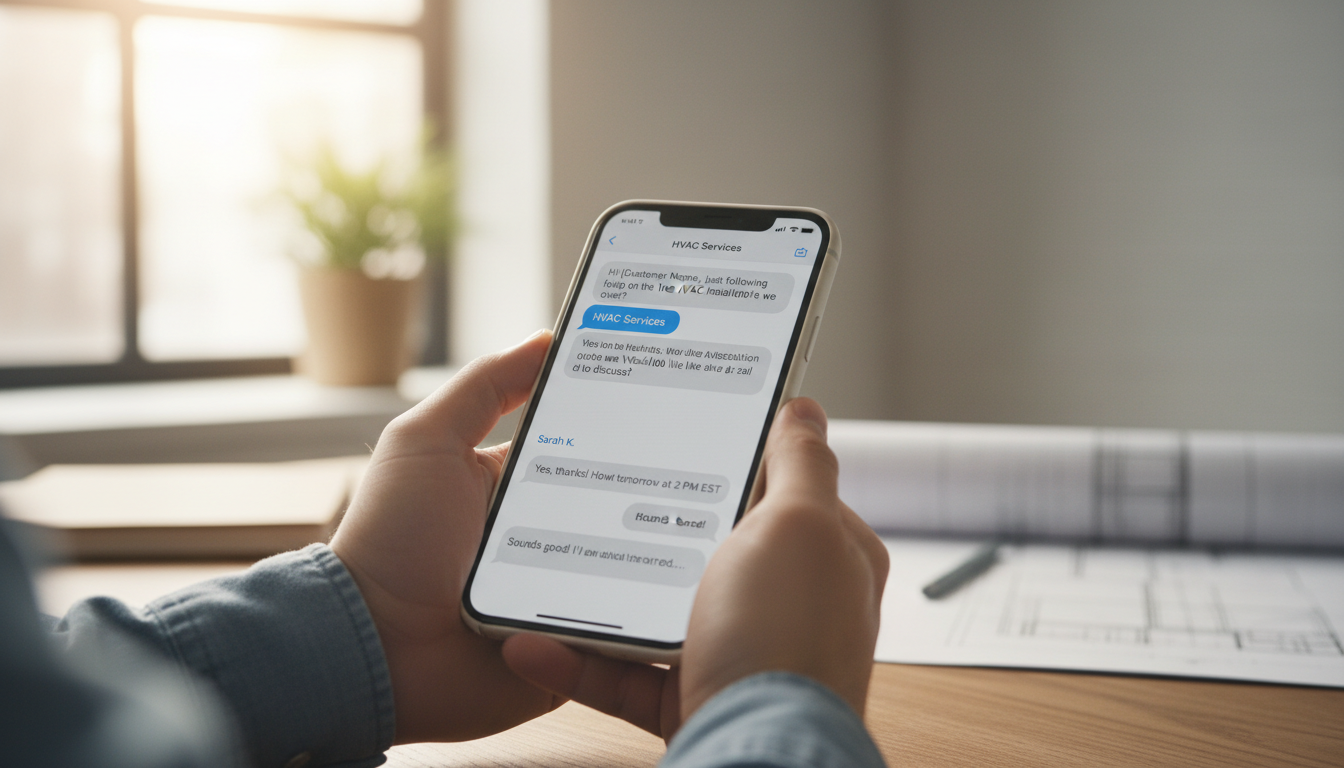
Yes—text message follow-up gets 5-8 times higher response rates than voicemail for HVAC quotes, especially with homeowners under 55. The key is keeping texts short, helpful, and professional. A text like "Hi Sarah, this is Mike from ABC Heating. Just sent your furnace quote to your email—let me know if you have any questions!" feels conversational and low-pressure. It also gives them an easy way to respond without committing to a phone call.
Texts work best at the 24-hour and day-3 touchpoints. Use calls for the initial outreach and closing conversations. Avoid sending more than two texts per lead—beyond that, it crosses into spam territory.
What Should You Track to Know If Follow-Up Is Working?
You can't fix what you don't measure. The single most important metric for HVAC follow-up is quote-to-close conversion rate—the percentage of quotes you send that turn into booked jobs. If you're below 25%, your follow-up process has major gaps. At 35-45%, you're competitive. Above 50%, you're either extremely good at qualifying leads upfront or you have best-in-class follow-up.
Track these numbers weekly:
- Time to first contact: How many minutes between lead coming in and your first response?
- Number of touchpoints per lead: How many times are you actually reaching out before you give up?
- Quote-to-close rate: What percentage of quotes turn into jobs?
- Revenue per lead: Total monthly revenue divided by total leads—this captures both close rate and average ticket.
Most HVAC companies don't track any of this. They know monthly revenue and maybe lead count, but they have no idea how many quotes died from lack of follow-up versus genuine price objections or bad fit. Use a simple spreadsheet if you have to. The act of tracking forces accountability and reveals patterns you'd otherwise miss.
Want to see what better follow-up would mean in actual dollars? Calculate your losses based on your current lead volume and close rate—the numbers are usually shocking enough to force change.
Real Example: How One HVAC Company Recovered $43,000 in Lost Revenue
A residential HVAC company in Tennessee was spending $3,500/month on Google Ads and generating about 40 leads. They were closing 8-10 jobs per month with an average ticket of $4,200. Solid business, but the owner felt like they were leaving money on the table.
When we audited their process, the problem was obvious: they were responding to leads quickly, but follow-up stopped after one or two attempts. The owner was personally calling leads between jobs, and if he didn't reach them on the second try, he assumed they weren't interested. Out of 40 monthly leads, 28-32 were getting no follow-up beyond the initial quote.
They brought on a part-time office person whose sole job was follow-up. She worked 20 hours a week and used a simple checklist: call at day 1, text at day 2, call at day 4, email at day 6, final call at day 9. No fancy software—just a spreadsheet and a phone. Within 60 days, their close rate went from 22% to 37%. Same ad spend. Same lead quality. They were now closing 15 jobs per month instead of 9.
The math: 6 additional jobs × $4,200 average ticket = $25,200 in additional monthly revenue. Over six months, that's $151,200. The part-time hire cost them $2,400/month. The ROI was 10:1, and it came entirely from leads they were already paying for and ignoring.
Why Following Up With HVAC Customers After the Job Matters Just as Much
Post-job follow-up is where average HVAC companies create one-time customers and great ones build annuity revenue streams. According to Harvard Business Review, acquiring a new customer costs 5-25 times more than retaining an existing one, yet most contractors treat installation as the finish line instead of the starting line.
A simple post-job follow-up sequence looks like this: thank-you call or text within 24 hours of job completion, maintenance reminder at 6 months, seasonal check-in before cooling and heating seasons, and annual service contract renewal outreach. Each touchpoint is an opportunity to upsell maintenance agreements, catch small problems before they become emergency calls, and generate referrals.
The lifetime value difference is staggering. A one-time $6,000 AC replacement customer is worth $6,000. A customer who also buys a $300/year maintenance plan, calls you first for a $1,200 furnace repair three years later, refers two neighbors, and replaces their second unit with you in year seven is worth $15,000-$20,000. The only difference is whether someone followed up.
Frequently Asked Questions
How many times should I follow up on an HVAC quote before giving up?
Follow up at least five times over 7-10 days. Research shows 80% of HVAC sales close after five or more touchpoints, but most contractors stop after two. Use a mix of calls, texts, and emails. After day 10, send a final "closing the loop" message and move them to a long-term nurture list for seasonal check-ins.
What's a good close rate for HVAC quotes?
A healthy quote-to-close rate for residential HVAC is 35-45%. If you're below 25%, you either have a lead quality problem or a follow-up problem—usually the latter. Above 50% is exceptional and typically indicates strong qualification upfront and persistent follow-up.
Should I follow up differently for emergency calls versus planned replacements?
Yes. Emergency repair leads need immediate response—within 5 minutes—and faster booking. Planned replacement or upgrade quotes require more touchpoints because the buying cycle is longer. Emergency calls should convert within 24 hours. Replacement quotes often take 7-14 days and benefit from educational follow-up about financing, efficiency, and timing.
Is it worth paying someone just to do follow-up calls?
Absolutely. If you're generating more than 20 leads per month, a dedicated follow-up person or team will pay for themselves many times over. A part-time hire at $15-20/hour costs $1,200-1,600/month. If they help you close even 2-3 additional jobs per month at a $3,000-5,000 average ticket, the ROI is 5:1 or better.
How quickly should I respond to HVAC leads?
Within 5 minutes for the best results. Response times beyond 5 minutes reduce your odds of qualifying the lead by 400%. For emergency calls, every minute counts—homeowners are calling down a list and booking with whoever answers first. For non-emergency quotes, aim for contact within 30 minutes maximum.
What should I say in a follow-up text message to an HVAC customer?
Keep it short, helpful, and conversational. Example: "Hi [Name], this is [Your Name] from [Company]. Just wanted to make sure you got the quote we sent for your AC replacement. Any questions I can answer?" Avoid being pushy. The goal is to make it easy for them to respond and re-engage the conversation.
Stop Losing Revenue You've Already Paid For
Every HVAC lead that goes cold because nobody followed up represents marketing dollars you'll never get back. You paid to generate that inquiry. You invested time in the quote. Then you walked away and let a competitor who called three times scoop the revenue. This isn't a marketing problem or a pricing problem—it's a follow-up problem, and it's costing you 30-50% of your potential revenue.
The fix doesn't require expensive software or a complete operational overhaul. It requires someone whose job is to make sure every lead gets five touchpoints across seven days. Whether that's a part-time hire, an office manager with a checklist, or a dedicated front office team, the function has to exist and it has to be separate from the people doing the technical work.
If you're tired of watching leads evaporate and competitors win jobs you quoted first, it's time to treat follow-up like the revenue channel it is. See how a fully managed front office team can close the gap between quote and cash without adding to your plate.
John Edmonds is a native Texan and military combat veteran. He founded Book All Leads after identifying a critical gap in the service industry: business owners losing revenue not from lack of skill, but because no one was handling the calls, follow-ups, reviews, and payments while they were busy doing the work.
View LinkedIn Profile →