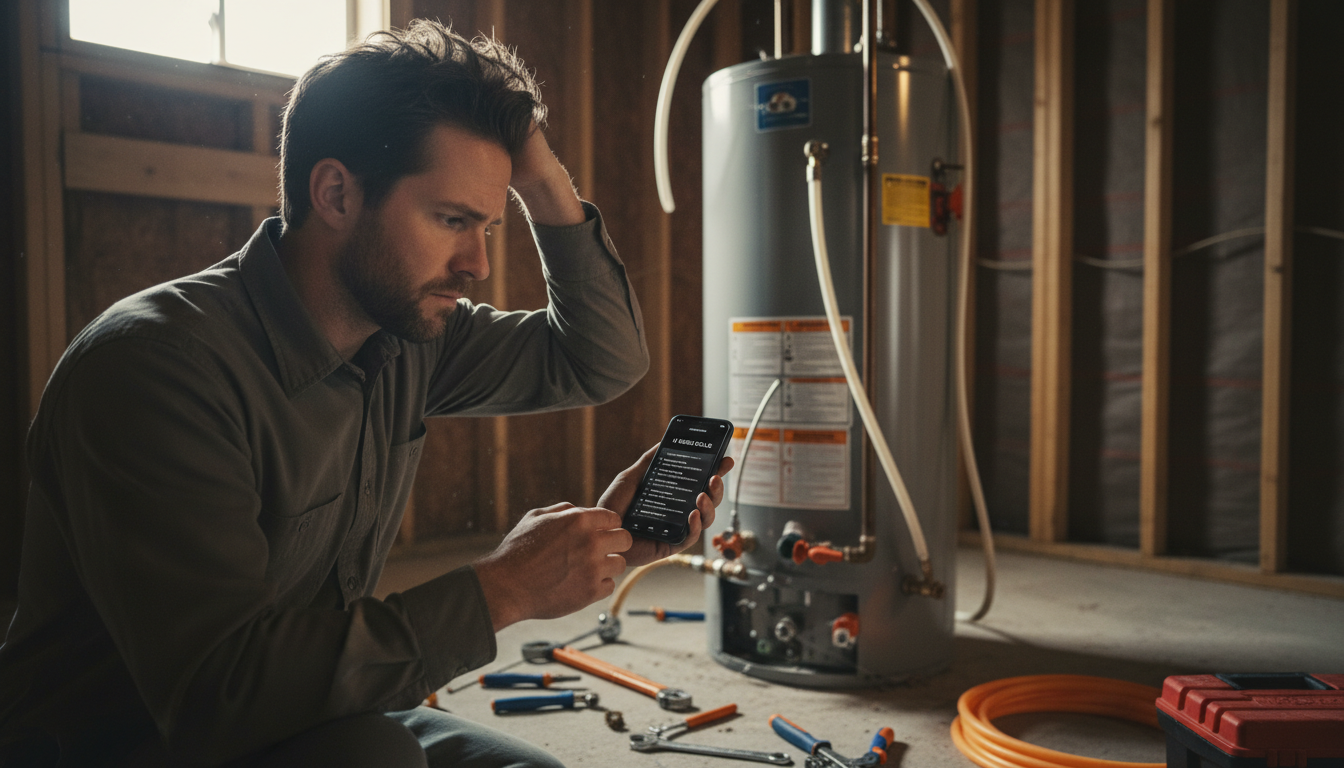
Plumbing water heater leads are some of the highest-value calls your business receives — averaging $1,800 to $3,500 per installation — yet most plumbing companies lose 40-60% of these opportunities before they ever book the job. The problem isn't your pricing or expertise. You're losing these high-ticket installs in the first five minutes after the phone rings, when homeowners with an urgent need call three plumbers and hire whoever answers first with confidence and availability.
Why Water Heater Installation Leads Disappear Before You Even Know They Called
Water heater failures don't wait for business hours. When a homeowner wakes up to cold showers or water pooling around their tank, they're calling plumbers at 6:47 AM or 8:23 PM. According to the Plumbing-Heating-Cooling Contractors Association (PHCC), 68% of water heater replacement calls happen outside traditional business hours, with the highest volume occurring evenings and weekends when most small plumbing shops send calls to voicemail.
The homeowner doesn't leave a voicemail. They call the next plumber. And the next. They're comparing three things in real time: who answers, how quickly they can come out, and whether the person on the phone sounds like they know what they're doing. If you're on a job site covered in PEX fittings or torching a copper line when they call, you've already lost to the plumber who has someone answering.
Here's what most articles won't tell you: The plumber who wins the water heater install isn't usually the cheapest or even the best-reviewed. They're the one who made the homeowner feel handled in the first 90 seconds of the call. That means acknowledging the urgency, offering same-day or next-day availability, and immediately moving toward booking — not asking the caller to "send photos" or waiting to call back with a quote.
What Happens When You Miss a Water Heater Lead
A missed water heater call doesn't just cost you one job. It costs you $2,400 in immediate revenue (the average residential water heater replacement), plus the lifetime value of a customer who now has a relationship with a different plumber. Research from Harvard Business Review shows that acquiring a new customer costs 5-25 times more than retaining an existing one, and repeat customers in the trades spend 67% more on average than first-time callers.
Here's the typical breakdown of what happens when a water heater lead comes in:
- 8:15 PM Friday: Homeowner discovers their 14-year-old water heater is leaking. They Google "emergency plumber water heater replacement near me" and start calling.
- First call: Goes to voicemail. Your outgoing message says you'll return calls the next business day.
- Second call: Answered by a competitor's answering service. The service takes a message but can't quote pricing or availability.
- Third call: Answered live by someone who says, "We can have someone there tomorrow morning between 8 and 10. Let me get your address and walk you through what to expect." Job booked.
You never knew the call happened. The homeowner never thinks about you again. That's $2,400 gone, and you can't calculate your losses if you don't know how many calls you're missing in the first place.

Why Plumbers Struggle to Convert Water Heater Calls Into Booked Jobs
Even when you do answer the phone, the conversion battle isn't over. Water heater installation leads require a different approach than service calls. The homeowner isn't price-shopping a $150 drain cleaning — they're making a $2,000+ decision under pressure, often with zero hot water and a timeline measured in hours, not days.
Most plumbing companies lose these calls in three specific ways:
You Answer, But You're Distracted
You're under a sink or driving between jobs when the call comes in. You answer, but the homeowner can hear the noise, the distraction, the fact that you're doing three things at once. They ask about tankless versus traditional, and you give a vague answer because you're not in front of your pricing or calendar. You tell them you'll call back in 20 minutes. They book with someone else in 12.
You Can't Give Immediate Availability
Water heater replacements are urgency-driven. According to IBISWorld, 73% of homeowners who need emergency plumbing services — including water heater failures — expect a technician to arrive within 24 hours. If you can't confidently say "I can have someone there tomorrow morning" or "We can fit you in this afternoon," the homeowner hears "I'm too busy for your problem" and moves on.
The issue isn't that you're actually too busy. It's that you don't have real-time visibility into your schedule when you're answering calls from a crawl space, so you hedge. Hedging kills conversions on high-ticket plumbing jobs.
You Don't Sound Like You Want the Job
Homeowners calling about water heater replacement are stressed, inconvenienced, and making a decision they didn't budget for. They need someone who sounds confident, reassuring, and eager to help. When a plumber answers the phone sounding rushed, annoyed, or unsure, the homeowner interprets that as "this company doesn't really need my business." They're right.
This is where companies with a dedicated front office team win. BookAllLeads provides plumbing companies with a full six-person team that answers every call like it's the most important one of the day — because to that homeowner, it is. They know your pricing, your availability, and how to move a stressed caller from "I need help" to "You're booked for 9 AM tomorrow" without putting them on hold or transferring them three times.
How to Stop Losing Water Heater Replacement Marketing Dollars
If you're spending money on Google Ads, truck wraps, or direct mail to generate water heater installation leads, but you're missing calls or fumbling conversions, you're pouring revenue into a leaky bucket. The fix isn't more marketing. It's making sure every lead that comes in gets handled like the $2,400 opportunity it is.
Answer Every Call, Every Time — No Exceptions
Data from InsideSales.com shows that response times longer than five minutes reduce your odds of qualifying a lead by 400%. For emergency plumbing calls, the window is even tighter. If a homeowner's third call gets answered and yours goes to voicemail, they're not waiting. They're booking.
This doesn't mean you personally need to be glued to your phone 24/7. It means you need a system where someone — a person, not a voicemail box — answers every single call within three rings, knows what to say, and can book the job on the spot.
Know Your Pricing and Availability in Real Time
Homeowners calling about water heater replacement want three pieces of information immediately: ballpark cost, when you can come, and whether you handle their specific situation (tankless, gas-to-electric conversion, permit-required installs, etc.). If the person answering your phone has to say "let me check and call you back" for any of these, your conversion rate craters.
Your front office — whether it's an in-house person or an external team — needs live access to your calendar, your standard pricing for common scenarios, and decision-making authority to say "yes, we can do that tomorrow at 10 AM" without waiting for you to text back from a job site.
Follow Up Relentlessly on Estimates
Not every water heater call books immediately. Some homeowners want to get a couple of quotes, check with their spouse, or see if their home warranty covers it. But here's the reality: the plumber who follows up wins the job 60-70% of the time, even if they weren't the cheapest quote.
Most plumbers send a quote via text or email and never follow up. The homeowner gets busy, the sense of urgency fades, and the job sits in limbo until the water heater fully dies — at which point they call whoever answers first, which may or may not be you. A proper follow-up sequence — a call 24 hours later, a check-in text, a "we have availability opening up" nudge — turns maybes into booked jobs.

The Real Cost of Doing It Yourself
Many plumbing business owners try to solve the missed-call problem by answering their own phone. You keep your phone in your pocket, you answer between jobs, you stay on top of it. And it works — sort of. You catch more calls. But you also:
- Interrupt billable work four to eight times a day to answer calls, extending every job by 30-45 minutes
- Sound distracted or rushed on calls, which tanks your close rate on high-ticket jobs
- Spend evenings returning calls and sending quotes instead of managing your business or having a life
- Still miss calls when you're torching a joint, running wire, or dealing with an angry property manager
Your hourly rate on a job site — the revenue you generate when you're actually doing plumbing work — is $125 to $200+ depending on your market. Every time you stop work to answer a call, you're trading $150/hour work for $25/hour administrative work. Do that six times a day, and you've lost $750 in billable time while also delivering a worse customer experience than a dedicated person whose only job is to answer your phone.
What a Proper Front Office Does for Water Heater Leads
A dedicated front office team — not an answering service that takes messages, but a team that books jobs, handles follow-ups, and manages your schedule — changes the entire equation for high-ticket plumbing jobs. Here's what happens when a water heater lead calls a plumber with a real front office:
The call gets answered in two rings, every time, even at 7 PM on a Saturday. The person answering knows your company, knows plumbing, and knows how to talk to a homeowner who's stressed about a broken water heater.
The caller gets immediate information: "A standard 50-gallon gas replacement typically runs $2,200 to $2,600 installed, and we can have someone out tomorrow morning between 8 and 10 to assess your specific situation and give you an exact quote. Does that work for your schedule?"
The job gets booked on the spot, the homeowner receives a confirmation text, and a follow-up call happens 24 hours later to confirm the appointment and answer any new questions. The plumber shows up to a warm lead who's already 80% sold.
Meanwhile, you never stopped working. You finished your current job, checked your calendar at the end of the day, and saw a $2,400 water heater install booked for tomorrow morning. That's how it's supposed to work.
How One Plumber Stopped Losing $30K a Month in Water Heater Installs
Mike runs a three-truck plumbing operation in a mid-sized Texas city. He's excellent at the work, his pricing is competitive, and he's been in business for 11 years. But he was stuck at $40K/month in revenue and couldn't figure out why he wasn't growing.
The breakthrough came when he started tracking missed calls. He set up a simple system where every call that went to voicemail got logged. Over 30 days, he counted 47 missed calls. He called back every single one within a few hours. Only three returned his call. The rest had already booked with someone else.
He estimated conservatively that 40% of those missed calls were water heater or other high-ticket jobs (the rest were service calls, quote requests, etc.). That's 18 lost water heater leads in a month. At an average job value of $2,400, he'd left $43,200 on the table — more revenue than his entire monthly gross — just from calls that went to voicemail.
He brought on a front office team that answered his calls live, managed his schedule, and followed up on estimates. Within 90 days, his monthly revenue jumped to $71K. The difference wasn't that he got more leads. He just stopped losing the ones that were already calling him.
Why Generic Answering Services Don't Work for Water Heater Leads
Some plumbers try to solve the missed-call problem with an answering service. The service picks up, takes a message, and forwards it to you via text or email. You call the customer back 20 minutes or two hours later. By then, they've booked with someone else.
Generic answering services can't book jobs. They don't know your pricing, they don't have access to your calendar, and they're not trained to handle the specific questions a homeowner asks when their water heater dies. They're a marginal improvement over voicemail, but they're not a solution for capturing high-value plumbing leads.
You need a team that can say "Yes, we can replace your tankless Rinnai, we can be there tomorrow at 2 PM, and here's what to expect" — and then actually put that appointment on your calendar. Anything less is still leaving money on the table.
The Fix: Treat Every Water Heater Call Like the $2,400 It Is
The difference between plumbing companies that are stuck and plumbing companies that are scaling isn't the quality of their work. It's how they handle the 60 seconds between when the phone rings and when the job gets booked. Water heater installation leads are some of the best opportunities your business will ever get — they're high-ticket, they're urgent, and the homeowner is ready to buy today. Losing them because you're under a sink or because your answering service can't book jobs is a choice, not a necessity.
If you want to stop losing revenue to missed calls and fumbled conversions, the fix is simple: make sure every call is answered by someone who knows what they're doing, has the authority to book jobs, and treats every caller like the most important customer of the day. That's not a nice-to-have. It's the difference between staying stuck at $40K a month and scaling past six figures.
Your competitors already figured this out. The plumber who beat you to that last water heater install didn't have better skills or lower prices. They just had someone who answered the phone.
Frequently Asked Questions
How many water heater leads does a typical plumbing company lose each month?
Most plumbing companies with 2-5 trucks lose 15-25 high-value leads per month due to missed calls, slow response times, or poor call handling. At an average water heater install value of $2,400, that's $36,000 to $60,000 in monthly revenue walking out the door. The issue isn't lead volume — it's conversion and availability. Tracking your missed calls for 30 days will show you the exact number for your business.
What's the best way to answer calls when I'm on a job site?
The best solution is to have someone else answer them — a dedicated front office person or team who can book jobs, answer pricing questions, and manage your schedule without interrupting your billable work. Answering calls yourself while you're working costs you $100-150 per interruption in lost productivity, and homeowners can tell you're distracted, which kills your close rate on high-ticket jobs.
Do I really need to answer calls after hours for water heater jobs?
Yes. According to PHCC, 68% of water heater replacement calls happen outside traditional business hours. Homeowners with no hot water aren't waiting until Monday morning — they're calling until someone answers and can help them today. If you're not available after 5 PM or on weekends, you're voluntarily giving up two-thirds of your highest-value leads to competitors who are.
How quickly do I need to respond to a water heater lead?
Immediately. Data shows that response times over five minutes reduce your odds of converting the lead by 400%. For emergency plumbing calls like water heater failures, the window is even shorter. Homeowners are calling multiple plumbers simultaneously and booking with whoever answers first and sounds competent. A callback 20 minutes later is too late — they've already booked with someone else.
What should I say when a homeowner calls about a water heater replacement?
Start by acknowledging the urgency: "I understand — no hot water is a real problem. Let's get you taken care of." Then provide ballpark pricing, immediate availability, and next steps: "A standard 50-gallon gas replacement typically runs $2,200-$2,600 installed. We can have someone out tomorrow morning to assess your setup and give you an exact quote. Does 9 AM work?" Move toward booking within the first 90 seconds.
Is it worth paying for a front office team just to answer calls?
If you're losing even five water heater installs per month due to missed calls — which is conservative for most plumbing companies — that's $12,000 in monthly revenue you're not capturing. A front office team that recovers even half of those lost leads pays for itself 3-5 times over, while also freeing you to focus on billable work instead of playing phone tag with homeowners. Check your pricing options to see what makes sense for your volume.
Stop Losing High-Ticket Plumbing Jobs to Competitors Who Just Answer the Phone
Every water heater lead that calls your business is a $2,400 decision happening in real time. If you're not answering, if you're sounding distracted, or if you can't book the job on the spot, that revenue is going to the plumber who can. The fix isn't working harder or spending more on marketing. It's making sure every single call gets handled by someone who knows what they're doing and has one job: turning that caller into a booked customer.
That's what BookAllLeads does. A full front office team — six people working around the clock — answers every call, books every job, and follows up on every estimate. No software for you to learn, no contracts locking you in, and you're live in five days. Your competitors already have teams like this. It's time you did too.
John Edmonds is a native Texan and military combat veteran. He founded Book All Leads after identifying a critical gap in the service industry: business owners losing revenue not from lack of skill, but because no one was handling the calls, follow-ups, reviews, and payments while they were busy doing the work.
View LinkedIn Profile →