
Pool cartridge filter customers are choosing Home Depot and Leslie's over local pool service companies at an alarming rate — not because retail stores offer better service or expertise, but because they answer the phone, have stock on hand, and make the buying process frictionless. Local pool companies lose an estimated 40-60% of their filter replacement revenue to big box competitors, costing the average pool service business $25,000-$45,000 annually in missed sales and downstream service opportunities.
Why Pool Service Companies Keep Losing Filter Customers to Retail Stores
Your customers aren't leaving because you're bad at your job. They're leaving because retail stores have solved the convenience problem while you're still wrestling with phones, inventory headaches, and scheduling chaos. When a pool owner needs a new cartridge filter, they want it today — not next Tuesday when you finish your route and can swing by their house.
Here's the brutal reality: retail stores win on three fronts that matter more than your decades of expertise.
They Answer Every Single Call
Big box stores staff their phone lines with live bodies who pick up within two rings. You're in a backyard diagnosing a pump issue when your customer calls about a filter. By the time you pull off your gloves and check your phone, they've already ordered from Leslie's online or driven to Lowe's.
Here's what most articles won't tell you: According to InsideSales.com, lead response time makes a 400% difference in conversion rates when comparing under-5-minute responses to 10-minute responses. But filter customers aren't even leads anymore — they're existing customers who already trust you. When they can't reach you, they interpret it as "my pool guy doesn't want this small job." That perception destroys the relationship faster than any pricing issue.
Instant Inventory Availability
Walk into any Leslie's and you'll find 47 different cartridge filters in stock. Your customer knows their Hayward C900 or Pentair Clean & Clear needs replacing, and they can walk out with it in ten minutes. You might stock the top five models, but that still means telling 60% of callers "I'll need to order that and get back to you."
That delay costs you the sale. Every single time.
No Appointment Necessary
Retail customers don't need to coordinate schedules, wait for service windows, or take time off work. They stop by on their lunch break. Your model requires them to be home, plan around your route, and often pay a service call fee just to hand them a $89 filter.
The math doesn't work in your favor. Your customer knows it. You know it. And that's why they're shopping elsewhere.
What Losing Pool Cartridge Filter Customers Actually Costs Your Business
Missing filter sales isn't just about the $75-$150 margin on the cartridge itself. You're losing the relationship touchpoint that leads to service calls, chemical sales, equipment upgrades, and referrals. When customers buy their filters at retail stores, they start questioning why they need you at all — and that's when they discover YouTube videos showing them how to balance chemicals and vacuum their own pool.
The average residential pool service company handles 80-150 accounts. If just 30% of those customers defect to retail for their filter replacements, you're looking at real losses:
- Direct filter sales: $8,000-$15,000 annually in lost product revenue
- Service call opportunities: Each filter replacement is a chance to inspect equipment, recommend upgrades, and identify issues before they become emergencies — lost value of $12,000-$20,000 per year
- Customer lifetime value erosion: Customers who handle their own filter purchases are 3x more likely to cancel service within 18 months, according to retention patterns in the home service industry
- Chemical and accessory sales: Retail stores bundle filters with chemicals and cleaning tools — add-on revenue you'll never see
For most pool service businesses, calculate your losses and you'll find the total impact ranges from $25,000 to $50,000 annually. That's enough to hire another technician or upgrade your entire truck fleet.

How the Best Pool Companies Win Back Pool Filter Customers
The companies winning this battle aren't trying to beat retail stores at their own game — they can't stock 47 filter models or stay open until 9 PM. Instead, they're fixing the one thing they can control: being reachable when customers need them. When every call gets answered by a real person who can immediately help, quote accurately, and schedule delivery or installation, the convenience gap disappears.
This is where most pool companies hit a wall. You can't answer phones while you're elbow-deep in a filter housing. Your admin person works 9-5, but your customers call at 7 PM when they get home from work and notice their filter pressure gauge is in the red.
Book All Leads solves this exact problem for pool service companies. Instead of hiring front office staff or missing calls, you get a full team handling every call, text, and email — booking filter deliveries, scheduling service, collecting payments, and following up with customers who need reorders. Your customers reach a real person every time. You stay focused on the technical work. The calls get answered, the filters get sold, and the customers stay yours.
Make Filter Replacement a Service, Not Just a Product
Stop selling filters. Start selling filter replacement as a service package. Charge a flat $150 for delivery, installation, inspection, and disposal of the old cartridge. Now you're not competing with Home Depot's $89 filter — you're offering a completely different value proposition that retail stores can't match.
The customer pays more, but they don't lift a finger. No driving, no guessing which filter fits, no struggling with stuck housings or O-rings. You deliver convenience that justifies the premium.
Build Filter Replacement Subscriptions
Cartridge filters need replacing every 1-3 years depending on usage and water chemistry. You know when your customers are due. Create a subscription program that automatically schedules filter inspections and replacements based on their pool's history.
Charge $15-25 monthly for filter membership that includes annual replacement (cost amortized), priority scheduling, and a discount on other services. Lock in the recurring revenue before they even think about shopping at Leslie's.
Stock Strategic Inventory and Deliver Same-Day
You don't need to stock 47 models. Analyze your customer base and stock the top 8-10 filters that cover 80% of your accounts. For the other 20%, offer next-day delivery from your supplier and frame it as "custom ordering the exact right filter for your system."
When you can deliver same-day or next-day with installation included, retail stores lose their speed advantage. The customer would rather wait 18 hours for you to install it than drive to the store, buy the wrong model, and wrestle with it themselves.
The Real Reason Pool Pros Struggle to Compete with Retail
It's not inventory. It's not pricing. It's accessibility. When a pool owner can't reach you easily, they assume you're too busy for their "small" filter job — even though you'd happily take that business. The gap between "I should call my pool guy" and "I'll just grab one at Home Depot" is measured in unanswered rings and unreturned voicemails.
Research from Bain & Company shows that increasing customer retention rates by just 5% can increase profits by 25-95% in service industries. Keeping your existing pool filter customers engaged through reliable communication and convenient service delivery is exponentially more valuable than acquiring new accounts to replace the ones quietly defecting to retail.
The pool service companies thriving right now have figured out that front office operations matter as much as technical skill. Every call answered is a sale protected. Every customer who reaches a helpful voice instead of voicemail is a customer who stays loyal.
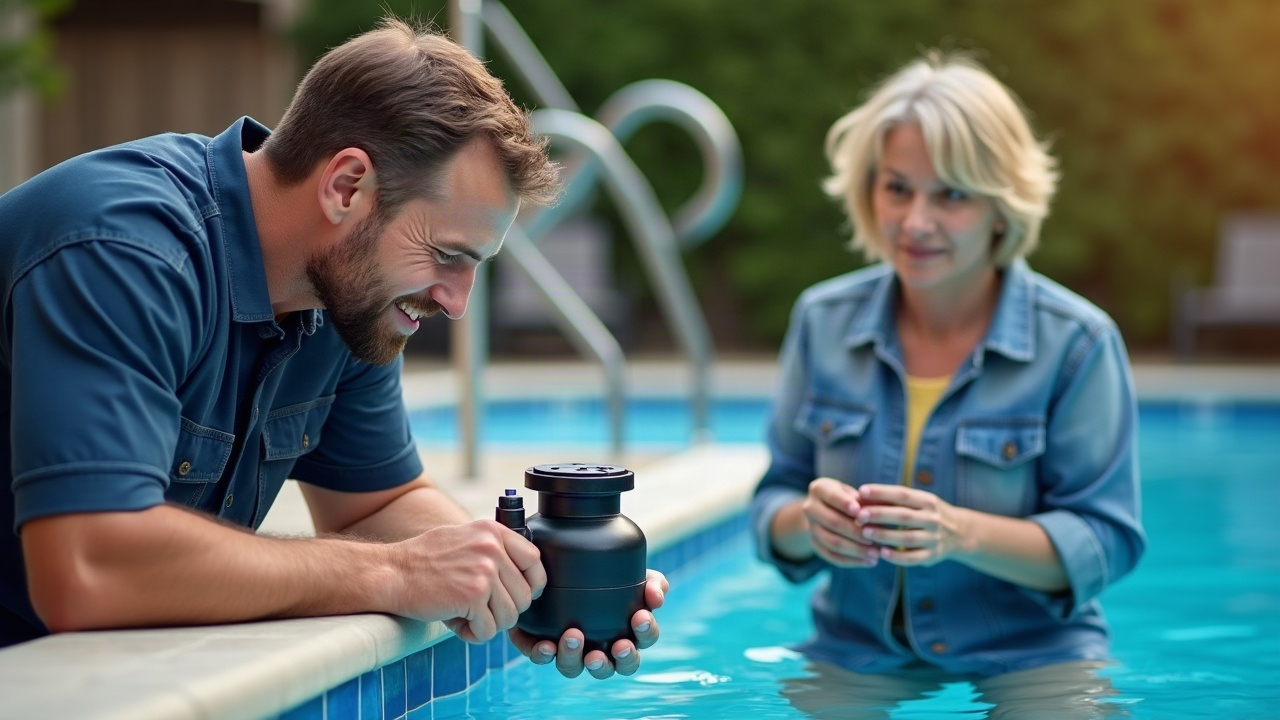
What One Pool Service Owner Did to Stop the Bleeding
Mike runs a 90-account pool service business in Phoenix. Two years ago, he realized he was losing filter customers to Leslie's at an alarming rate — he'd see his own customer accounts in the checkout line buying cartridges he should have sold them. His revenue was flat despite adding new accounts, because existing customers were defecting for consumables.
The breaking point came when a long-term customer canceled service entirely. "I called you about a filter three times over two weeks and never got a callback," she told him. "So I went to Leslie's, and while I was there, the guy showed me how to do my own chemical testing. I figured if I'm buying my own supplies anyway, why am I paying for service?"
Mike's first instinct was to hire an office person, but the math didn't work — salary plus benefits for someone to answer phones 40 hours a week when most of his calls came in evenings and weekends. Instead, he brought in a team that handled all his customer communication around the clock.
Within six months, his filter sales doubled. Not because he changed his inventory or pricing, but because every customer who called about a filter got an immediate answer, accurate quote, and same-day or next-day installation scheduled on the spot. His customer retention rate climbed from 71% to 89%. The customers stopped wandering into retail stores because they could actually reach Mike's team whenever they needed something.
Mike's business grew by $80,000 in year one — not from new customer acquisition, but from keeping the revenue that was already his.
How to Calculate What Missing Filter Calls Costs You
Most pool service owners have no idea how much revenue walks out the door when they miss calls. Here's how to get a rough estimate that'll likely shock you:
- Count your managed accounts: How many pools are you servicing regularly?
- Estimate filter replacement frequency: Assume 40% need cartridge replacement annually (conservative estimate for 1-3 year replacement cycles)
- Calculate potential filter revenue: Multiply account count × 40% × $150 (average filter + installation price)
- Assess your capture rate: What percentage of those filter jobs do you actually perform versus customers handling it themselves? Most honest pool pros admit it's 40-60% at best.
- Calculate the gap: The difference between potential and actual filter revenue is what you're losing to retail competition and missed communication
For a 100-account pool service business, that's 40 filter replacements per year worth $6,000 in revenue. If you're only capturing half of those because customers can't reach you or find it easier to go to retail, you're leaving $3,000 on the table — just in filter sales. Add the downstream impacts on customer relationships, and the real cost is closer to $10,000-$15,000 annually.
According to the Bureau of Labor Statistics, the pool service industry employs over 90,000 workers across the United States with steady demand growth driven by residential pool installation increases. But employment growth means more competition for the same customer base. The pool companies that retain their customers through better accessibility and service delivery will capture the growth while competitors struggle with churn.
Why "Just Hire Someone" Doesn't Solve the Problem
The obvious answer is hiring an office manager or receptionist, but that introduces a different set of problems. Full-time employees cost $35,000-$50,000 annually when you factor in salary, taxes, benefits, and training. They work 40 hours a week, but your customers call evenings and weekends. They get sick, take vacations, and quit without notice.
You also need to train them on pool equipment, pricing, scheduling, and customer service. That's weeks of your time invested in someone who might leave in six months for a job with better benefits. Meanwhile, you're still missing the after-hours calls that drive customers to retail stores.
Part-time help seems cheaper until you realize you need coverage across 60-70 hours per week to catch the majority of customer calls. Now you're coordinating schedules, managing multiple people, and still dealing with gaps in coverage.
The pool service owners solving this problem efficiently aren't hiring employees — they're bringing in teams that are already trained, already managing multiple pool service businesses, and already operating 24/7. The front office is handled completely, and there's nothing new to learn or manage.
Frequently Asked Questions
How much profit margin do pool companies make on cartridge filter sales?
Pool service companies typically mark up cartridge filters 40-60% over their wholesale cost, resulting in $50-$100 profit per filter depending on the model. When you include installation service at $50-75, total margin on a filter replacement job ranges from $100-$150. However, the real value isn't the immediate margin — it's maintaining the customer relationship and preventing them from discovering they can handle pool maintenance themselves through retail store guidance.
Why can't I just compete on price with big box stores?
You'll lose that battle every time. Home Depot, Lowe's, and Leslie's buy in massive volume and can sell filters at prices that barely cover your wholesale cost. Competing on price trains customers to see filters as commodities and erodes your service business. Instead, compete on convenience, expertise, and service — bundle filter replacement with installation, inspection, and expert recommendations that retail stores can't provide.
What percentage of pool service customers buy their own filters at retail stores?
Industry estimates suggest 40-60% of pool service customers purchase at least some supplies and parts directly from retail stores rather than through their service provider. This percentage increases dramatically when customers can't easily reach their pool service company or face delays in getting simple items like replacement filters. The shift typically starts with small purchases like filters and chemicals, then escalates to equipment and eventually DIY service.
Should I stock every filter model my customers might need?
No. Stock the 8-10 most common cartridge filter models that cover 70-80% of your customer base. For less common models, establish next-day delivery relationships with local pool supply distributors. Frame special orders as "getting the exact right filter for your specific system" rather than admitting you don't have it in stock. The key is responding immediately when customers call, even if delivery takes an extra day.
How do I transition filter customers from buying retail to using my service?
Start with proactive communication. Before their filter needs replacing, reach out with a maintenance reminder and offer to handle the replacement during their next scheduled service. Make it easier to say yes to you than to add "buy pool filter" to their weekend to-do list. Consider offering a small discount for customers who commit to buying all supplies through you, or create a subscription program that includes filter replacements on schedule.
What if customers say they prefer buying filters themselves?
Ask why. Usually it's not about preference — it's about convenience or past frustration trying to reach you. Address the real objection. If they couldn't get ahold of you last time they needed something, acknowledge it and explain what's changed. If they think they're saving money, show them the total cost including their time, potential for buying the wrong filter, and installation headaches. Position your service as the premium option for people who value their weekends.
Stop Losing Pool Filter Customers You've Already Earned
You've built your pool service business on expertise, reliability, and taking care of customers' pools better than they could themselves. Losing those same customers to big box stores for filter replacements isn't a pricing problem or an inventory problem — it's an accessibility problem. When customers can't reach you easily, they make other choices. Those choices become habits. Those habits cost you thousands in lost revenue and eventually cost you the entire account.
The solution isn't working harder or staying glued to your phone. It's making sure every customer who reaches out gets a helpful response immediately, whether you're available or not. The pool service businesses winning back their pool cartridge filter customers have figured out that front office operations are just as important as technical skills. Every call answered is revenue protected. Every customer who gets immediate help is a customer who stays loyal.
If you're ready to stop losing filter customers to retail stores and start capturing the revenue that's already yours, Book All Leads can have your front office running in five days. Real people answering every call, booking every job, and keeping your customers away from Home Depot and Leslie's. No software to learn, no employees to manage, no contracts locking you in. Just a team that makes sure you never lose another customer because you couldn't get to the phone.
John Edmonds is a native Texan and military combat veteran. He founded Book All Leads after identifying a critical gap in the service industry: business owners losing revenue not from lack of skill, but because no one was handling the calls, follow-ups, reviews, and payments while they were busy doing the work.
View LinkedIn Profile →