
Pool installation lead qualification is the difference between locking in a $60,000 consultation and watching that prospect sign with someone else before you even return their call. Most inground pool contractors lose qualified leads not because they answered too slowly, but because they asked qualifying questions too slowly — leaving budget, lot suitability, and timeline unclear while competitors who pre-qualify within minutes secure consultation deposits. When the average inground pool installation starts at $40,000 and takes 8-12 weeks, prospects don't wait for callbacks to find out if they're even a fit.
Why Pool Companies Lose Qualified Leads Before the First Conversation Ends
You lose inground pool leads because the first person who answers isn't the first person who qualifies. The contractor who picks up on ring two but schedules a vague "free consultation" loses to the competitor who answers on ring four but confirms budget range, lot access, and preferred start date before the caller hangs up. According to InsideSales.com, leads contacted within five minutes are 21 times more likely to convert than those contacted after 30 minutes — but in the pool installation sales process, "contact" without qualification just delays the real decision.
Here's what happens: A homeowner calls three pool companies in an afternoon. Company A answers immediately but says "someone will call you back to schedule a consultation." Company B goes to voicemail. Company C answers, confirms the lot is accessible for equipment, verifies they're looking at a $50K-$70K range, and books a site visit for Thursday at 3 PM while the caller is still on the phone. Company C gets the deposit. Companies A and B get ghosted.
Here's what most articles won't tell you: The "free consultation" is killing your conversion rate. When you offer a no-commitment site visit without pre-qualifying budget or timeline, you're training prospects to treat your time as disposable. High-intent buyers expect to be vetted. They're spending $60,000 and waiting three months for completion — they want to know you're selective about who you work with. Pre-qualification isn't a filter that loses leads; it's a signal that builds trust with the buyers who actually close.
What Pre-Qualifying During the First Call Actually Looks Like
Pre-qualification isn't an interrogation. It's confirming three things before you hang up: budget alignment, site feasibility, and decision timeline. For inground pools, that means asking if they've researched typical investment ranges ($40K-$100K+), whether their property has equipment access for excavation, and if they're planning to move forward this season or next. These aren't "filtering out" questions — they're qualifying both directions. You're saving the homeowner from wasting a Saturday on a consultation that won't fit their budget, and you're protecting your schedule from tire-kickers who ghost after three estimates.
When a prospect hears "most of our gunite installations in this area run $55,000 to $85,000 depending on size and features — does that align with what you were planning?" they either confirm they're serious or self-select out. Either outcome is a win. The qualified lead moves to site visit with realistic expectations. The unqualified lead doesn't waste your estimator's afternoon.
The Real Cost of Slow Pool Installation Lead Qualification
Slow qualification costs you twice: once in lost deposits, once in wasted estimates. When you delay budget and timeline conversations until the on-site consultation, you're spending two hours and $150 in labor to discover what a three-minute phone conversation would have revealed. The National Association of Home Builders reports that specialty contractors spend an average of 18 hours per week on estimates that don't convert — and for pool contractors working $50K+ projects, that's often because the prospect was never financially qualified in the first place.
Here's the math: If you run 12 consultations per month and half of them were unqualified on budget or timeline, you've burned 12 hours your lead estimator could have spent closing qualified jobs. At a $75/hour labor cost, that's $900 in direct waste. But the real loss is opportunity cost. Those six unqualified consultations displaced six qualified prospects who booked with competitors while your calendar showed "no availability until next week."
One pool contractor in Scottsdale tracked this for a quarter. Before implementing phone-based qualification, they closed 22% of site visits. After training their front office team to confirm budget range and lot access before booking, their close rate jumped to 41% — not because they got better at selling, but because they stopped estimating jobs they were never going to win. The qualification questions didn't reduce lead volume; they doubled revenue per lead.
Why "Call Back to Schedule" Kills Pool Installation Sales Calls
The callback model assumes prospects are waiting by the phone for you. They're not. They're calling the next name on the list. When a homeowner searches "inground pool installation near me," they're not looking for one contractor — they're auditioning three to five. The first company that makes them feel understood and books a specific next step wins. The companies that promise callbacks lose momentum.
This isn't about answering speed; it's about conversation completion. A prospect who ends a call with "we'll get back to you" is still shopping. A prospect who ends a call with "we'll see you Thursday at 3 PM, and I'm texting you the address now" is 80% decided. That remaining 20% is whether your on-site estimate matches the professionalism of the intake call — but you've already disqualified your slower competitors.
Book All Leads builds and manages a full front office team that picks up every pool installation call live, qualifies budget and site access in the first conversation, and books consultations directly onto your calendar while the prospect is still on the phone. No software for you to learn. No voicemail lag. No "we'll call you back." Your team shows up to pre-qualified site visits with homeowners who already confirmed budget and timeline — so your close rate reflects actual sales skill, not luck.
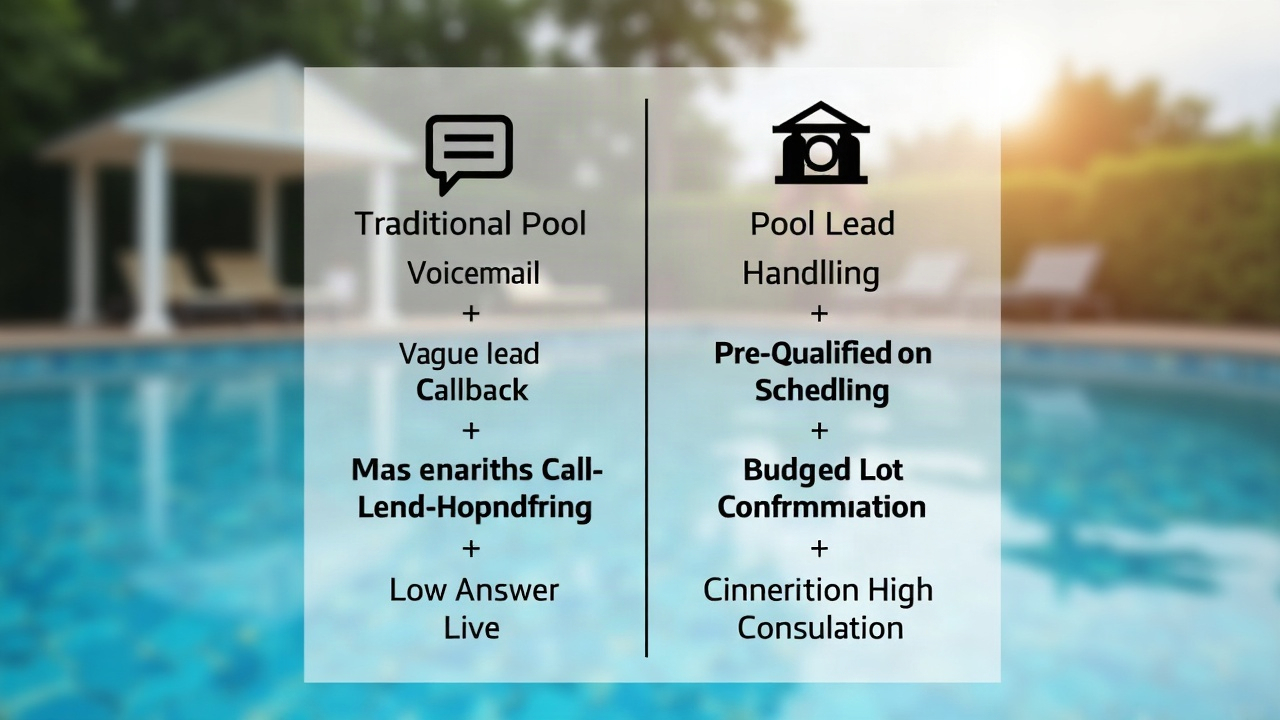 voicemail > callback > vague scheduling > low conversion) versus "Pre-Qualified Pool Lead Handling" (call > live answer > budget/lot confirmation > booked consultation > high conversion)" width="1280" height="720" loading="lazy">
What Questions Separate Qualified Pool Leads from Tire-Kickers
Effective pool installation lead qualification comes down to four questions, asked conversationally in the first three minutes. Budget: "Most inground projects in our area start around $50K and go up from there depending on size and features — is that the range you were planning for?" Timeline: "Are you looking to have this done this season, or planning for next year?" Lot access: "Do you have side-yard access wide enough for excavation equipment, or would we need to come through the house?" Decision-maker: "Is this something you and your spouse are deciding together, or are there other folks we should include in the consultation?"
These aren't trick questions. They're respect. You're signaling that your consultation time is valuable and that you work with homeowners who are serious. High-intent buyers appreciate this. They've done the research. They know pools are expensive. They're relieved to talk to someone who treats this like the major investment it is.
How to Handle "I'm Just Getting Ballpark Pricing" Calls
When a caller says they're "just looking for a rough estimate," don't dismiss them — and don't offer to send a generic price sheet. This is a qualification moment. Respond with: "Totally understand. Most of our gunite pools range from $55K to $90K depending on size, features, and site prep. Does that fit what you were hoping to spend, or are you still in the early research phase?" If they confirm budget alignment, book the consultation. If they're sticker-shocked, offer to email a planning guide and follow up in three months when they've saved more or adjusted expectations.
This approach converts fence-sitters without wasting consultation slots. You've given them real information, set accurate expectations, and created a follow-up path. The prospects who are ready move forward immediately. The prospects who aren't stay in your pipeline without clogging your calendar.
Why Site Visits Booked Without Budget Conversations Waste Your Weekends
Unqualified site visits feel productive — you're out meeting homeowners, walking properties, building rapport. But if 40% of those consultations end with "we're still getting quotes" or "we didn't realize it would be that much," you're running a very expensive hobby. Pool construction lead conversion depends on meeting with people who are ready to decide, not people who are window-shopping.
Research from Bain & Company shows that sales cycles shorten by an average of 30% when qualification happens in the initial contact rather than during the first face-to-face meeting. For pool contractors, that means fewer follow-up visits, fewer revised estimates, and fewer "we decided to wait another year" emails after you've already invested three hours in design drawings.
One pool builder in Tampa ran the numbers: qualified consultations (budget and timeline confirmed on intake call) closed at 54%. Unqualified consultations (anyone who called got booked) closed at 19%. The difference wasn't sales skill — it was who showed up. Homeowners who had already acknowledged budget and timeline on the phone arrived ready to talk design and start dates. Homeowners who hadn't were still price-shopping and wasted everyone's Saturday.
When to Walk Away from a Lead That Won't Pre-Qualify
Some prospects refuse to discuss budget until they "see what you offer." This is a red flag, not a negotiation. In the inground pool sales process, homeowners who won't confirm a realistic budget range before a consultation are usually price-anchoring — they want your detailed estimate so they can negotiate your competitor down. Politely offer to send a planning guide and invite them to reconnect when they're ready to discuss investment range. Protecting your consultation calendar from non-qualifiers is how you keep slots open for serious buyers.
How Fast Competitors Steal Your Pool Leads While You're on the Jobsite
You're managing a $70,000 gunite pour in Gilbert. A qualified lead calls at 10:30 AM — homeowner has $65K budget, accessible lot, wants to start in eight weeks. Your phone goes to voicemail. You see the notification at 12:15 PM during lunch and call back at 12:45 PM. The homeowner already booked a consultation with the competitor who answered live, confirmed budget, and scheduled Thursday at 4 PM — all before you finished your pour.
This isn't a theoretical problem. It's the daily reality for owner-operated pool companies. You can't pause a job to take every call, but every missed call is a prospect who's moving down their list. The solution isn't working less — it's having a front office team that handles pool installation consultation booking while you're running crews.
That means live humans who understand pool construction, know your calendar, and can speak confidently about budget ranges and timelines. Not an answering service reading a script. Not voicemail with a "we'll call you back" promise. An actual office team that closes the loop before the prospect moves on.

What High-Converting Pool Companies Do Differently on Intake Calls
Top-performing pool contractors treat intake calls like the first stage of the sale, not administrative scheduling. Their front office teams are trained to:
- Confirm budget range within the first two minutes using conversational framing: "Just so we're designing the right scope, most of our projects start around $55K — does that match what you were planning?"
- Verify lot suitability before booking: "Do you have side-yard access at least eight feet wide for equipment, or would we need alternate access?"
- Qualify timeline and decision urgency: "Are you hoping to have this done this season, or planning ahead for next year?"
- Book the consultation with a specific date, time, and confirmation text before the call ends — no "we'll call you back to schedule."
- Send a pre-consultation email within 10 minutes with what to expect, what to prepare, and who will be there.
This five-step process takes three to four minutes. It eliminates 60% of unqualified consultations and doubles the close rate on site visits. The cost is minimal. The revenue impact is massive.
Why "Free Consultation" Messaging Attracts the Wrong Pool Leads
Advertising "free consultations" sounds customer-friendly, but it trains prospects to treat your time as disposable. High-intent pool buyers don't need "free" — they need "qualified." They're spending $60,000 and occupying their backyard for two months. They want to work with a contractor who's selective, not desperate.
Reframe your intake messaging: "We offer on-site design consultations for homeowners ready to move forward this season. Most of our inground projects start around $50K depending on size and features. If that aligns with your planning, we'll schedule a site visit to walk your property and build a custom proposal." This language attracts serious buyers and repels price shoppers. Your calendar fills with better leads, and your close rate reflects it.
Should You Charge a Consultation Fee for Pool Estimates?
Some high-end pool builders charge $150-$300 for design consultations, refundable if the client signs. This works in luxury markets and further filters for financial commitment. But even if you don't charge, treating the consultation as a valuable appointment — not a free service you hand out to anyone who calls — shifts prospect behavior. When your intake team positions the site visit as "we only have three slots this week, so we prioritize homeowners who've confirmed budget and timeline," you're creating scarcity and respect. The leads who push back weren't going to close anyway.
How to Calculate What Slow Pool Lead Qualification Is Costing You
Run this math for your business. Count how many site visits you ran last month. Subtract the ones that closed or are in active proposal. You're left with dead consultations — prospects who were never qualified, never serious, or never in budget. Multiply that number by two hours (average site visit and estimate prep time) and your estimator's hourly cost. That's your monthly waste from poor qualification. Now multiply by 12. If the number makes you wince, you've found the problem.
For most pool contractors, this reveals $15,000 to $40,000 in annual labor waste. That's not counting the opportunity cost of qualified leads who booked competitors while your calendar showed no availability. Want to see the real impact? Use our calculator to estimate how many qualified leads you're losing monthly to response delays and booking friction.
What to Do When Your Team Is Too Busy to Pre-Qualify Pool Leads
If you're running crews, managing permits, and handling client calls, you don't have time to pre-qualify every inbound lead. Your field guys certainly don't. And your office admin is already juggling scheduling, invoicing, and vendor coordination. This is the gap that kills growth. You know pre-qualification matters. You just don't have the people to do it.
The solution isn't hiring an answering service that reads a script. It's building a front office team that knows your business, understands pool construction timelines, and handles intake calls like an extension of your operation. That means live people who can discuss budget, confirm lot access, book consultations, send follow-up texts, and hand you a qualified pipeline without you managing the process.
This is what separates scaling pool companies from stuck ones. The owner-operators who grow past $2M in revenue stop answering their own phones and start building front office infrastructure. The ones who stay stuck keep telling themselves "I'll get to it when things slow down." Things never slow down. You build the team or you stay on the phone.
Why Your Current Pool Lead Qualification Process Is Probably Broken
Most pool contractors think they're qualifying leads, but they're really just scheduling appointments. They ask "when works for you?" instead of "what's your budget range?" They book site visits without confirming timeline or decision-maker involvement. They treat every caller the same — whether it's a homeowner with $70K ready to go or a renter daydreaming about a pool they'll never build.
Here's the test: Pull your last 20 consultations. How many included a budget conversation before the site visit? If the answer is fewer than half, you're not qualifying — you're hoping. And hope is expensive when your estimator bills $75/hour and your close rate is 22%.
The fix isn't complicated. It's a phone script, 10 hours of role-play training, and accountability. Teach your intake team (or whoever answers the phone) to ask budget, timeline, and lot access questions before they open the calendar. Make it non-negotiable. Track qualification rate and close rate weekly. The consultations that come from qualified intake calls will close at triple the rate of the ones that don't — and you'll know exactly why.
Frequently Asked Questions
How quickly should I respond to inbound pool installation leads?
Within five minutes for maximum conversion. Research shows leads contacted within five minutes are 21 times more likely to convert than those contacted after 30 minutes. For high-ticket purchases like inground pools, speed matters because prospects are calling multiple contractors simultaneously. The first company to answer, qualify, and book a consultation typically wins the job — even if they weren't the first on the prospect's list.
What budget questions should I ask on the first call?
Use conversational framing: "Most of our inground pools in this area start around $50,000 and go up depending on size, features, and site conditions. Does that align with what you were planning to invest?" This gives context before asking and makes the question feel helpful rather than intrusive. If they confirm alignment, move to timeline and lot access. If they're surprised by the range, offer to send a planning guide and follow up when they've adjusted expectations.
Should I book consultations for leads who won't discuss budget?
No. Prospects who refuse to confirm a realistic budget range before a site visit are usually price-anchoring — they want your detailed estimate to negotiate competitors down or aren't serious about moving forward. Politely offer educational resources and invite them to reconnect when they're ready to discuss investment. Protecting your consultation calendar from non-qualifiers keeps slots open for serious buyers and prevents wasted estimates.
How do I qualify lot suitability over the phone?
Ask: "Do you have side-yard access at least eight feet wide for excavation equipment, or would we need to plan for alternate access?" Most homeowners know if they have a gate or path wide enough for machinery. If they're unsure, ask them to measure and text you a photo before the consultation. This prevents showing up to a site visit only to discover equipment access requires removing fencing or coming through the house — both of which add cost and complexity that should be discussed before you invest consultation time.
What's a good close rate for inground pool consultations?
For properly qualified site visits (budget, timeline, and lot access confirmed on intake call), 40-50% is achievable. If you're closing below 30%, you're likely booking unqualified leads or struggling with estimate follow-up. For unqualified consultations (anyone who calls gets booked), 15-25% is typical — which means you're wasting 75% of your estimator's time on jobs that were never going to close. Pre-qualification is the single fastest way to improve close rate without changing your sales process.
How can I pre-qualify leads when I'm on jobsites all day?
You need a front office team that handles intake calls while you're running crews — not an answering service, but trained people who understand pool construction, know your calendar, and can qualify budget, timeline, and lot access before booking consultations. This ensures every call gets answered live, every lead gets pre-qualified, and you only show up to site visits with prospects who are ready to move forward. Without this infrastructure, you'll keep losing qualified leads to competitors who answer faster and qualify better.
Stop Losing Pool Installation Leads to Faster Competitors
Pool installation lead qualification isn't about answering calls quickly — it's about asking the right questions before you hang up. Budget, timeline, lot access, and decision-maker involvement. Four questions that take three minutes and double your consultation close rate. The contractors who pre-qualify during intake win more jobs, waste less time, and grow faster. The ones who treat every caller the same stay stuck at 20% close rates and wonder why they're always busy but never profitable.
If you're tired of running unqualified consultations and losing deposits to competitors who locked in serious buyers while you were calling people back, it's time to build a front office that handles this for you. Book All Leads gives you a full team that picks up every call, qualifies every lead, and books every consultation while you focus on running great installations. No software to learn. Live in five days. Let's fix your qualification process and fill your calendar with leads who actually close.
John Edmonds is a native Texan and military combat veteran. He founded Book All Leads after identifying a critical gap in the service industry: business owners losing revenue not from lack of skill, but because no one was handling the calls, follow-ups, reviews, and payments while they were busy doing the work.
View LinkedIn Profile →