
Pool service call answering directly impacts your revenue — most pool companies lose 40-60% of incoming calls to voicemail when their techs are on route and the owner is underwater with work. Every missed call represents a lost opportunity: a weekly maintenance customer wanting to add equipment repair, a homeowner with a green pool emergency, or a neighbor asking for a quote. When callbacks take hours (or never happen), those callers move to the next company. For pool service businesses, missed calls don't just cost individual jobs — they quietly drain thousands in monthly revenue from add-on work that should be yours.
The Real Problem: Your Best Customers Call During Your Busiest Hours
Here's the cruel timing issue every pool service owner faces: your existing weekly maintenance customers call between 9 AM and 3 PM on weekdays — exactly when you and your techs are running routes, skimming pools, balancing chemicals, and cleaning filters. They're not calling to cancel service. They're calling because their pool heater stopped working, their pump is making a grinding noise, or they want to schedule that equipment upgrade you mentioned last month.
These aren't cold leads — they're your highest-value callers. According to research from Bain & Company, existing customers spend 67% more than new customers over time. When your weekly maintenance client calls about adding a salt system or repairing their automation panel, that's a $2,000-$8,000 opportunity calling. And it's going straight to voicemail while you're testing chlorine levels three properties away.
The math is brutal. If you service 80 weekly maintenance accounts and half of them call once per quarter with an add-on request, that's 40 calls. Miss half of those because of poor pool service phone coverage, and you've lost 20 opportunities. At an average add-on job value of $1,200 (conservative for equipment repairs and minor installations), you've just left $24,000 on the table annually — and that's only counting your existing customer base, not new caller inquiries.
Here's what most articles won't tell you: Your voicemail message is costing you more than the missed call itself. When a homeowner with a cloudy pool calls three companies, the one that answers gets the job 80% of the time — even if they're not the cheapest. The callback window closes fast. According to InsideSales.com, lead response times beyond 5 minutes see conversion rates drop by 400%. By the time you finish your route at 4 PM and start returning calls, those homeowners have already booked someone else.
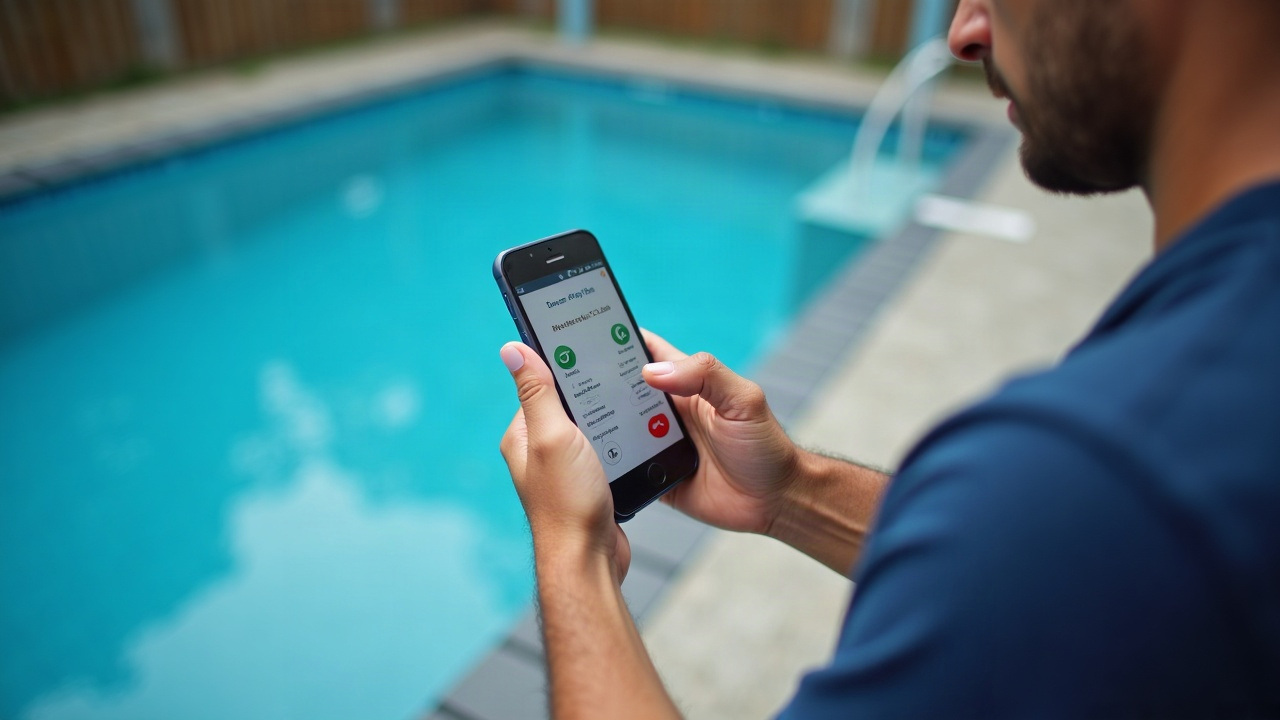
Why Pool Company Missed Calls Happen (Even When You Try to Answer)
Pool company missed calls aren't about lazy owners or bad customer service — they're a structural problem built into how pool service businesses operate. The work requires physical presence at customer properties for extended periods, often in areas with poor cell reception or situations where answering a phone mid-task creates safety issues or unprofessional interruptions.
Consider the typical route day structure. You start at 8 AM and hit 12-15 properties by 3 PM. Each stop takes 20-45 minutes depending on service complexity. You're balancing chemicals, cleaning baskets, backwashing filters, and inspecting equipment. Your phone is in your pocket or the truck. When it rings, you're mid-task — hands wet, gloves on, testing strip in hand. By the time you dry off and pull out your phone, the call's gone to voicemail.
Even when you do answer, the interruption costs you. You lose your place in the service checklist. The customer on the phone hears pool equipment noise in the background. The homeowner whose property you're servicing watches you take a call instead of working on their pool. It's a no-win scenario that plays out dozens of times per week.
The Hidden Toll of Pool Service Voicemail Dependency
Pool service voicemail creates a secondary problem beyond the missed revenue: it trains customers to expect slow response. When callers consistently hit voicemail, they learn your business isn't accessible. Weekly maintenance customers start texting instead (which you also can't answer promptly during routes). Emergency callers immediately dial the next company. Prospective customers assume you're too busy to take on new work.
This perception problem compounds over time. Your business develops a reputation for being hard to reach, even among satisfied customers. They stop calling with add-on requests because they assume you won't answer. They don't refer neighbors because they remember the frustration of trying to reach you. The revenue loss extends far beyond the immediate missed call.
How Much Revenue Your Pool Business Loses to Missed Calls
Pool service revenue loss from missed calls varies by business size, but the pattern is consistent: service companies lose between $3,000 and $15,000 monthly in bookable revenue that goes to voicemail. The loss breaks into three categories — new customer inquiries, existing customer add-ons, and emergency service calls — each with different dollar values and conversion windows.
Start with new customer inquiries. The typical pool service company receives 15-40 new inquiry calls monthly during peak season (April through September) and 5-15 during off-season. If you miss half due to poor phone coverage and those callers book elsewhere, you're losing 5-20 new accounts monthly. At an average first-year customer value of $2,400 (assuming weekly maintenance at $50/week for 48 weeks), missing just 5 new customers per month costs you $12,000 in first-year revenue.
Existing customer add-ons represent an even larger opportunity cost because these calls convert at dramatically higher rates. Your weekly maintenance customers call about equipment repairs, chemical delivery, filter replacements, automation upgrades, and seasonal opening/closing services. Industry data suggests 60-70% of weekly maintenance customers request at least one add-on service annually. These jobs average $800-$3,500 depending on complexity.
| Call Type | Monthly Volume | Miss Rate | Avg Job Value | Monthly Revenue Lost |
|---|---|---|---|---|
| New Inquiries | 25 | 50% | $2,400/year | $2,500 |
| Customer Add-Ons | 18 | 45% | $1,200 | $9,720 |
| Emergency Service | 8 | 60% | $450 | $2,160 |
| Total Monthly Loss | $14,380 |
Emergency service calls — green pools, broken pumps, heater failures — represent high-margin work with immediate need. These callers are in pain and ready to pay premium pricing for same-day or next-day service. When they hit your voicemail, they're calling the next company within 60 seconds. You don't get a callback opportunity on these.
Use our calculator to estimate your specific revenue loss based on your call volume and current answer rate.
What Actually Fixes Pool Service Call Answering
Fixing pool service call answering requires removing the owner and field techs from the phone equation entirely — not teaching them to answer faster or implementing voicemail-to-text band-aids. The only solution that preserves revenue is having dedicated people whose only job is answering your phones, qualifying callers, and booking jobs while you're running routes.
This isn't about call forwarding to an answering service that takes messages. Those services don't book jobs — they just create a cleaner list of people you still have to call back (which means you still lose the revenue to timing). The fix is a full front office team that knows your pricing, understands pool service terminology, accesses your calendar, and books jobs on the spot.
Book All Leads builds a complete front office team for pool service companies — six roles working around the clock to answer every call, quote your services, book appointments, send confirmations, and collect payments. Your team answers in your business name, knows the difference between a cartridge filter and a DE filter, and can quote a green pool cleanup or salt cell replacement accurately. You don't manage software or train anyone — the team handles everything and goes live in five days.
What Dedicated Phone Coverage Actually Looks Like
Real phone coverage for pool service businesses means every call gets answered by a live person within three rings, every day including weekends, during your actual business hours (which should extend beyond your route schedule). The person answering understands pool service, can discuss chemical issues without sounding confused, knows your pricing structure, sees your schedule, and books the job immediately.
This requires specific pool industry knowledge that generic answering services don't have. When a homeowner calls saying their pool "turned green overnight," your front office needs to know the likely causes (algae bloom, chemical imbalance, circulation failure), ask qualifying questions (when did you last add chlorine, is the pump running, is there debris in the pool), and quote appropriate service (typically $200-$400 for green pool cleanup depending on size and severity).
The same applies to equipment calls. When someone says their "pool isn't heating," your team should ask whether they have gas or electric heat, check if the pump is running, and determine if this is emergency service or can wait for your next scheduled visit. That level of conversation can't happen with a script-reading operator — it requires trained people who understand pool service operations.

The Myth of "I'll Just Call Them Back Later"
Why doesn't callback later work as a strategy for pool service phone coverage? Because your callers don't sit around waiting for you — they move to the next company immediately, especially for time-sensitive requests like equipment failures or water quality emergencies. The callback window for service businesses is measured in minutes, not hours.
Pool service owners consistently overestimate their callback conversion rates. You remember the callbacks that worked — the loyal customer who waited for you, the caller who didn't mind waiting three hours for a return call. You forget the dozen callers who booked someone else and never answered when you finally called back. This creates a dangerous blind spot where owners believe they're only losing 10-20% of missed calls, when the actual loss is closer to 60-70%.
Even when callbacks do reach the customer, you're now competing instead of closing. When you answered live, you were the only company they'd contacted — the job was yours to lose. When you call back three hours later, they've already spoken to two competitors, received quotes, and possibly booked. You've transformed a warm inbound lead into a competitive bid situation where price becomes the deciding factor.
Why Pool Service Revenue Loss Accelerates Over Time
Pool service revenue loss from poor phone coverage doesn't stay constant — it accelerates as your reputation for unavailability spreads. Customers who struggle to reach you stop referring neighbors. Online reviews mention difficulty getting through. Your business develops an identity as "hard to reach," which prospective customers interpret as "too busy for new clients" or "doesn't care about customers."
This reputation damage affects more than phone calls. It influences how customers perceive your service quality overall. When they can't reach you by phone, they assume your field service will be similarly unresponsive. They hesitate to sign up for weekly maintenance because they worry about getting help if something goes wrong. The phone accessibility problem bleeds into customer retention and lifetime value.
The acceleration effect is particularly visible during growth phases. As you add weekly maintenance accounts and your routes get fuller, your availability drops further. The busier you get, the more calls you miss. The more calls you miss, the slower your growth — creating a ceiling effect where poor phone coverage caps your business at whatever size you can personally manage while still answering 40-50% of calls.
The Competitive Disadvantage You Can't Overcome
In most service territories, at least one pool service company answers their phones consistently. That company captures the overflow from everyone else's voicemail. They're not necessarily better technicians or cheaper — they're just reachable. Over time, they accumulate the customers that every other company lost to timing.
You can't overcome this disadvantage with superior technical skills or better equipment. The customer calling about a green pool emergency doesn't know yet that you're a better tech than the company that answered on ring two. They just know one company answered and you didn't. The booking decision happens in that moment, not in the callback hours later.
What Pool Service Owners Try Before Finding a Real Solution
Most pool service owners cycle through the same ineffective solutions before addressing the core problem. They start by trying to answer more calls themselves — keeping the phone in their pocket, taking calls between properties, pulling over to talk. This fails because it interrupts service delivery, frustrates the customers whose pools you're servicing, and still only captures 40-50% of calls.
Next comes delegating phone duty to a field tech or office spouse. The tech-with-a-phone approach fails because techs are doing the same physical work that prevents answering. The spouse-answering-from-home approach works initially but doesn't scale — it ties a person to the phone during specific hours, creates resentment when call volume spikes, and falls apart when that person gets sick or takes vacation.
Then comes the voicemail-to-text or call-forwarding-to-cell phase. Owners convince themselves that faster notification of missed calls solves the problem. It doesn't. You still have to stop working to return the call, and the customer has still moved on by then. These tools create the illusion of responsiveness without capturing revenue.
The final attempt is usually a basic answering service — the kind that takes messages or uses rigid scripts. These services answer the phone but don't book jobs. Callers hear "let me take your information and someone will call you back," which sounds exactly like voicemail with extra steps. The conversion rate barely improves because the fundamental problem — delayed response — hasn't changed.
How to Know If Missed Calls Are Costing Your Pool Business
If you're running routes and answering your own phone, you're losing revenue to missed calls — the only question is how much. But specific signs indicate whether your loss is minor (10-15% of potential revenue) or severe (40-60%). Watch for these patterns over a two-week period to assess your actual situation.
First, check your phone log. How many calls do you receive between 9 AM and 4 PM on weekdays? How many of those show duration under 10 seconds (indicating they went to voicemail)? If more than 30% of weekday calls are under 10 seconds, you're missing significant revenue. Track this separately for different days — many pool service businesses see 60-70% miss rates on their busiest route days.
Second, listen to your voicemails. How many are from existing customers requesting add-on work (repairs, equipment, upgrades)? How many are new customer inquiries? How many are time-sensitive emergencies? Calculate the potential value of each. If you're seeing $5,000+ weekly in potential revenue hitting voicemail, you have a major leak.
Third, track your callback conversion. Of the people who leave voicemail, how many do you actually reach when you call back? Of those you reach, how many book? Most pool service owners are shocked to discover their callback-to-booking rate is under 30% — meaning 70% of voicemail callers book elsewhere before the callback happens.
- Weekday missed call rate above 40%
- More than $3,000/week in potential revenue hitting voicemail
- Callback-to-booking conversion under 40%
- Customer complaints about difficulty reaching you
- Online reviews mentioning phone accessibility issues
- Slow growth despite strong technical reputation in your area
Frequently Asked Questions
How many calls does a typical pool service company receive per week?
Pool service companies with 50-100 weekly maintenance accounts typically receive 25-60 calls per week during peak season (April-September) and 15-35 calls during off-season. This includes new customer inquiries, existing customer add-on requests, emergency service calls, billing questions, and scheduling changes. Larger companies with 150+ accounts can see 80-120 weekly calls during peak months.
What percentage of pool service calls are missed when the owner answers their own phone?
Pool service owners running routes miss 45-65% of incoming calls during weekday business hours (9 AM - 4 PM). The miss rate varies by day — typically highest on Wednesdays and Thursdays when route schedules are fullest. Off-hours and weekend calls see even higher miss rates, often 80-90%, because most pool service owners don't answer business calls during evenings or Sundays.
Can't I just hire a local answering service to take messages?
Traditional answering services that take messages don't solve the revenue problem because they delay the booking decision. When callers hear "someone will call you back," they hang up and dial the next company. Message-taking services might reduce your callback workload, but they don't capture time-sensitive callers or competitive situations where the first company to quote wins the job. You need people who can quote, schedule, and book on the spot.
How quickly do pool service callers move to the next company?
For emergency calls (green pools, equipment failures, leak concerns), 75-80% of callers contact a second company within 5 minutes if the first call goes to voicemail. For routine service inquiries and maintenance requests, the window extends to 30-60 minutes before they try someone else. New customer inquiries typically call 3-4 companies in a single session and book with whoever answers first and sounds competent.
What's the average value of a missed pool service call?
The average missed pool service call represents $380-$850 in potential revenue when you account for the mix of call types. New customer inquiries average $2,400 first-year value, existing customer add-ons average $1,200 per job, emergency service calls average $450, and routine questions or scheduling changes have zero direct value but affect retention. Weighted across typical call distribution, each missed call costs $600-$700 in expected revenue.
Do customers really care if I call them back within an hour?
Callback timing matters far more than most pool service owners realize. Callers who reach a live person book 73% of the time. Callers who receive a callback within 5 minutes book 48% of the time. Callbacks within 30 minutes convert at 28%. Callbacks after an hour convert at just 12-15% because by that point, most callers have already booked a competitor or lost urgency about the issue. Speed-to-response is the single biggest predictor of conversion for service businesses.
Stop Losing Pool Service Revenue to Voicemail
Every day you run routes without dedicated phone coverage, you're losing bookable revenue to competitors who simply answer their phones. The callers aren't coming back. The revenue isn't waiting for you. Your callback list represents jobs that mostly booked elsewhere while you were balancing chemicals and cleaning filters.
Fixing this doesn't require working longer hours or answering your phone during service calls. It requires removing yourself from the equation and putting dedicated people on your phones — people who know pool service, quote accurately, book jobs immediately, and work while you're building the business.
Your front office shouldn't be your voicemail. Get a team that answers every call, books every job, and turns your phone line into a revenue channel instead of a missed opportunity log. See how Book All Leads builds your complete front office and starts booking calls in five days.
John Edmonds is a native Texan and military combat veteran. He founded Book All Leads after identifying a critical gap in the service industry: business owners losing revenue not from lack of skill, but because no one was handling the calls, follow-ups, reviews, and payments while they were busy doing the work.
View LinkedIn Profile →