
Swimming pool appointment confirmations fail when companies rely on customers to remember service dates or when confirmation messages don't reach clients in time. No-shows cost pool service companies between $150 and $350 per missed appointment when you factor in wasted drive time, lost labor, and the revenue gap from jobs that could have filled that slot. During peak season, when routes are fully booked, a single no-show can cascade into schedule gaps that ripple through the entire week.
The Problem: Your Confirmation Process Has Too Many Breakpoints
Pool service companies lose confirmations because their process depends on things outside their control: customers checking voicemail, reading texts immediately, or remembering a date mentioned three weeks ago. The typical confirmation flow has at least four points where it can break down: the initial booking gets logged but not entered into a reminder schedule, the reminder goes out but lands in a spam folder, the customer sees it but forgets to respond, or the response comes back but nobody's monitoring that channel to update the schedule.
During spring opening season and weekly maintenance cycles, when you're running eight to twelve stops per day, a single no-show doesn't just cost you that appointment. It creates a hole in your route that you can't fill on short notice. Your technician still drives to the location, still spends fifteen minutes knocking and calling, still has to navigate to the next job with dead time in between.
Here's what most articles won't tell you: The highest no-show rates don't come from one-time cleanings or repairs. They come from seasonal services like opening and closing, where customers booked the appointment two or three months in advance. They genuinely forget, because unlike their weekly maintenance visits, these appointments don't follow a predictable pattern. A customer who's had you come every Thursday at 10 a.m. for five years will still forget their April 12th pool opening if you only sent one text reminder two days before.
According to InsideSales.com, response times and confirmation rates drop dramatically after the first 24 hours following initial contact. For service appointments booked weeks or months in advance, that initial momentum is long gone by the time the service date arrives. Without a structured confirmation cadence, you're hoping the customer writes it down and remembers.
Why Pool Service Appointment Confirmations Break Down
Most pool companies confirm appointments the same way: they mention the date when booking, maybe send a text a day or two before, and hope the customer shows up. This works until it doesn't, and the failure points are predictable. Confirmation messages sent only once give customers a single opportunity to see and act on them. If that text arrives while they're in a meeting or driving, it gets buried under fifty other notifications by evening.
The breakdown accelerates when you're juggling multiple communication channels without a central point of accountability. One customer prefers email, another only checks texts, a third wants a phone call. Your office sends confirmations through whatever channel is easiest in the moment, which means there's no consistent tracking of who confirmed and who didn't. By the time you realize someone didn't respond, it's the morning of the appointment.
- Confirmations sent too early get forgotten; too late and customers have already made other plans
- Single-channel reminders miss customers who don't actively monitor that channel
- No follow-up on unconfirmed appointments until the day of service
- Route changes or reschedules communicated once, without verification the customer received the update
Seasonal peaks compound these problems. During April and May, when you're scheduling dozens of pool openings per week, confirmation volume overwhelms whoever's handling the office. Messages go out in batches without personalization, customers don't feel urgency to respond, and unconfirmed appointments pile up. You don't realize how many are at risk until you're standing in someone's driveway and nobody's home.
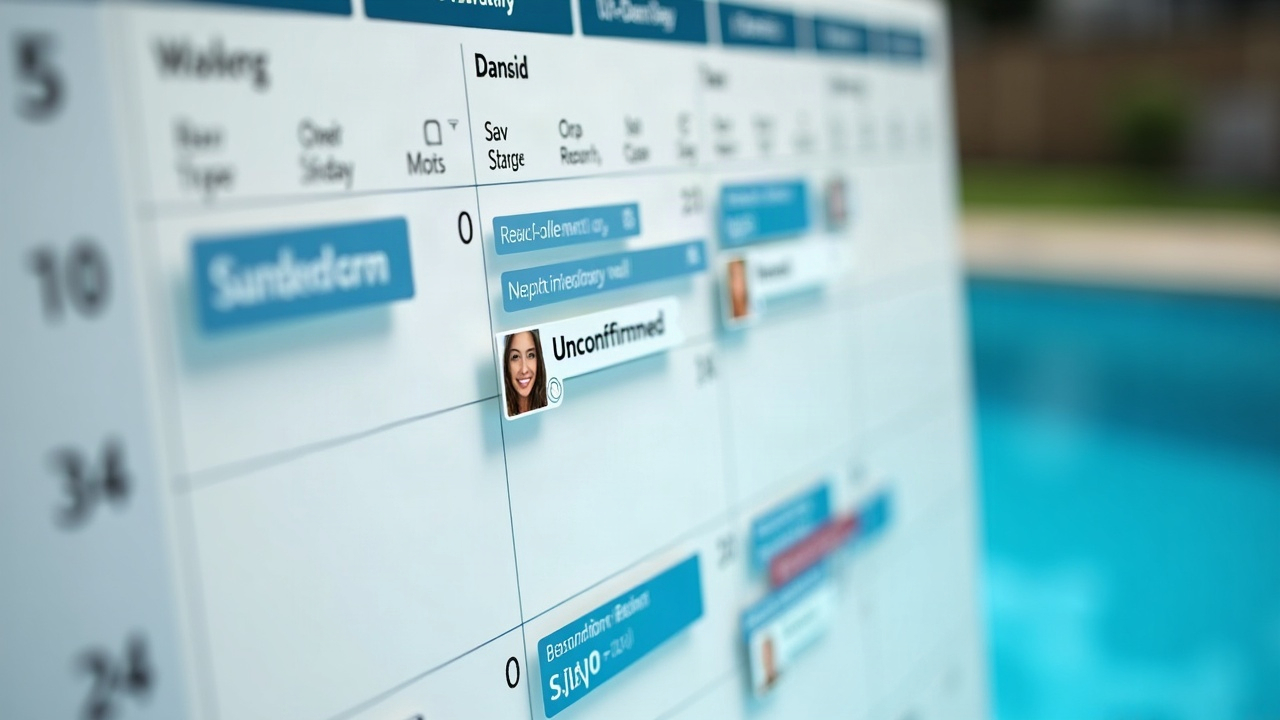
What Every No-Show Actually Costs You
A no-show costs more than the immediate lost revenue from that appointment. The actual cost includes your technician's hourly wage for wasted time, fuel and vehicle wear for the unnecessary trip, the opportunity cost of the job you could have scheduled in that slot, and the cascading schedule disruption that affects the rest of the day's route. For a $200 pool opening that becomes a no-show, your real loss is closer to $350 when you account for all these factors.
Break it down: Your technician drives twenty minutes to the site, spends ten to fifteen minutes attempting contact, then drives another twenty minutes to the next job with what's now a forty-minute gap in the schedule. That's nearly an hour of paid labor producing zero revenue. At a $45 average hourly cost for a pool service technician (including benefits and overhead), you're out $45 in direct labor before counting fuel, which the Bureau of Labor Statistics data on transportation costs suggests adds another $15-$20 for a moderate-distance service area.
The opportunity cost hurts more. During peak season, you likely had other customers requesting that time slot. A no-show on Tuesday at 2 p.m. means you turned away a confirmed job to hold that space. If your schedule is running at 90% capacity during May and June, every no-show is a confirmed job you didn't book. Multiply that across a season: if you're running twelve appointments per day and experiencing even a 5% no-show rate, that's 0.6 missed appointments per day, or three per week. Over a twelve-week peak season, that's thirty-six lost appointments.
Here's the math: thirty-six no-shows at $200 average appointment value equals $7,200 in lost revenue. Add the wasted labor and fuel costs of thirty-six unnecessary trips at roughly $60 each, and you're looking at another $2,160. Your total seasonal drain from pool service no-shows at just 5% is over $9,000. Companies running at 8-10% no-show rates during peak booking periods can easily lose $15,000 to $18,000 per season.
How to Fix Your Confirmation Process (Without Adding More Work)
The fix isn't sending more reminders through the same broken channels. It's building a confirmation process where someone is actually responsible for getting a yes or no from every customer, with enough lead time to fill the slot if they cancel. That means multiple touchpoints across multiple channels, tracked centrally, with a real person following up on anyone who doesn't confirm. For most pool service companies running lean operations, that's a full-time job during peak season.
Companies that solve this problem typically move confirmation responsibility to a dedicated front office team that treats it like a daily workflow, not an occasional task. Instead of your field supervisor sending bulk reminder texts between jobs, someone calls every unconfirmed appointment three days out, sends a follow-up text if they don't reach them, and escalates to email if needed. The key is persistence with accountability: every appointment gets confirmed or marked for replacement.
Book All Leads handles this by assigning confirmation responsibility to a front office team that works your schedule like it's their only job. They reach out to customers 72 hours before the appointment, follow up on non-responders, and track confirmations in real time so you know exactly which slots are solid and which need backup bookings. If someone doesn't confirm after multiple attempts, they contact you with enough lead time to fill the slot from your waitlist. You get a confirmed route every morning without assigning someone in your office to chase down responses.
What a Working Confirmation Schedule Looks Like
A reliable confirmation process touches each customer at least three times before the appointment, through at least two different channels. The first touchpoint happens immediately after booking—a confirmation message that includes the date, arrival window, service details, and what the customer needs to prepare. This isn't a reminder; it's proof that both parties agree on the scope and timing.
The second touchpoint comes 72 hours before the appointment. This is where you get active confirmation: a message that requires a response. "We're scheduled to open your pool this Thursday between 9 and 11 a.m. Reply YES to confirm or call us if you need to reschedule." If they don't respond within 24 hours, someone calls them directly. Not a voicemail. An actual conversation.
The third touchpoint is 24 hours before service: a final reminder that includes the technician's name, arrival window, and your contact number. This message assumes they've already confirmed, so it's framed as "Looking forward to seeing you tomorrow" rather than "Do you still want this?" By this point, you've already replaced any unconfirmed appointments, so you're not scrambling the morning of.
The Real Cost of Pool Service No-Shows Nobody Talks About
No-shows damage more than your schedule. They erode your team's morale and your reputation with customers who are waiting for appointments. When your technician arrives to an empty house for the third time that week, they start questioning whether the schedule is worth trusting. They pad their routes with extra buffer time, which reduces daily capacity. They get frustrated and start looking for companies where the office "has their act together." Turnover in this industry is already over 20% according to data on specialty trade contractors; operational chaos accelerates it.
Your reputation takes a hit with the customers you didn't serve. Every no-show is an appointment slot you could have given to someone who called two weeks ago and is still waiting. When you finally call to reschedule the no-show customer, you're offering them a date that's now three weeks out because your schedule filled up. Meanwhile, the customer who would have confirmed and been home is still waiting for their first available appointment. You're optimizing for unreliable customers and making reliable ones wait.
Research from Bain & Company shows that increasing customer retention rates by just 5% can increase profits by 25% to 95%, because repeat customers spend more and cost less to serve. No-shows work against this dynamic: they waste resources on one-time or unreliable customers while your capacity-constrained schedule makes loyal customers wait longer for service. You're literally losing money to serve the wrong people.

Why Most Pool Companies Don't Fix This Until It's Too Late
Most pool service owners know confirmations are a problem but don't prioritize fixing it until they've lost enough money to feel it. The issue is that no-show costs are diffuse: you see the individual lost appointment, but you don't see the cumulative seasonal impact or the opportunity cost clearly. It's easier to blame "flaky customers" than to acknowledge your confirmation process isn't working.
The other reason companies don't fix it is that the real solution—having someone dedicated to working confirmations daily—feels expensive until you calculate what you're currently losing. Paying someone even part-time to manage confirmation calls and follow-ups feels like overhead. Until you calculate your losses across a full season and realize that 5% no-show rate is costing you more than a part-time office person would.
There's also an operational inertia problem. During peak season, everyone's buried. Your office staff is answering new customer calls, your field supervisor is juggling route changes, and nobody has bandwidth to redesign the confirmation process. So you patch it with bulk reminder texts and hope for better customer behavior next year. The underlying process never changes, which means the losses don't either.
What Changes When Confirmations Actually Work
When your confirmation process works, you know 48 hours in advance exactly which appointments are confirmed and which slots need filling. Your routes stay full because unconfirmed appointments get replaced with waitlist customers who are ready to book. Your technicians trust the schedule because they're not showing up to empty houses. And your capacity utilization during peak season jumps from 75-80% to 95%+ because you're not leaving gaps from last-minute no-shows.
The financial impact shows up in two places: increased revenue per technician and reduced customer acquisition costs. When you're running confirmed routes at 95% capacity, each technician completes two to three more appointments per week than they did with a 10% no-show rate. Over a twelve-week season, that's twenty-four to thirty-six additional completed jobs per technician. At $200 per appointment, that's $4,800 to $7,200 in recovered revenue per technician, per season.
Customer acquisition costs drop because you're serving more customers with the same marketing spend. Instead of ten no-shows per month requiring ten replacement customers just to maintain revenue, you're converting 95% of booked appointments into completed jobs. The customers you already spent money to attract actually become revenue. Your marketing dollars go further because your operations aren't leaking customers after booking.
Frequently Asked Questions
How many appointment reminders should pool service companies send?
Send at least three touchpoints: one immediately after booking to confirm details, one at 72 hours before service to get active confirmation, and one final reminder 24 hours before the appointment. The 72-hour confirmation is most critical—it gives you time to replace no-shows from your waitlist if customers don't respond.
What's the average no-show rate for pool service appointments?
Pool service companies typically see no-show rates between 5% and 12%, with the highest rates occurring for seasonal services like openings and closings where appointments are booked months in advance. Weekly maintenance routes with established customers usually run closer to 2-3% no-shows.
Should I charge cancellation fees for pool service no-shows?
Cancellation fees can reduce no-shows but often damage customer relationships and create billing disputes that cost more to manage than the fee recovers. A better approach is preventing no-shows through active confirmation processes that catch cancellations early enough to fill the slot with another customer.
What's the best way to confirm pool opening appointments?
For pool openings booked months in advance, use a multi-touchpoint approach: initial booking confirmation, a 30-day advance notice, a 7-day reminder, and a 72-hour confirmation call that requires a response. The 72-hour call is critical because customers often forget appointments made months earlier, and it gives you time to rebook if needed.
How much does a pool service no-show actually cost?
A no-show costs $150-$350 per appointment when you factor in wasted labor ($45-$60), fuel and vehicle costs ($15-$20), and the opportunity cost of the job you could have scheduled in that slot ($100-$250 depending on service type). During peak season when routes are fully booked, the opportunity cost is the primary driver.
Can automated text reminders reduce pool service no-shows?
Automated texts help but aren't sufficient on their own. Customers often ignore or miss single-channel automated messages. The most effective approach pairs automated reminders with live follow-up calls for customers who don't respond, ensuring every appointment gets confirmed by a real person before service day.
Stop Losing Money to Unconfirmed Appointments
Swimming pool appointment confirmations fail when companies treat them as a one-time reminder instead of a managed process with accountability. The companies that eliminate no-shows don't send better text messages—they assign someone to actually confirm every appointment, follow up on non-responders, and replace unconfirmed slots before service day. During peak season, that difference between hoping customers remember and knowing they'll be home is worth $10,000 to $18,000 in recovered revenue.
You can keep patching your current process and accepting the losses, or you can move confirmations to a team that treats it like their primary job. Book All Leads manages your entire confirmation workflow—multiple touchpoints per customer, live follow-up on non-responders, and real-time schedule updates so you know which appointments are solid and which need replacement. Your routes stay full, your technicians stop showing up to empty houses, and you keep the revenue you're currently leaving on the table. See how much you're losing to no-shows and what a fully confirmed schedule would add to your bottom line at bookallleads.com.
John Edmonds is a native Texan and military combat veteran. He founded Book All Leads after identifying a critical gap in the service industry: business owners losing revenue not from lack of skill, but because no one was handling the calls, follow-ups, reviews, and payments while they were busy doing the work.
View LinkedIn Profile →