
Swimming pool financing leads are lost most often before the estimate appointment even happens. Companies that pre-qualify customers for pool financing options before the site visit close 40-60% more high-ticket jobs than those who present payment plans only after price shock sets in. The difference isn't the quality of your pool or your sales pitch—it's whether the customer knows they're approved and can afford it before you spend hours designing their dream backyard.
The Problem: Price Shock Kills Pool Jobs Before You Can Recover
You drive out to the property. You spend two hours measuring, dreaming with the homeowner, sketching possibilities. They're excited. You're excited. Then you present the number: $65,000 for the gunite pool they want, maybe $45,000 for the vinyl option.
The energy leaves the room. "We need to think about it." You follow up three times. They ghost you. Two months later, you drive past their house and see your competitor's crew breaking ground.
What happened? Your competitor got them approved for financing before the estimate appointment. The customer walked into that meeting knowing exactly what they could afford. No sticker shock. No "let me talk to my spouse" delay. Just a conversation about which features fit their pre-approved budget.
Here's what most articles won't tell you: The financing conversation isn't a sales closer—it's a lead qualifier. If you're waiting until after the estimate to discuss pool payment plans, you're spending hours on leads that were never financially viable. Worse, you're letting price-sensitive leads cool off for 3-7 days while they "explore options," which really means they're calling your competitors who promise lower prices or easier payments.
Why Pool Companies Avoid Pre-Qualifying for Financing
Most pool contractors skip financing pre-qualification because they assume it adds friction to the booking process or requires specialized staff. In reality, three specific fears drive this mistake, and all three are based on outdated assumptions about how customers make $40K+ buying decisions.
Fear #1: "Asking About Financing Will Scare Off Qualified Buyers"
You worry that mentioning financing makes you look like a used car dealership, or that cash buyers will be offended. But according to NAHB research, 73% of major home improvement projects over $30,000 involve some form of financing—even among homeowners with excellent credit. Customers expect the financing conversation for high-ticket purchases. Not bringing it up makes you look inexperienced.
Cash buyers aren't insulted when you mention payment options. They simply say "we're paying cash" and move on. Meanwhile, the 7 out of 10 customers who need financing finally exhale because you've acknowledged the elephant in the room.
Fear #2: "We Don't Have Time to Handle Financing Calls"
This one's legitimate. Most pool companies are owner-operators running jobs during the day. Your office phone goes to voicemail half the time. The idea of adding financing pre-qualification calls—asking about credit scores, income verification, pulling applications—sounds impossible.
But pre-qualification doesn't mean you become a loan officer. It means your front office asks three questions during the initial call: "Have you thought about how you'd like to pay for the project? Would financing information be helpful? Can I connect you with our financing partner before your estimate appointment?" That 60-second conversation turns a maybe-lead into a qualified-or-disqualified lead before you ever leave the shop.
Companies like Book All Leads solve this exact problem by providing a full front office team trained to handle financing pre-qualification conversations. When a swimming pool financing lead calls, the team qualifies their budget and financing needs before booking the estimate—so you only drive out to properties where the customer knows they can afford the job.
Fear #3: "Financing Companies Have Low Approval Rates"
You've heard horror stories: customers with good credit getting denied, interest rates so high that customers walk away, approval processes that take days. So you avoid partnering with financing companies entirely.
This was true a decade ago. Today's pool financing options include specialized lenders with 70-85% approval rates for homeowners with 620+ credit scores, promotional 0% APR periods, and instant pre-qualification that takes 90 seconds. The financing landscape changed—but most contractors are still operating on 2015 assumptions.
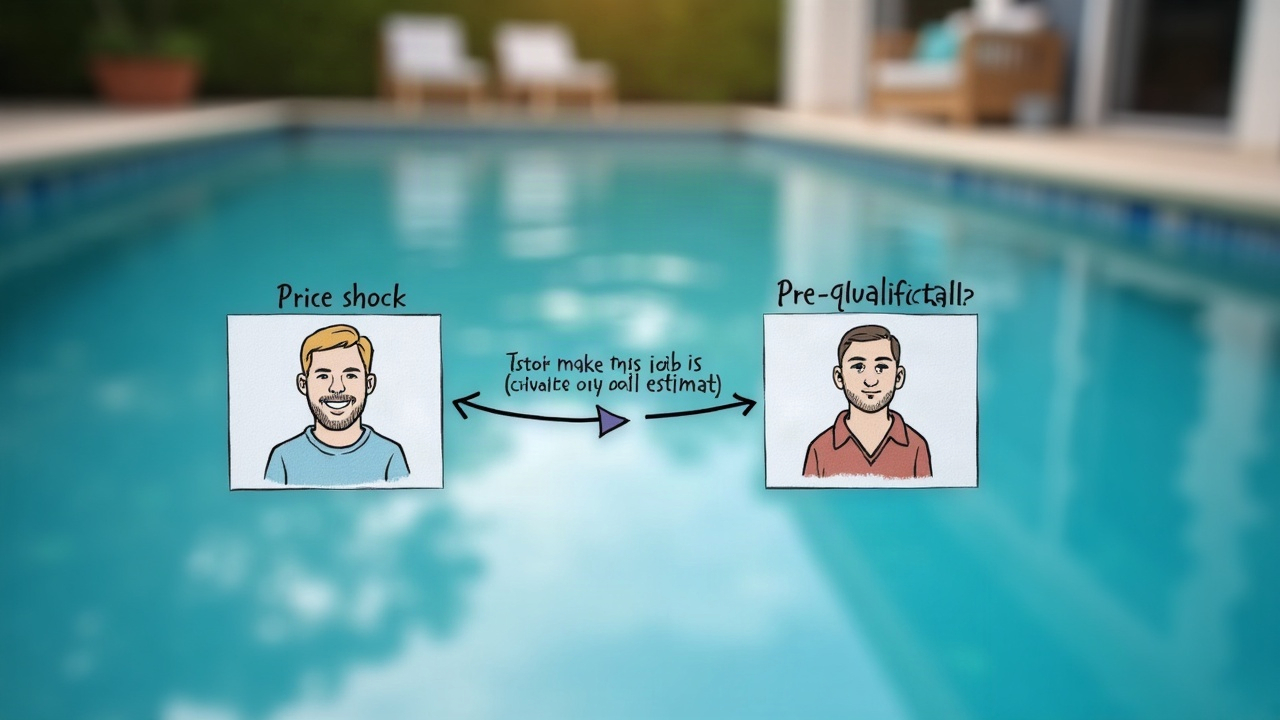
How Competitors Are Stealing Your Swimming Pool Financing Leads
Your smartest competitors restructured their entire sales process around financing pre-qualification. They're not better pool builders—they're better at converting expensive leads into funded projects. Here's exactly what they're doing differently, starting the moment a customer calls.
The First Call Sets the Buying Context
When a lead calls your competitor, the front office says: "Most of our customers finance pools between $35,000 and $75,000. Have you had a chance to think about your budget or whether you'd like to explore payment options?"
That question does three things. First, it anchors the price expectation high—no more "$20,000 will get me a pool, right?" Second, it normalizes financing so the customer doesn't feel embarrassed. Third, it identifies immediate disqualifiers: the customer who hangs up because they thought pools cost $15,000 was never going to buy, and you just saved 3 hours of estimate time.
According to InsideSales.com, leads contacted within 5 minutes are 21 times more likely to qualify than those contacted after 30 minutes. Your competitors are having the financing conversation during that first golden window—before the lead calls two other pool companies and gets confused by wildly different price ranges.
Pre-Approval Happens Before the Estimate Appointment
After the first call, your competitor sends the customer a financing application link via text. The customer completes a soft credit pull in 90 seconds—no impact to their credit score, instant pre-approval amount. Now the customer knows they're approved for $55,000 at 7.9% APR before you ever show up with a tape measure.
You show up with no pre-qualification. You present a $65,000 estimate. The customer's mental math starts: "Can we afford $600/month? What's our equity line rate? Should we wait and save up?" You've turned a buying decision into a financing research project.
Your competitor shows up to a customer who already knows they're approved. The estimate conversation focuses on features, timelines, and design—not affordability anxiety. The close rate difference is staggering: 58% versus 23% for the same quality of lead.
Payment Plans Are Framed as Options, Not Desperation
Here's a subtle but critical difference. When you bring up financing after the customer flinches at your price, it reads as a Hail Mary. "I can see that's higher than you expected—let me tell you about our financing options." You've just told the customer they can't afford you.
Your competitor discusses pool payment plans before price ever enters the conversation. "We work with three financing partners. Most customers choose the 12-month interest-free option for projects under $50K, or the 7-year term for larger builds. You're pre-approved for up to $60,000, so we can design within that range or discuss ways to phase the project." Financing isn't a consolation prize—it's the assumed buying method.
What Pre-Qualification Actually Looks Like in Practice
Pre-qualifying swimming pool financing leads isn't about running credit checks on every caller. It's about structuring your intake process so financing conversations happen naturally, early, and without sales pressure. The goal is information exchange, not application pressure.
The front office asks these questions during the initial call:
- Budget awareness: "Most inground pools in our area range from $40K to $80K depending on size and features. Does that align with what you were planning?"
- Payment preference: "Have you thought about whether you'd pay cash, use a home equity line, or explore financing options?"
- Financing interest: "If I could send you a quick pre-qualification link—no impact to your credit—would that be helpful before we schedule your estimate?"
These aren't hard-close questions. They're consultative. Roughly 60% of callers say "yes, send the link." Another 25% say "we're using equity/paying cash" and you note that in their file. The remaining 15% deflect, which tells you they're either very early in research or not financially ready—both scenarios where a 2-hour estimate appointment is premature.
After the call, the front office sends a text with the pre-qualification link. The customer enters basic information: name, income range, estimated credit score. The financing partner returns an instant pre-approval range. No hard credit pull. No commitment. Just information.
Now when you show up for the estimate, you know the customer is pre-approved for $65,000. You can confidently discuss features that fit that budget. You're not guessing whether they can afford the project—you're designing within known parameters.
The Revenue Math: Why This Matters More for Pool Companies
Pool installation has a unique economic problem: extremely high customer acquisition costs combined with long sales cycles. According to Bain & Company, acquiring a new customer costs 5-25 times more than closing repeat business, and in the pool industry—where customers buy once every 15-20 years—nearly every job is a new acquisition.
Your cost per lead for qualified pool inquiries runs $150-$400 depending on your market and lead source. A qualified estimate appointment—after you've screened out tire-kickers—costs you 3-4 hours of labor, drive time, and design work. You're $500-$700 into each estimate before you present a price.
If your close rate is 25%, you need four estimates to close one job. That's $2,000-$2,800 in sunk costs per closed project just for sales activity. If pre-qualification increases your close rate to 45%, you only need 2.2 estimates per close—cutting your customer acquisition cost nearly in half.
The math gets more dramatic when you consider average project value. If financing pre-qualification increases your close rate by 20 percentage points and your average pool job is $55,000, you need just two additional closes per year to add $110,000 in revenue. Most companies see 4-8 additional closes annually after implementing financing pre-qualification, representing $220K-$440K in otherwise-lost revenue.
Want to see how much revenue you're leaving on the table? Calculate your losses based on your current lead volume and close rate.
Real Example: How One Pool Company Recovered After Losing Five Straight Financing Jobs
A pool contractor in North Carolina—20 years in business, excellent reputation—lost five consecutive jobs in a six-week period in spring 2023. All five leads came from his website. All five seemed qualified. All five went with competitors who charged similar prices.
Frustrated, the owner called one of the lost customers and asked what happened. The customer was surprisingly candid: "Your competitor got us pre-approved for financing before they even came out. When you gave us the estimate, we had no idea if we could afford it. We felt stupid asking if you offered payment plans, like we couldn't afford it otherwise. The other company made it so easy—they just said 'you're approved for $60K, here's what that buys you.'"
The owner restructured his entire intake process. He started asking about financing during the first call. He partnered with two pool-specific lenders offering instant pre-qualification. He trained his wife—who handled the phones—on how to position financing as an option, not a red flag.
Within eight weeks, his close rate jumped from 22% to 41%. He closed seven jobs in May that previously would have ended in "we'll think about it" dead-ends. The financing conversation became his qualifier: customers who got pre-approved almost always moved forward; customers who refused to discuss budget almost never did, and he stopped wasting time on those estimates.
The competitor who beat him on those five jobs? That company had implemented financing pre-qualification two years earlier and built their entire sales process around it. They weren't better pool builders—they were better at removing the #1 obstacle between leads and closed contracts.
Implementing Pool Financing Pre-Qualification Without Adding Staff
You don't need to hire a financing coordinator or learn lending regulations to pre-qualify swimming pool financing leads. You need your front office—whoever answers the phone—to ask different questions and send one additional text message. The entire process adds 90 seconds to your intake call.
Here's the step-by-step implementation for a typical pool company:
- Partner with 1-2 pool financing providers. Look for companies offering instant pre-qualification, soft credit pulls, and approval rates above 70% for customers with 620+ credit scores. Ask your suppliers or industry association for referrals.
- Train your front office on the three financing questions. Write them on a script. Practice until they sound conversational, not scripted. The goal is normalizing the financing conversation, not pitching a loan.
- Set up automated text delivery. When a customer says "yes" to pre-qualification, your front office sends a pre-written text with the financing link. No manual follow-up needed.
- Track pre-qualification rate and close rate separately. Measure what percentage of leads agree to pre-qualify, and what percentage of pre-qualified leads close. This tells you if the problem is your intake conversation or your estimate process.
- Adjust your estimate approach based on financing status. When you show up to a pre-qualified customer, lead with "You're approved for $X—let's talk about what that builds." When you show up to a cash buyer, skip the financing talk entirely.
The most common mistake is treating this like a sales tactic rather than a qualification process. Pre-qualification isn't about pushing customers into debt—it's about identifying which leads have the financial means to move forward, so you stop spending time on tire-kickers and start closing more qualified buyers.
Why Most Pool Companies Will Never Fix This
Despite the revenue impact, most pool contractors won't implement financing pre-qualification. Not because it's complicated, but because it requires changing a process that's worked "well enough" for years. You've closed jobs without it before—why start now?
Here's why: your market is changing faster than your sales process. Ten years ago, customers called 2-3 pool companies and chose based on reputation and price. Today they call 5-7 companies, read reviews obsessively, and make financing decisions before they ever contact you. The competitors who acknowledge that reality early—and structure their intake process accordingly—are capturing a disproportionate share of high-ticket pool financing leads.
The companies that cling to "we'll discuss pricing and payment during the estimate" are watching their close rates decline year over year, blaming the economy or lead quality, and wondering why the same leads that ghost them are closing with competitors.
The difference isn't the quality of your pools. It's whether you're selling to informed, pre-qualified buyers or hoping to overcome price shock with sales skills.
Frequently Asked Questions
Should I pre-qualify every lead for pool financing, or only those who seem price-sensitive?
Pre-qualify everyone who isn't explicitly paying cash. You can't reliably identify "price-sensitive" leads during the first call—customers who seem wealthy may have cash flow issues, and working-class customers may have excellent credit and savings. Making financing conversation standard removes the stigma and catches opportunities you'd otherwise miss. The only leads you skip are those who volunteer they're paying cash upfront.
Won't offering financing make customers think my prices are too high?
The opposite is true. Not offering financing makes customers assume you only work with wealthy cash buyers, which shrinks your addressable market. Every major pool builder and national franchise offers financing—if you don't, you look small-time or out-of-touch. Financing is an expected option for any purchase over $20,000, not a signal of inflated pricing.
What if the customer gets pre-approved for less than my typical project cost?
This is valuable information that saves you from wasting an estimate appointment. If they're approved for $35,000 and your minimum inground pool is $50,000, you can have that conversation over the phone: "Our typical range starts higher than your approval amount—would you like to explore above-ground options, or would you prefer to save up and revisit this next year?" You've just saved 3 hours and maintained goodwill by being honest early.
How do I bring up financing without sounding like I'm questioning their ability to pay?
Frame it as standard procedure, not a judgment. Say: "Most of our customers use financing for pools in the $40K-$80K range—would it be helpful if I sent you a quick pre-qualification link before your estimate? It's a soft credit check, so no impact to your score, and it helps us design within your comfortable budget." You're offering help, not interrogating their finances.
What approval rate should I expect from pool financing partners?
Quality pool financing companies report 70-85% approval rates for customers with credit scores above 620. If your partner's approval rate is below 60%, they're either too strict or you're not pre-screening leads at all. Ask potential financing partners for their approval rate by credit tier before partnering—this tells you if they're realistic for your customer base.
Should I work with one financing company or offer multiple options?
Offer 2-3 options covering different credit tiers and term lengths. One lender for prime credit customers (680+), one for near-prime (620-680), and optionally one for promotional periods like 0% for 12 months. This increases your approval rate and gives customers legitimate choice. Don't offer more than three—too many options creates decision paralysis.
Stop Losing High-Ticket Pool Jobs to Competitors Who Qualify First
You're already spending $150-$400 per swimming pool financing lead and 3-4 hours per estimate appointment. Pre-qualifying customers for pool financing options before the estimate doesn't add meaningful cost—it just redirects effort toward leads that can actually close. The alternative is continuing to present $60,000 estimates to customers who haven't thought past "$30,000 seems reasonable," then wondering why your close rate hovers at 20% while competitors close 40-50% of similar leads.
The revenue opportunity is immediate. If you're running 8 estimates per month at a 25% close rate, increasing to 40% by pre-qualifying financing adds 1.2 closed jobs monthly—$15,000 to $25,000 in additional monthly revenue with zero increase in marketing spend. You're already getting the leads. You're already doing the work. The only change is asking three questions during the intake call and sending one text message.
If your current front office can't handle financing pre-qualification because nobody's available to answer the phone, Book All Leads provides a complete team trained to qualify, book, and pre-screen swimming pool financing leads before they ever reach you. Learn more about how a full front office team can transform your intake process.
John Edmonds is a native Texan and military combat veteran. He founded Book All Leads after identifying a critical gap in the service industry: business owners losing revenue not from lack of skill, but because no one was handling the calls, follow-ups, reviews, and payments while they were busy doing the work.
View LinkedIn Profile →