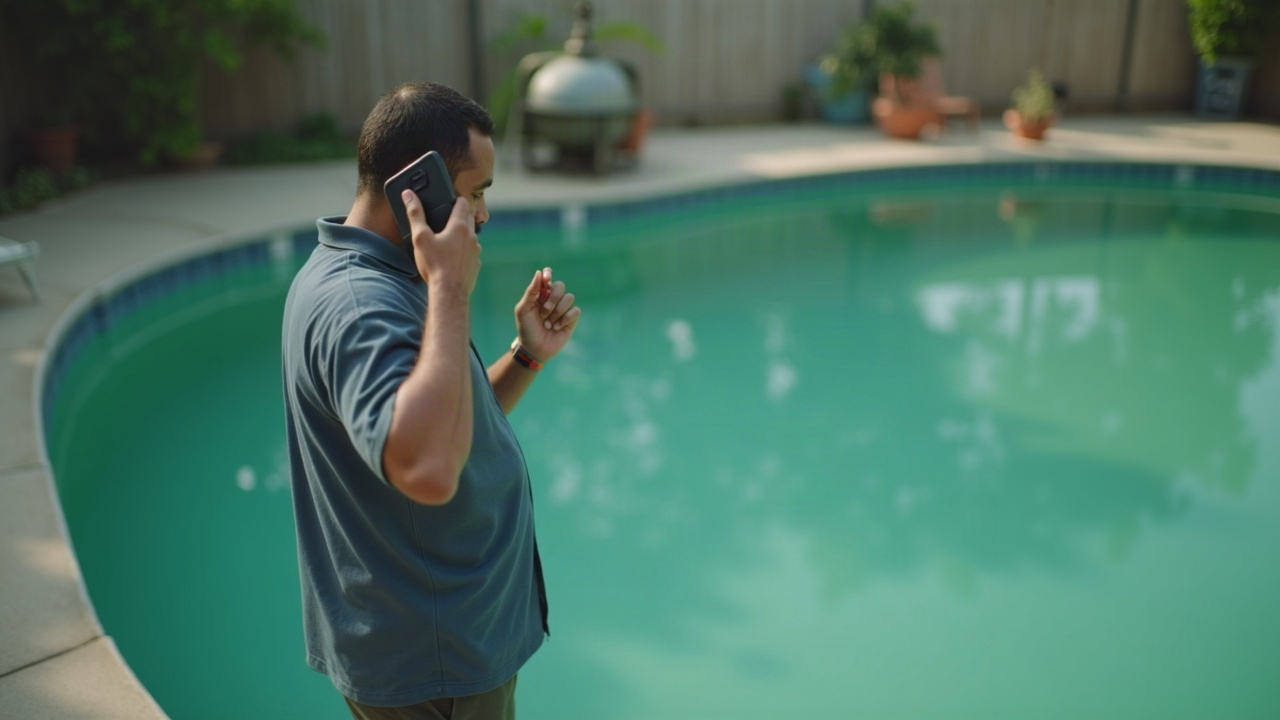
Swimming pool repair response time determines who books the job. When a pool owner calls about a broken pump or cloudy water at 6 PM on a Thursday, they're calling the next three companies on their list until someone picks up. The pool company with the fastest swimming pool repair response doesn't just win that call—they win the $800 repair job, the seasonal maintenance contract, and every referral that follows. Miss the call by five minutes, and you've lost to the competitor who answered on ring two.
Pool emergencies don't wait for business hours. A pump failure on Friday afternoon means a green swamp by Monday morning. A leak discovered Saturday means rising water bills and foundation concerns. These aren't courtesy calls—they're distress signals from homeowners who need help now and will hire whoever responds first.
The difference between a booked calendar and a voicemail full of missed opportunities isn't your technical skill or your pricing. It's whether someone answered the phone when it rang.
## Why Do Pool Repair Calls Go to the First Company That Answers?Pool repair calls go to the first company that answers because homeowners are in crisis mode, not comparison-shopping mode. When a pool pump stops working before a weekend party or algae blooms overnight, the pool owner isn't building a spreadsheet of quotes—they're frantically dialing numbers until a human voice says "we can help." According to InsideSales.com, calling a lead back within five minutes makes you 21 times more likely to qualify that lead than waiting 30 minutes. In pool repair, that window is even tighter.
Here's the typical sequence: A homeowner discovers their pool is green on Thursday evening. They Google "pool repair near me" and start calling. The first company goes to voicemail. The second goes to voicemail. The third company—your competitor—picks up on ring two, expresses concern, and books a visit for Friday morning. By the time you return the first homeowner's call Friday at 9 AM, they've already got someone scheduled. Your callback gets a polite "we're all set, thanks."
Pool owners aren't loyal to companies they've never worked with. They're loyal to whoever solved their immediate problem. The repair call is your audition. Miss it, and you don't get a second chance.
Here's what most articles won't tell you: The homeowner who reaches your voicemail doesn't leave a message and wait patiently. They hang up within 8 seconds and dial the next number. You're not competing against their patience—you're competing against the dial button. Every ring you don't answer is a ring your competitor does.
### What Makes Pool Repairs More Urgent Than Regular Maintenance?Pool repairs carry financial and social urgency that routine maintenance doesn't. A missed cleaning appointment is an inconvenience. A broken pump before a birthday party is a crisis. Homeowners will wait three days for a weekly service visit, but they need a repair technician today because:
- Equipment failures cascade quickly — A failing pump means stagnant water, which breeds algae within 24-48 hours
- Visible problems create embarrassment — Neighbors see the green pool, and upcoming events get canceled
- Damage costs compound daily — Leaks waste hundreds of gallons, running up water bills and risking structural damage
- Summer creates scarcity — Peak season means every pool company is busy, amplifying the fear of "what if nobody can come?"
This urgency makes pool owners willing to pay premium rates for immediate response. The $450 pump repair becomes $650 for same-day service, and they'll gladly pay it. But only if you answer the phone first.
## What Happens When Pool Companies Miss Repair Calls?When pool companies miss repair calls, they lose both the immediate job and the lifetime value of that customer relationship. A missed call isn't just a lost $800 repair—it's a lost $3,200 annual maintenance contract, lost referrals to three neighbors with pools, and a lost opening and closing service package. The homeowner who couldn't reach you becomes someone else's recurring revenue.
Here's a real example: A Phoenix pool company owner we spoke with tracked his missed calls for two weeks in June. He counted 43 calls that went to voicemail during evenings and weekends. He returned 41 of them within 12 hours. Only 5 converted to booked jobs. The rest had already hired someone else. At an average repair ticket of $750, those 36 missed opportunities represented $27,000 in lost revenue in two weeks alone.
The math gets worse when you factor in repeat business. According to Harvard Business Review, acquiring a new customer costs five times more than retaining an existing one, and existing customers spend 67% more than new ones. Every missed repair call closes the door on years of potential revenue.
But there's a hidden cost beyond the spreadsheet: reputation damage. The homeowner who reaches your voicemail three times stops seeing you as "busy" and starts seeing you as "unreliable." They won't call back for seasonal opening next spring. They won't refer you to their neighbor. They'll scroll past your name in search results, remembering the frustration of needing help and hearing silence.

Pool companies need to answer repair calls within three rings or risk losing the job to the next name on the list. Speed-to-answer isn't about courtesy—it's about conversion. Research from Vendasta shows that 80% of callers sent to voicemail won't leave a message, and 85% of those who do won't call back. In pool repair, where urgency is high and alternatives are plentiful, those percentages climb even higher.
The competitive window is brutal: You're not competing against "eventually answering." You're competing against the company that picks up right now. A homeowner with a broken pool heater in April (prime opening season) will call five companies in 15 minutes. The first one that answers, sounds competent, and offers a same-day or next-day visit wins. The other four get nothing.
Your pool service phone answering standard should be:
- Ring 1-3: Phone answered by a live person who knows your services and pricing
- Seconds 4-30: Caller's problem understood, urgency acknowledged, confidence expressed
- Minute 1-2: Appointment time offered (ideally same-day or next-morning), contact details captured
- Minute 2-3: Service expectations set, callback promised if schedule shifts, caller feels heard
This timeline isn't aspirational. It's table stakes. Your competitors are already doing it, which is why your voicemail box fills up with hangups instead of messages.
### Why Can't Pool Company Owners Answer Every Call Themselves?Pool company owners can't answer every call themselves because they're physically doing the work that generates revenue. You're balancing pool chemistry at a commercial property when a residential repair call comes in. You're diagnosing a heater issue with your hands full of tools when another phone rings. You're driving between job sites when three calls come in within ten minutes.
The Bureau of Labor Statistics reports that there are approximately 65,000 pool service technicians working in the United States, and the majority work for companies with fewer than 10 employees. In businesses this small, the owner is often the lead technician, the estimator, and the dispatcher—all roles that require focus and both hands.
Stopping mid-repair to handle pool repair call handling means:
- The current customer watches you prioritize someone else
- The caller hears background noise and gets a distracted, rushed conversation
- You don't have your calendar, pricing, or job details in front of you
- Critical details get forgotten between "I'll call you back" and actually calling back
You end up doing two jobs poorly instead of one job well. The repair you're on takes longer. The caller doesn't get the confident, detail-oriented service they need to feel comfortable booking. Both experiences suffer.
## What's the Fix for Pool Companies That Miss Too Many Repair Calls?The fix for pool companies missing repair calls is having a dedicated front office team that answers every call live, books jobs immediately, and follows your pricing and scheduling rules without needing your involvement. This isn't about voicemail transcription or appointment reminder software—it's about having real people who represent your business professionally the moment the phone rings, whether that's Tuesday at 2 PM or Saturday at 6 PM.
Book All Leads operates as your complete front office—six roles working around the clock to answer calls, qualify leads, book appointments, send confirmations, follow up with no-shows, and collect payments. You don't manage software or train AI. You get a team that learns your business, handles your calls like they've worked for you for years, and goes live in five days. No contracts. No learning curve. Just a phone number that always gets answered by someone who knows what a variable speed pump costs and when your next opening is.
For pool companies, this means a homeowner calling about a green pool at 7 PM on Friday hears a knowledgeable voice that says, "We can have someone there tomorrow morning at 9. Does that work?" while you're finishing up your last service call of the day. The job books itself. You show up to the address. The payment processes automatically. You never touched your phone.
### What Should Happen When a Pool Repair Call Comes In?When a pool repair call comes in, the person answering should immediately acknowledge the urgency, ask qualifying questions about the problem, check real-time availability, quote an accurate price range, and book the appointment before the call ends. The entire interaction should feel like talking to your most competent office manager—someone who knows your business, cares about the outcome, and has the authority to make decisions.
Here's the ideal call flow:
- "Thanks for calling [Company Name], this is [Name]. What's going on with your pool?" — Opens with empathy and immediately focuses on their problem
- "That sounds frustrating. How long has this been happening?" — Gathers diagnostic information that helps the technician prepare
- "We can get someone out there tomorrow at 10 AM or 2 PM. Which works better?" — Offers specific times, not vague "we'll call you back"
- "The service call is $89, and if it's the pump motor like you described, that repair typically runs $450-$650 depending on the model. We'll know exactly once our technician sees it." — Sets pricing expectations so there are no surprises
- "I'm texting you the confirmation now with our technician's name and photo. You'll get a heads-up when he's 15 minutes away." — Establishes next steps and reduces no-show anxiety
This conversation takes three minutes and converts 80%+ of callers into booked appointments because it sounds like someone who gives a damn and knows what they're doing.

Pool companies lose thousands of dollars per month to missed calls, and most owners drastically underestimate the scale. To calculate your losses, multiply your missed calls by your average repair ticket, then factor in the lifetime value of seasonal contracts those one-time callers would have become. A single missed call isn't worth $750—it's worth $750 now, plus $1,200 in annual maintenance, plus $600 in opening and closing services, plus referrals. Over three years, one missed call costs you $5,000+.
Let's use a conservative example: A pool service company in Florida gets 60 inbound calls per month during peak season (April-August). If 30% go to voicemail (18 calls), and 80% of those don't convert because they hired someone else (14 lost jobs), and the average repair ticket is $700, that's $9,800 in lost revenue per month. Over a five-month season, that's $49,000 that walked away because nobody answered the phone.
| Metric | Conservative | Typical | Busy Season |
|---|---|---|---|
| Monthly Inbound Calls | 40 | 60 | 90 |
| Calls to Voicemail (%) | 25% | 30% | 40% |
| Voicemail Calls Lost | 10 | 18 | 36 |
| Avg Repair Ticket | $650 | $750 | $850 |
| Monthly Lost Revenue | $6,500 | $13,500 | $30,600 |
These numbers don't include the long-tail value. A homeowner who hires you for a $700 pump repair often becomes a $1,200/year maintenance customer. Lose 14 repair calls per month, and you're not just losing $9,800—you're losing $16,800 in first-year revenue and compounding losses every year after.
### How Do Missed Calls Affect Pool Company Reputation?Missed calls damage pool company reputation in ways that don't show up in revenue reports immediately but erode your market position over time. Every voicemail you don't return becomes a one-star Google review that starts with "I called three times and never heard back." Every homeowner who reaches your competitor instead tells their neighbor "don't bother with [Your Company]—they never answer." You lose visibility in the algorithm, lose position in local search, and lose the referrals that used to fill your shoulder season.
Online reviews increasingly mention responsiveness as a deciding factor. A pool owner choosing between two companies with similar ratings will pick the one whose reviews say "picked up immediately" over the one whose reviews say "great service once you finally reach them." That urgency bias means even your best technical work gets overshadowed by your front-office failures.
## Why Voicemail and Callback Systems Don't Work for Pool RepairsVoicemail and callback systems don't work for pool repairs because urgency and anxiety drive pool owners to keep calling until they reach a human, not wait patiently for a return call. The homeowner staring at a green pool doesn't want to leave a message and hope—they want reassurance right now that help is coming. A voicemail greeting that says "leave a message and we'll call you back within 24 hours" might as well say "call someone else."
Automated callback systems create the same problem with a different interface. A text that says "we received your call and will respond soon" doesn't answer the homeowner's core question: When can someone fix my pool? They're left in limbo, still anxious, still scrolling through search results, still one click away from calling your competitor.
Even callbacks within an hour often fail because the window has closed. The homeowner called four companies in 15 minutes. The one that answered live and booked an appointment got the job. When you call back 45 minutes later, they're polite but firm: "Thanks, but we're all set." You were fast by most standards. You were too slow by pool repair standards.
The only "system" that works is a human answering the phone while it's ringing and booking the job before the caller hangs up. Anything else is a delay, and delays lose jobs.
## What Should Pool Companies Look for in a Front Office Team?Pool companies should look for a front office team that understands the technical details of pool service, can quote pricing confidently, books appointments with authority, and operates after-hours when most repair calls happen. The team should feel like an extension of your business—not a generic call center reading scripts, but knowledgeable representatives who know the difference between a cartridge filter and a DE filter, and why a green pool needs a technician visit while a loose skimmer basket doesn't.
Key capabilities that matter:
- Technical fluency: Can answer basic diagnostic questions (pump not priming, cloudy water, algae bloom) and know when to escalate
- Pricing authority: Can quote service call fees, common repair costs, and seasonal packages without "I'll have to check and call you back"
- Real-time scheduling: Sees your actual calendar and books appointments into open slots instantly
- After-hours coverage: Answers calls at 6 PM on Friday and 9 AM on Sunday—when most pool emergencies happen
- Follow-through: Sends confirmations, reschedules no-shows, follows up on estimates, and collects payments without your involvement
Most importantly, the team should reduce your workload, not add to it. You shouldn't spend time training them on software, reviewing call recordings, or manually updating schedules. They should plug into your business, learn your preferences, and handle the entire front office while you stay focused on the work that actually requires your expertise.
## Frequently Asked Questions About Pool Repair Call HandlingHow many pool repair calls do companies typically miss each month?
Pool companies typically miss 20-40% of inbound calls depending on season and staffing. During peak months (May-August), that often translates to 15-30 missed calls per month for a solo operator or small team. Most misses happen after 5 PM, on weekends, and during the morning rush when technicians are loading equipment and can't stop to answer.
What's the average value of a pool repair call?
The average pool repair call ranges from $450-$850 depending on the issue and region. Pump repairs typically run $500-$700, heater repairs $600-$1,200, and leak detection $400-$800. Emergency or after-hours service often commands a 20-30% premium, making those missed evening and weekend calls even more costly.
Do pool customers really hire the first company that answers?
Yes. In pool repair situations—especially equipment failures and water quality emergencies—homeowners are in crisis mode and will hire the first competent-sounding company that can come out quickly. They're not comparison shopping or waiting for multiple quotes. They want the problem solved today, and whoever picks up first and offers a same-day or next-day visit wins the job.
Can a pool company owner handle calls between jobs?
Pool company owners can physically answer calls between jobs, but the quality of those conversations suffers. You're rushed, distracted, often don't have access to your calendar or pricing details, and the customer can hear the chaos in the background. You end up saying "I'll call you back" more often than booking the job, which gives them time to call your competitor who has a dedicated person answering calmly and booking immediately.
What happens to pool customers who reach voicemail?
Pool customers who reach voicemail rarely wait for a callback. About 80% hang up and immediately call the next company on their list. Of the 20% who leave a message, only 15% will still be available when you call back—the rest have already booked with a competitor. Voicemail isn't a pause button; it's a fast-forward to your competitor's phone ringing.
How quickly do pool companies need to return missed calls?
Pool companies need to return missed calls within 5 minutes to have a realistic chance of booking the job. After 30 minutes, your conversion rate drops by over 80% because the caller has already spoken with other companies and likely scheduled service. By the next business day, you're essentially calling to confirm they hired someone else. Speed-to-callback is nearly as important as speed-to-answer.
Your technical skills aren't the problem. Your pricing isn't the problem. Your reputation isn't the problem. The problem is that pool owners in crisis call the company that answers first, and if that's not you, it's revenue walking out the door every single day.
You didn't start a pool service company to sit by the phone. You started it because you're good at fixing pumps, balancing chemistry, and solving problems that other techs can't figure out. But none of that expertise matters if you never get the chance to show up.
A front office team that answers every call, books every qualified lead, and handles the entire customer experience from first ring to final payment means you stay focused on the work only you can do—while your calendar fills itself with jobs that used to go to voicemail.
If you're ready to stop losing repair calls to competitors who just happened to pick up faster, Book All Leads gives you a full front office team that goes live in five days. No software to learn. No contracts. Just a phone that always gets answered by someone who knows your business and books the job before the caller hangs up.
John Edmonds is a native Texan and military combat veteran. He founded Book All Leads after identifying a critical gap in the service industry: business owners losing revenue not from lack of skill, but because no one was handling the calls, follow-ups, reviews, and payments while they were busy doing the work.
View LinkedIn Profile →