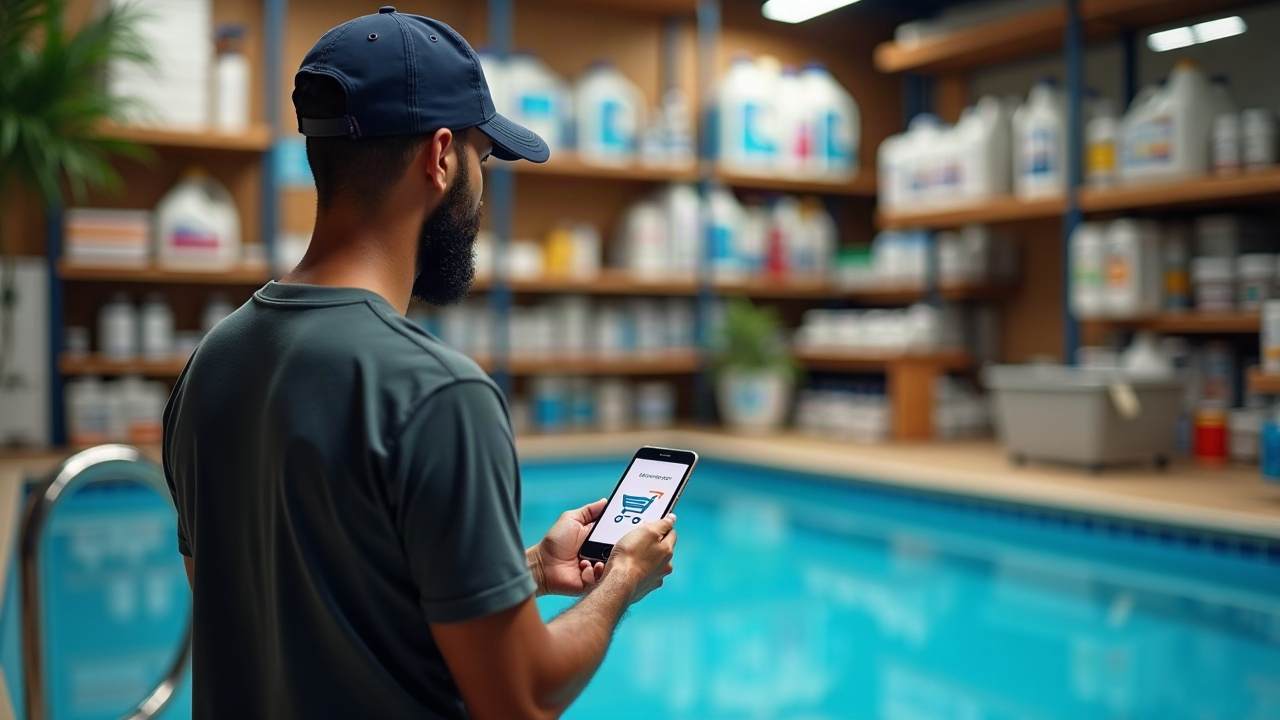
Swimming pool retail competition has intensified as online retailers like Amazon, Leslie's, and Swim University dominate the pool chemical and supply market with lower prices and 24/7 ordering. Local pool companies lose thousands in annual retail revenue not because their prices can't compete, but because they fail to convert service calls into retail visits, miss phone inquiries about products, and offer no convenient path for customers to get expert advice when they need it most—right before they buy.
Why Pool Owners Choose Online Stores Over Your Retail Counter
Pool owners default to online purchases because your retail counter isn't available when they need it. Most pool chemical emergencies happen evenings and weekends—a green pool on Friday night before a Saturday party, cloudy water Sunday morning. When they call your store at 6 PM or Saturday afternoon and get voicemail, they open their Amazon app and order within minutes.
The price difference isn't as significant as you think. Pool owners will pay 15-20% more for immediate expert guidance and same-day pickup. What they won't do is wait until Tuesday morning to ask a question about balancing pH when their pool looks like a swamp and guests arrive in 18 hours.
According to InsideSales.com, businesses that respond to inquiries within five minutes are 100 times more likely to convert than those responding after 30 minutes. In pool retail, that window is even tighter. A pool owner researching chlorine options will visit three websites, call two stores, and buy from whichever responds first with a confident answer.
Here's what most articles won't tell you: You're not losing pool supply sales to better prices—you're losing them to better availability. Online stores don't close. Their "add to cart" button works at 11 PM. Their product pages answer basic questions instantly. Your expertise is superior, but it's locked behind business hours and an understaffed phone line.
The Hidden Cost of Missed Retail Calls
Every unanswered call about pool chemicals represents $60-180 in immediate lost revenue and $400-600 in annual customer value. Pool owners who buy chemicals from you once typically return 6-8 times per season. Miss that first call, and you've lost the entire relationship to an online competitor.
Most pool companies don't track retail inquiry calls separately from service calls. They see a missed call log and assume it was someone asking about pool cleaning. But analyze your voicemail transcripts and you'll find 30-40% are product questions: "Do you carry stabilizer?" "What's the best algaecide for mustard algae?" "Can I pick up shock today?"
Each of these callers is standing in their backyard, looking at a problem, ready to buy right now. When you don't answer, they don't leave a voicemail and wait patiently. They order online before they walk back inside.
How Your Service Business Accidentally Kills Retail Revenue
Your service techs are your best retail sales team, but most pool companies never activate this advantage. When a tech services a pool, tests water, and recommends a chemical adjustment, that's a perfect retail moment. But if the process to actually buy those chemicals requires the homeowner to call the office, get transferred, ask about inventory, arrange pickup, and drive across town during business hours—they'll just order online.
The same technician who diagnosed the problem could take payment and arrange delivery of the chemicals on the spot. Or at minimum, your front office should immediately call the homeowner after the service visit to confirm they want the recommended chemicals delivered with the next service or available for pickup today.
This rarely happens because your office team is overwhelmed answering new service calls, rescheduling appointments, and handling billing issues. Proactive retail follow-up gets deprioritized every single time.
Many pool companies face this exact bottleneck—too many revenue opportunities buried under operational chaos. Book All Leads provides a full front office team that answers every call live, books service appointments, and—critically for retail revenue—follows up on technician recommendations immediately while the customer is still thinking about their pool problem. No software for you to learn. Your team just handles it, live in five days.
Why "Stop By Anytime" Doesn't Work Anymore
The casual retail model—"we're open 9-5, stop by if you need chemicals"—worked when pool owners planned their chemical purchases around errands. That behavior has vanished. Modern pool owners don't run errands; they order online during commercial breaks.
Your retail space needs appointment-driven traffic. Water testing appointments. Seasonal pool opening consultations. Equipment upgrade assessments. These are bookable, scheduled reasons for customers to visit your store, where impulse purchases and expert upselling happen naturally.
What Actually Drives Pool Owners Back to Local Retail Stores
Local pool retailers reclaim market share by making expertise bookable and immediately accessible. When a pool owner can call at 7 PM and reach a real person who books them for a free water test tomorrow morning at 10 AM, you've created a path to the retail counter that online stores cannot match. That face-to-face interaction typically generates $120-200 in chemical and accessory sales, plus builds the relationship for future purchases.
Free water testing has always been a pool retail staple, but most stores handle it passively—"bring a sample whenever we're open." The winners treat it like an appointment-based service. They answer calls after hours, book specific time slots, confirm via text, and follow up if the customer no-shows. This structure converts 4-5 times better than walk-in-only models.
According to research from Bain & Company, increasing customer retention by just 5% can increase profits by 25% to 95%. In pool retail, retention means capturing repeat chemical purchases throughout the season. One water test appointment can generate six follow-up retail visits if you execute the relationship properly.
The Service-to-Retail Conversion Path That Works
Top-performing pool companies build a structured handoff from service to retail. Here's the exact sequence:
- During the service visit: Technician tests water, notes what's needed, and tells the homeowner "our office will call you this afternoon about getting these chemicals"
- Within 2 hours: Office calls with specific product recommendations, pricing, and offers same-day pickup or next-service delivery
- Immediate booking: If customer chooses pickup, office books a specific pickup window and sends confirmation
- 48-hour follow-up: If customer doesn't commit, office follows up once more before the opportunity goes cold
This process converts 60-70% of service-identified chemical needs into retail sales. Without the process, conversion drops below 20% because the busy homeowner defaults to ordering online later that evening.
Why Pool Equipment Retail Requires a Different Strategy
Pool equipment purchases—pumps, filters, heaters, cleaners—follow a different decision path than chemicals. These are higher-ticket, infrequent purchases where homeowners research extensively and price-shop aggressively. You won't win these sales with phone availability alone; you need consultative appointments and installation bundling that online retailers can't provide.
The key is responding immediately when a homeowner calls about equipment. They're comparing three local companies and two online options. Whoever books an in-home assessment first usually wins the sale. According to InsideSales.com, the first company to respond to a service inquiry wins the business 35-50% of the time, regardless of price.
Your front office needs to treat equipment inquiry calls as emergency responses. Immediate answer. Immediate booking. Confirmation within minutes. If your current team answers these calls three hours later because they were busy with other tasks, you're losing $3,000-8,000 equipment sales to faster competitors.
The Installation Advantage Online Stores Can't Touch
Equipment sales die online when homeowners realize they need professional installation. A $1,200 pump becomes a $2,000 project when they factor in electrician and plumber costs. Your bundled pricing—equipment plus installation—often competes favorably with DIY online purchases once homeowners do the real math.
But you have to surface this advantage during the first conversation. When a homeowner calls asking about pump prices, your team should immediately offer "let me book you for a free assessment where we'll measure your setup and give you an exact installed price." That appointment has a 40-50% close rate. A phone quote has a 10-15% close rate.
How to Calculate What Pool Retail Competition Is Actually Costing You
Most pool companies guess at their retail revenue loss but never quantify it. Here's the formula: Count your active service customers. Multiply by $400 (conservative annual chemical spend per pool). That's your potential captive retail market. Now look at your actual retail sales to existing service customers. The gap is what online stores are taking from you.
For a pool service company with 200 active accounts, that's $80,000 in potential retail revenue. If your actual retail sales to those customers totals $25,000, you're losing $55,000 annually to online competitors. You can calculate your losses based on your specific customer count and current retail penetration.
The next question is why. Pull your call logs and identify how many retail-related calls you missed or answered after a delay. Check your voicemail for product inquiries that never got callbacks. Review your service tickets for technician recommendations that didn't convert to retail sales. These operational gaps are where the $55,000 leaked out.

Real-World Example: How One Pool Company Reclaimed $73,000 in Annual Retail Sales
A Florida-based pool service company with 180 active accounts was generating just $22,000 annually in retail chemical sales—mostly walk-ins from nearby neighborhoods. They knew they were losing sales but blamed online pricing. When they analyzed their missed calls, they discovered they were missing 40% of after-hours calls, and 60% of daytime calls went to voicemail when the office manager was helping walk-in customers.
They implemented three changes: extended phone coverage to 8 PM on weekdays, added a structured technician-to-retail handoff process, and started proactively booking water testing appointments after every service visit where water chemistry was discussed.
Within four months, retail sales to existing service customers increased to $58,000 annually. By month nine, they hit $95,000—an increase of $73,000 compared to the prior year. The owner attributed 60% of the gain to simply answering the phone reliably and booking appointments immediately. The remaining 40% came from the structured service-to-retail handoff that turned technician recommendations into same-day retail sales.
Their cost to achieve this was one part-time evening phone person and the discipline to follow the new process. The ROI was immediate and compounding—once customers bought chemicals in-store once, they defaulted to calling the store first for future needs.
Why "We're Too Busy" Is Costing You Six Figures
The most common objection to improving retail phone coverage is "we're already overwhelmed—we can't add more to our plate." This mindset misunderstands the problem. You're overwhelmed because you're manually handling repetitive booking and inquiry tasks that generate inconsistent revenue. Meanwhile, high-value retail opportunities slip through because no one has capacity to pursue them.
Retail revenue is the highest-margin income in your business. Chemicals and supplies typically carry 40-50% gross margins compared to 20-30% for service labor after you factor in drive time, wages, and vehicle costs. Every retail call you miss is a miss on your most profitable revenue stream.
The solution isn't working harder—it's ensuring every customer interaction that could generate retail revenue actually gets handled. When calls get answered live every time, water tests get booked immediately, and service recommendations convert to retail sales the same day, your revenue increases without adding trucks or technicians.

The Operational Changes That Stop Retail Revenue Leakage
Winning back pool supply sales from online competitors requires operational changes, not marketing campaigns. Here are the specific fixes that generate measurable retail revenue increases:
Answer Every Call Live, Especially After 5 PM
Extend your phone coverage to match when pool owners actually think about their pools—evenings and weekends. Hire a part-time evening person, use a call overflow service, or bring in a dedicated front office team. The goal is zero missed calls during peak inquiry hours (4-8 PM weekdays, Saturday mornings).
Make Water Testing Appointment-Based
Stop treating water testing as a walk-in service. Book specific 15-minute time slots. Confirm appointments via text. Follow up with no-shows. This structure ensures customers arrive when you're ready to spend time with them, dramatically increasing chemical sales per visit.
Create a 2-Hour Service-to-Retail Handoff Rule
When a technician identifies a chemical or equipment need during a service visit, your office must contact the homeowner within 2 hours with specific product recommendations and purchase options. This tiny operational tweak converts 3x more service observations into retail sales.
Track Retail Inquiry Calls Separately
Tag calls in your system as service requests vs. retail inquiries. Measure how many retail calls you receive, how many you answer live, and how many convert to sales. You can't improve what you don't measure. Most pool companies discover they're getting 30-50 retail inquiry calls per month they never properly tracked or converted.
Offer Same-Day Pickup Windows
When a customer commits to a chemical purchase over the phone, offer specific pickup windows: "I can have this ready for you today between 3-5 PM or tomorrow morning 9-11 AM." This structure reduces no-shows and creates urgency that competes with two-day Amazon shipping.
Frequently Asked Questions
Can local pool stores really compete with Amazon prices on chemicals?
Yes, but not on price alone. Pool owners will pay 10-20% more for same-day availability, expert advice, and correct product selection. The key is being available when they need help—evenings and weekends—and making pickup more convenient than waiting for delivery. Bundle water testing with chemical purchases and your value proposition beats online stores easily.
How many retail calls does the average pool company miss?
Most pool service companies miss 35-45% of calls during business hours when staff are helping walk-in customers, out on service routes, or handling other tasks. After-hours and weekend missed call rates often exceed 90%. Each missed retail inquiry call represents $60-180 in immediate lost revenue.
What's the best way to convert service customers into retail customers?
Create a structured handoff process where technicians identify needs during service visits, and your office follows up within 2 hours with specific product recommendations and purchase options (same-day pickup or next-service delivery). This process converts 60-70% of identified needs into retail sales versus under 20% with passive "stop by if you want" approaches.
Should pool companies focus on chemical sales or equipment sales to compete with online retailers?
Both, but with different strategies. Chemicals are repeat-purchase, relationship-driven sales won by phone availability and convenient water testing appointments. Equipment sales are higher-ticket, consultation-driven sales won by immediate response to inquiries and bundled installation pricing. Chemicals provide steady margin; equipment provides periodic large wins.
How long does it take to see retail revenue increase after improving phone coverage?
Most pool companies see measurable retail revenue increases within 30-60 days of implementing live call answering and appointment-based water testing. The compound effect builds over 6-12 months as more service customers shift their purchasing loyalty from online stores back to you. Expect 40-70% retail revenue increases in year one with consistent execution.
What profit margin should pool retail sales generate?
Pool chemicals and supplies typically generate 40-50% gross margins, making them significantly more profitable than service labor (20-30% margins after labor, drive time, and vehicle costs). Equipment sales vary widely—20-35% on popular items, up to 50% on specialty products. Retail revenue is your highest-margin income stream, which is why every missed retail call hurts so much.
Stop Losing Retail Revenue to Online Stores—Starting This Week
Swimming pool retail competition isn't about matching Amazon's prices—it's about being available when your customers need you and making expert advice easily accessible. Every unanswered evening call, every missed water testing opportunity, every service recommendation that doesn't convert to a retail sale is revenue walking straight to an online competitor.
The fix is operational, not aspirational. Answer calls live. Book water testing appointments immediately. Follow up on technician recommendations within hours. Track retail inquiries separately so you can measure what you're capturing versus missing.
Your expertise, local inventory, and same-day availability are genuine competitive advantages. But advantages don't generate revenue unless customers can access them reliably. If you're ready to reclaim the retail revenue your service business should naturally generate, Book All Leads provides a complete front office team that answers every call, books every appointment, and converts service relationships into retail loyalty—live in five days, no contracts, no software for you to learn.
John Edmonds is a native Texan and military combat veteran. He founded Book All Leads after identifying a critical gap in the service industry: business owners losing revenue not from lack of skill, but because no one was handling the calls, follow-ups, reviews, and payments while they were busy doing the work.
View LinkedIn Profile →