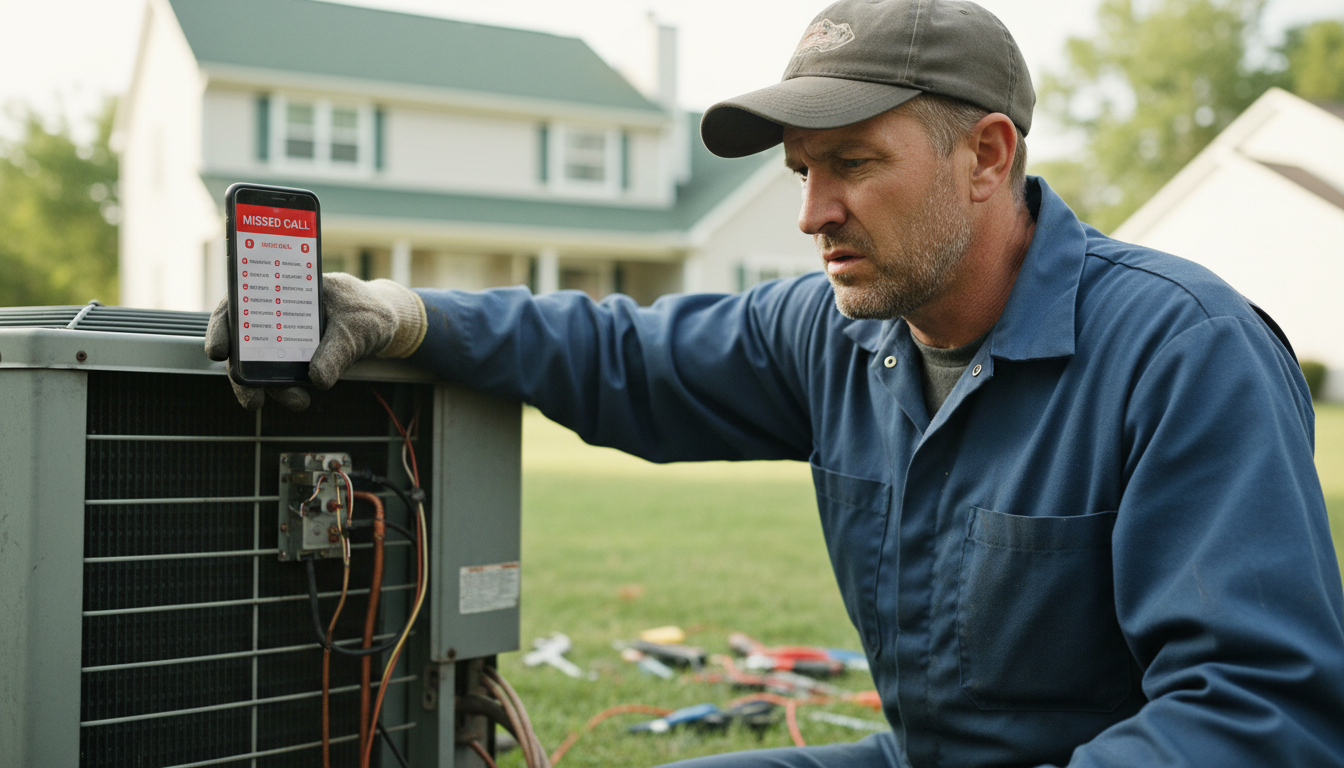
The cost of HVAC missed calls adds up faster than most contractors realize. Every unanswered call represents an average of $300–$800 in lost revenue per job, and according to BIA/Kelsey, 85% of callers who don't reach a live person won't call back. For a busy HVAC company missing just 5–10 calls per week, that's $78,000–$416,000 in revenue walking out the door every year. The real damage goes beyond the immediate lost job—it's the customer who becomes loyal to whoever did answer, the emergency service call at premium rates that went to your competitor, and the compound effect of lost referrals you'll never even know about.
Why HVAC Companies Miss More Calls Than Most Businesses
HVAC contractors miss calls because they're physically unreachable during the exact moments customers need them most. You're in an attic running ductwork, you're on a ladder replacing a compressor, you're elbow-deep in a furnace repair—and your phone is either in the truck, buried in your tool bag, or impossible to hear over the sound of equipment. Unlike office-based businesses, HVAC work happens in loud, dirty, confined spaces where stopping to answer a phone isn't just inconvenient—it's often unsafe or physically impossible.
The work itself creates the problem. According to the Air Conditioning Contractors of America (ACCA), the average residential HVAC service call takes 1.5–3 hours, and commercial jobs can stretch to full days. During that window, you're unreachable. Even if you have a helper or apprentice, they're just as buried in the work as you are.
Seasonal demand makes it worse. During heat waves and cold snaps—when call volume spikes 200–400%—you're already running from job to job, booked solid for days. That's precisely when homeowners are frantically calling every HVAC company in town, and whoever picks up first gets the work. Missing calls during peak season doesn't just cost you this week's revenue; it costs you customers who would have stayed with you for years of maintenance contracts and replacement jobs.
Here's what most articles won't tell you: The highest-value calls are the ones you're most likely to miss. Emergency calls come in during off-hours—evenings, weekends, holidays—when systems fail and customers will pay premium rates for immediate service. A no-heat call at 9 PM on a Saturday is worth 1.5–2x your standard rate, but if you're not answering, that $1,200 job goes to the company that has someone picking up 24/7.
The Real Dollar Cost: What Every Missed Call Takes Out of Your Pocket
A single missed HVAC call costs between $300 and $800 in immediate lost revenue, but the total impact is significantly higher when you factor in lifetime customer value and lost referrals. The homeowner who needed a $450 AC repair this summer would have called you for a $7,500 system replacement in three years and referred you to neighbors twice a year. You just lost $15,000–$20,000 in total revenue because your phone went to voicemail.
Breaking Down the Numbers by Call Type
Not all missed calls cost the same. Here's what you're actually losing based on the type of work:
- Emergency service calls: $450–$1,200 (premium rates, immediate need, high close rate)
- Standard repair calls: $300–$600 (diagnostic + parts, 70% close rate when you answer live)
- Maintenance calls: $150–$300 (lower immediate value, but 85% convert to future repair/replacement work)
- Replacement/installation quotes: $5,000–$12,000 (according to HomeAdvisor, average HVAC system replacement is $7,500)
Multiply those numbers by the calls you're missing. Most HVAC owner-operators we talk to estimate they miss 3–8 calls per week during moderate seasons and 15–25 per week during peak summer and winter. Even at the conservative end—5 missed calls weekly at $400 average—that's $104,000 per year in lost revenue.
But the compounding loss is worse. Research from InsideSales.com shows that response time directly impacts close rates: if you call a lead back within 5 minutes, you're 100x more likely to connect than if you wait 30 minutes. Even if you return the call an hour later—after you've wrapped up the current job and washed the grime off your hands—the customer has already booked someone else. You didn't just lose the call; you lost the race.

What Happens to Customers When You Don't Answer
When you miss a call, 85% of customers immediately dial the next HVAC company on their list, and 67% of those will book with whoever answers first, even if that company isn't the cheapest or closest. Speed beats price in HVAC because customers are calling when they're uncomfortable—sweating through a heat wave or shivering in a cold house—and discomfort makes people impatient. They don't want to leave voicemails and wait for callbacks. They want someone to acknowledge their problem right now.
This is especially true for emergency calls. A homeowner whose AC died at 3 PM on a 95-degree day isn't comparison shopping. They're panic-dialing until someone picks up. If that someone isn't you, you've handed a high-value, high-margin job to a competitor who might not even be better—they were just available.
Even non-emergency calls follow this pattern. Homeowners typically call 3–5 HVAC companies when they need work. The first one to answer and sound competent usually gets the job. The others never even get a chance to quote. By the time you call back at the end of your workday, the customer has already scheduled someone for tomorrow morning. Your voicemail apology doesn't pay the bills.
The Referral Multiplier You're Missing
Every customer you lose to a missed call takes their referrals with them. HVAC is a referral-heavy business—homeowners trust their neighbors' recommendations over ads. A single happy customer typically refers 2–4 new customers over the course of a few years. When you miss that initial call, you don't just lose one job; you lose the downstream referrals that would have come from doing great work for that person.
One HVAC contractor we worked with tracked this and found that customers acquired through referrals had a lifetime value 3.2x higher than customers from paid ads. Missed calls don't just cost you this quarter's revenue—they cost you years of compounding growth.
How Busy HVAC Owners Are Solving This Without Hiring
The traditional solution—hiring a full-time office person—costs $35,000–$45,000 per year with benefits, and you still miss after-hours calls unless you're paying overtime or double-shifting. Most owner-operators with 2–10 trucks can't justify that overhead, especially during slow seasons when call volume drops but payroll doesn't. You end up stuck between two bad options: miss calls and lose revenue, or hire someone and watch labor costs eat your margins.
What's working for HVAC companies that want to stop bleeding revenue is bringing in a full front office team that works 24/7—answering every call live, booking jobs into your calendar, following up with quotes, and even collecting payments. BookAllLeads gives you six people covering different roles around the clock: someone always picks up within three rings, books the job while the customer is still on the line, and sends you the details so you just show up and do the work. You're live in five days, no contracts, and you never touch software or train anyone—it just works like you hired a rockstar office manager who never sleeps.
This model works because it turns a fixed cost (salary) into a variable one that scales with your business. You pay for the value you get—answered calls, booked jobs, collected payments—not for someone scrolling Facebook between calls or taking PTO during your busiest week of the year.
The After-Hours Advantage Most HVAC Companies Ignore
After-hours calls—nights, weekends, holidays—represent the highest-margin opportunities in HVAC, yet most contractors let them go to voicemail. Emergency service calls during off-hours command premium rates (1.5–2x standard pricing), and customers calling at 10 PM on Sunday aren't price shopping—they're desperate for someone to fix their heat before their kids go to bed in a 58-degree house. These are the easiest calls to close and the most profitable to run.
The math is simple. If you typically charge $450 for a service call during business hours, you can charge $675–$900 after hours. If you miss just two after-hours emergency calls per week, you're leaving $70,000–$93,000 on the table annually. Competitors who do answer those calls aren't just taking your revenue—they're building a reputation as "the company that's always there," which feeds daytime referrals too.
Answering after-hours doesn't mean you personally need to be on call 24/7. It means someone answers the phone, assesses the urgency, books the high-value emergencies, and schedules the non-urgent calls for your next available slot. You decide which calls are worth rolling a truck for tonight and which can wait until morning—but either way, you've captured the customer instead of losing them to the competitor who picked up.
How to Calculate What You're Actually Losing
Most HVAC owners underestimate their missed call problem because they don't see it happening. You're on the job, the phone rings in your pocket, you ignore it because your hands are full, and you forget about it by the time you're done. That call vanishes into the "I wonder how many people tried to reach me" fog.
Here's how to calculate your losses with real numbers:
- Check your phone or answering service logs for the past month. Count total inbound calls.
- Count how many went to voicemail or rang unanswered.
- Multiply missed calls by your average job value (use $400–$500 if you're unsure).
- Multiply that number by 0.70 (assume 70% of answered calls would have booked).
- Multiply the result by 12 to get your annual lost revenue.
For example: 40 missed calls per month × $450 average job × 0.70 close rate × 12 months = $151,200 in lost annual revenue. That's the cost of not answering your phone.
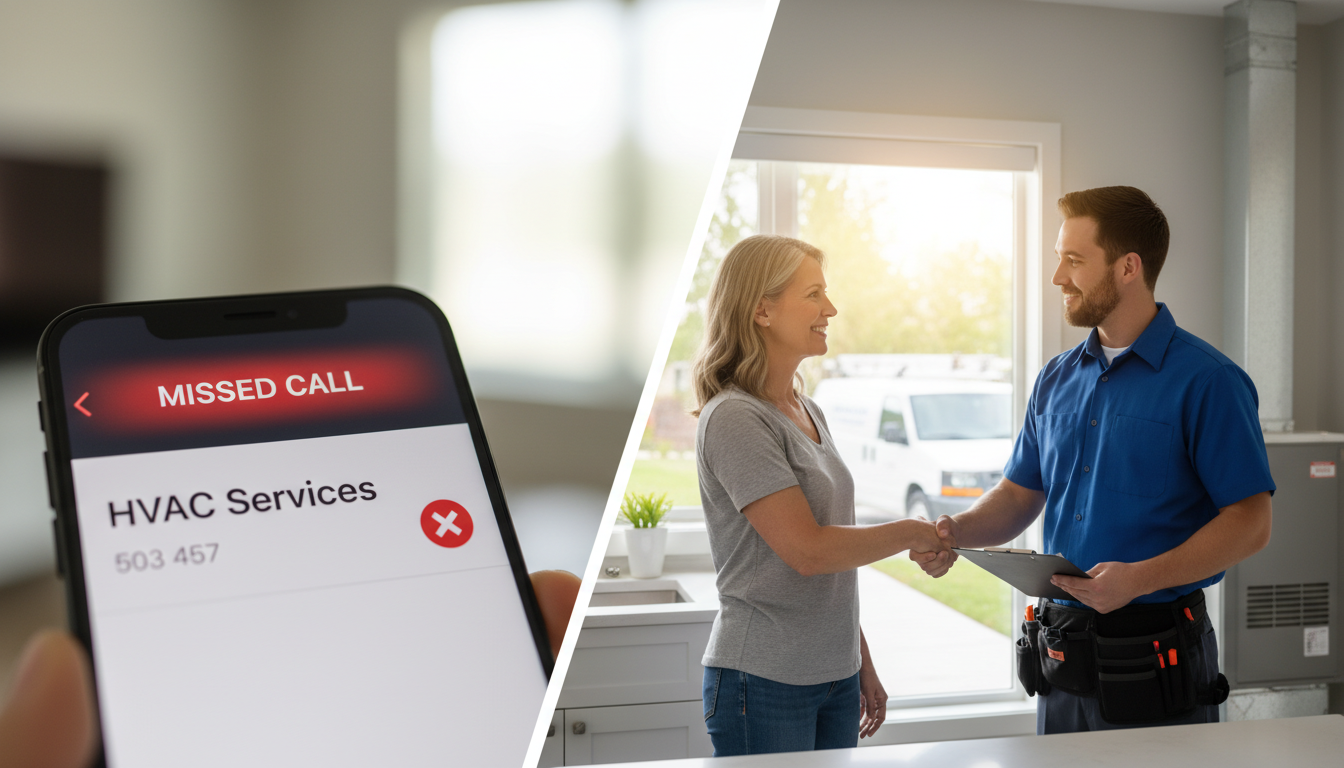
Real Example: How One HVAC Company Recovered $186K in Lost Revenue
A three-truck residential HVAC company outside Charlotte was missing 8–12 calls per week during shoulder seasons and 20+ per week during summer and winter peaks. The owner knew it was a problem—customers would mention they'd called twice before reaching him—but he didn't realize the scale until he looked at his phone records. Over six months, he'd missed 340 calls. At his $520 average ticket and a conservative 65% close rate, that was $115,000 in lost revenue in half a year.
He tried having his lead installer answer calls between jobs, but that just meant two people were distracted—the installer on the phone and the helper waiting around. Customers complained about background noise and being put on hold while he checked the schedule in the truck.
When he brought in a front office team to answer calls 24/7, three things changed immediately: call answer rate went from 58% to 98%, average callback time dropped from 2.3 hours to under 4 minutes (because the team handled most bookings live), and after-hours calls—which he'd been ignoring completely—started converting into premium-rate emergency work. In the first year, he added $186,000 in revenue he would have otherwise missed, and his close rate on inbound calls jumped from 65% to 81% because customers were talking to someone professional who wasn't yelling over a compressor.
The ROI was immediate. His team cost was a fraction of what he was losing to missed calls, and he never had to manage schedules, handle PTO, or worry about someone quitting during his busiest month.
Why Most "Solutions" Don't Actually Work for HVAC
Call forwarding to your cell phone doesn't solve the problem—it just moves the interruption around. You still can't answer when you're on a ladder or in a crawl space, and now you're stressed about it vibrating in your pocket all day. Voicemail-to-text helps you know who called, but it doesn't book the job—the customer is already talking to your competitor by the time you read the message.
Automated systems and chatbots frustrate HVAC customers because they're calling about urgent, expensive problems and they want to talk to a human. Nobody wants to text back and forth with a robot when their AC is broken and it's 92 degrees inside. They want reassurance that someone is coming to help, and they want it in the next 60 seconds or they're calling someone else.
Hiring a part-time receptionist covers business hours but misses evenings, weekends, and holidays—exactly when the most profitable calls come in. You end up paying someone to answer low-value scheduling calls during slow mornings while missing the $900 emergency call at 7 PM on Saturday.
The solution that works is having live people covering all hours—not you, not a part-timer with gaps, not a robot. Just a professional team that picks up every time, sounds like they work for you, and handles everything from first call to payment collection so you can focus on the work that actually requires your expertise.
Frequently Asked Questions
How much revenue do HVAC companies typically lose from missed calls?
HVAC companies miss an average of 5–10 calls per week during moderate seasons, which translates to $78,000–$104,000 in lost annual revenue at a $400 average job value and 70% close rate. During peak seasons (summer heat waves and winter freezes), missed calls can spike to 15–25 per week, pushing annual losses past $200,000 for busy companies. Emergency after-hours calls represent the highest value—often $675–$900 per job—and are the most commonly missed.
What percentage of HVAC customers call back if they don't reach you the first time?
Only 15% of callers leave a voicemail or call back after reaching an answering service or voicemail, according to BIA/Kelsey research. The remaining 85% immediately move on to the next HVAC company on their list. This is especially true for emergency calls during heat waves or cold snaps, when customers are calling multiple companies simultaneously and booking with whoever answers first. Speed beats price in HVAC service calls.
Is it worth answering HVAC calls after hours?
Yes—after-hours calls are typically the most profitable. Emergency service calls during evenings, weekends, and holidays command premium rates of 1.5–2x standard pricing ($675–$900 vs. $450 for a typical service call). Customers calling after hours are rarely price shopping—they're looking for immediate help and will pay premium rates for it. Missing just two after-hours emergency calls per week costs HVAC companies $70,000–$93,000 annually in lost high-margin revenue.
How quickly do I need to respond to HVAC leads?
Research from InsideSales.com shows you're 100x more likely to connect with a lead if you respond within 5 minutes versus 30 minutes. For HVAC calls specifically, 67% of customers book with the first company that answers and sounds professional, regardless of price or proximity. If you're calling leads back an hour or two later—after you've finished your current job—the customer has usually already scheduled service with a competitor. Speed is more important than your callback message or quote quality.
Can't I just hire someone part-time to answer calls?
Part-time receptionists cover some hours but still leave major gaps—especially evenings, weekends, and holidays when the highest-value emergency calls come in. You'll pay $15,000–$25,000 annually for part-time help but still miss after-hours calls worth $70,000+ in premium-rate emergency work. Full-time office staff costs $35,000–$45,000 with benefits and only covers 40 hours per week unless you're paying overtime. Most owner-operators with 2–10 trucks can't justify that overhead, especially during slow seasons.
What's the lifetime value of an HVAC customer I lose to a missed call?
The average homeowner who becomes a customer through an initial service call will spend $15,000–$20,000 with you over the next 5–10 years when you factor in annual maintenance contracts, future repairs, and eventual system replacement (average $7,500 according to HomeAdvisor). They'll also refer 2–4 neighbors over that time period. When you miss a call, you're not just losing a $450 repair—you're losing years of recurring revenue and referrals that compound your growth.
Stop Losing Revenue to Voicemail
Every missed call is revenue you earned through your marketing, your reputation, and your years of good work—and then handed to a competitor because you were too busy doing actual HVAC work to pick up the phone. The cost of HVAC missed calls isn't just the immediate lost job; it's the compound effect of lost customers, lost referrals, and lost opportunities to build the business you've been working toward.
You don't need to hire, train, or manage anyone to fix this. You need a team that's already trained, already working, and already handling everything from answering calls to booking jobs and collecting payments—24/7, within three rings, every single time. That's what stops the bleeding and starts turning every call into revenue instead of a regret.
Learn how BookAllLeads AI Business Team can handle every call, follow-up, and booking while you focus on the work only you can do.John Edmonds is a native Texan and military combat veteran. He founded Book All Leads after identifying a critical gap in the service industry: business owners losing revenue not from lack of skill, but because no one was handling the calls, follow-ups, reviews, and payments while they were busy doing the work.
View LinkedIn Profile →