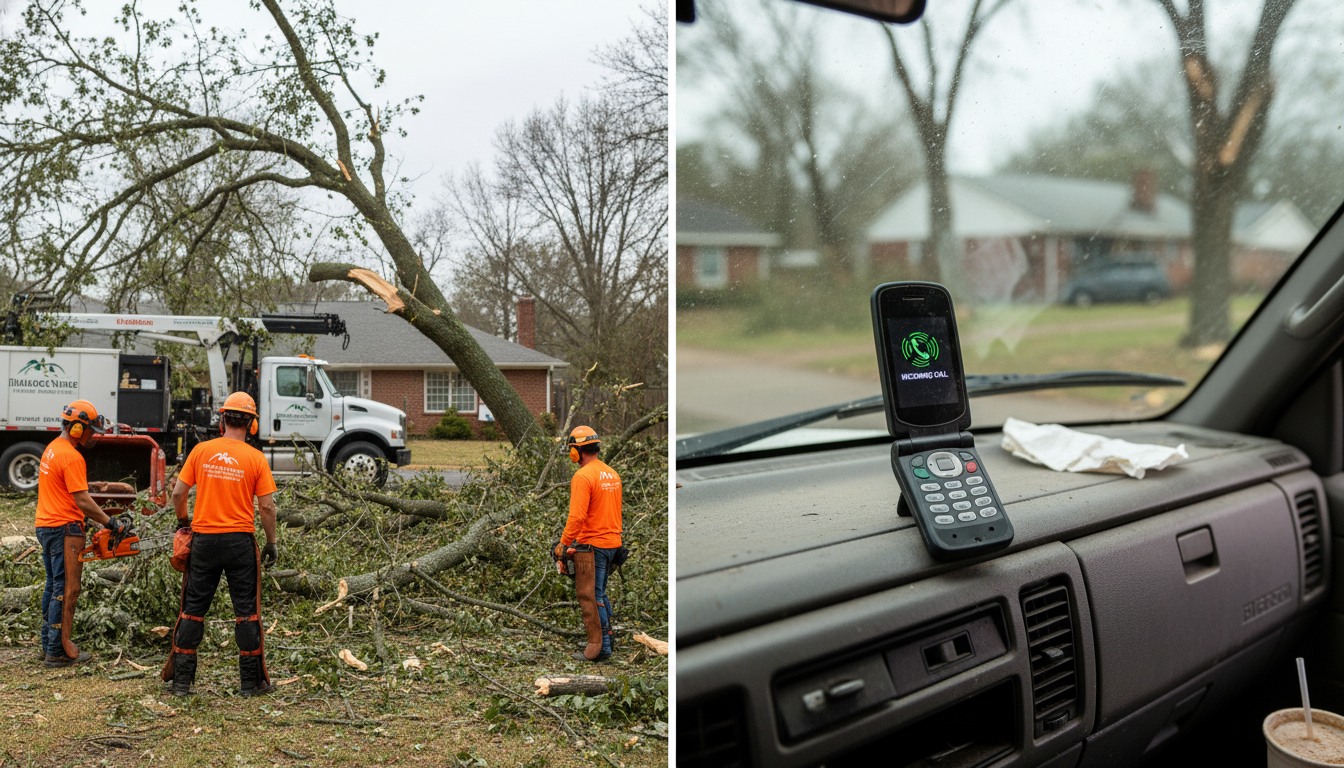
Tree service storm leads are lost in the first five minutes because emergency callers don't leave voicemails—they call the next company. When a storm hits and a tree crushes a garage or blocks a driveway, homeowners need someone now, not a callback in two hours. Most tree service companies lose 60-80% of these high-value emergency calls simply because they can't answer the phone while they're up in a tree with a chainsaw running. The revenue walks to whoever picks up first.
Why Tree Service Companies Miss Their Most Profitable Calls
Emergency tree removal leads after a storm are the most valuable calls your business will receive all year—often $2,500 to $8,000 per job—but they evaporate faster than any other lead type. The homeowner with a tree through their roof isn't browsing websites or comparing reviews. They're calling down a list until someone answers. If you're on a job site, that someone isn't you.
According to InsideSales.com, leads contacted within five minutes are 21 times more likely to convert than those contacted after 30 minutes. For emergency tree service, that window is even tighter. Storm damage calls are often booked within the first three attempts. If you're the fourth company they reach, you've already lost.
Here's what most articles won't tell you: The problem isn't that you're too busy—it's that storm season creates a surge you can't staff for. You can't afford to keep extra people waiting by the phone for weather events that might happen twice a year. But those two events can represent 30-40% of your annual profit if you capture them. Missing storm calls doesn't just cost you one job—it costs you the entire seasonal spike that funds your slower months.
The typical tree service operation runs lean: owner-operators with 2-6 crew members, all of whom are in the field during daylight hours. When a storm rolls through on a Tuesday afternoon and you're already committed to three jobs, your phone becomes a liability instead of an asset.
What Happens When You Miss an Emergency Tree Removal Lead
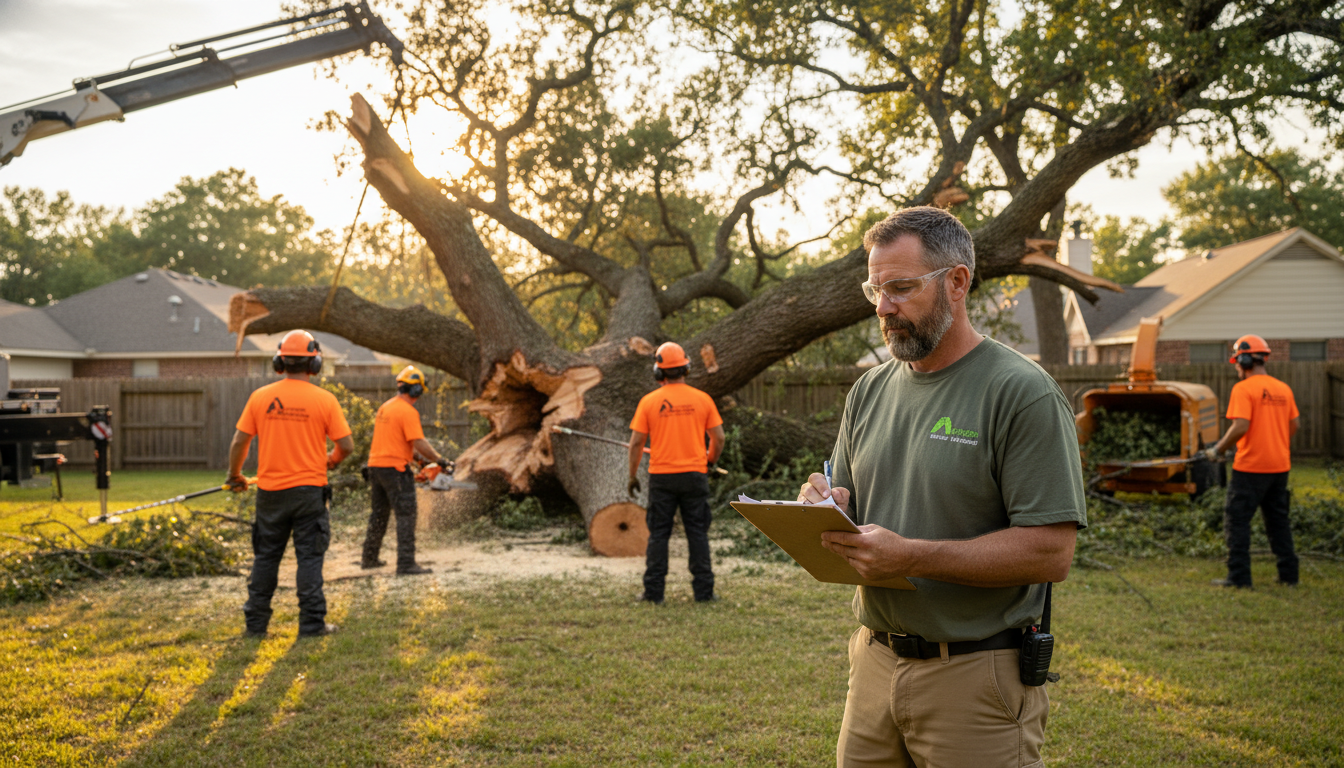
You don't just lose the immediate job—you lose the referral network that comes with being the company that showed up when it mattered. Storm damage creates visible, high-stakes work that neighbors notice. The crew removing a fallen oak from a driveway becomes the company everyone on the block saves in their contacts.
Here's the revenue math most tree service owners don't calculate: A missed emergency call isn't just one lost job. It's the initial $3,500 removal, plus the $1,200 stump grinding they would have added, plus the two neighbor referrals worth another $4,000 combined, plus the commercial property manager who drives by and needs your number for their vendor list.
One missed call during storm season can cost you $10,000 in cascading revenue. Miss a dozen calls during a major weather event, and you've just funded your competitor's equipment upgrade for the year.
The Voicemail Problem Tree Services Face
Emergency callers don't leave voicemails. A study by Vendasta found that 85% of callers who reach voicemail on their first attempt won't call back—they move to the next option immediately. For storm damage, that percentage is even higher because urgency eliminates patience.
Your outgoing message might say "We'll call you back within an hour," but the caller with a tree leaning against their power line doesn't have an hour. They have three more companies queued up in their search results, and one of them will answer.
How Tree Service Companies Lose Storm Leads Before the Phone Even Rings
Many tree services lose emergency revenue before the call happens because their online presence doesn't signal 24/7 availability. When someone searches "emergency tree removal near me" at 9 PM after a windstorm, they're looking for explicit confirmation that you answer after hours. If your website doesn't say it, your Google Business Profile doesn't mention it, and your ad copy doesn't promise it, they'll call the competitor who does—even if you would have answered.
Your missed-call problem starts with your marketing message. Homeowners facing emergency tree damage assume most companies are closed evenings and weekends. They self-filter you out of their call list before dialing. The companies capturing storm leads aren't necessarily available 24/7—they just say they are clearly enough that they get the call.
But saying you're available 24/7 creates a new problem: you actually have to answer. And that's where most tree service companies hit the operational wall. You can't stay by the phone around the clock, and your crew can't take calls while running equipment. Hiring someone just to answer occasional emergency calls doesn't pencil out—until you realize how much revenue you're losing.
Why Answering Services Don't Work for Tree Service Storm Calls
Most tree service owners who recognize the missed-call problem try a traditional answering service first. It seems like the obvious fix: someone answers the phone when you can't. But emergency tree removal calls require more than a warm body reading a script.
The homeowner calling about a tree on their garage isn't looking for someone to "take a message." They need to know:
- Can you get here today, or at least tomorrow morning?
- What's the ballpark cost so they can tell their insurance adjuster?
- Do you handle the tarp and temporary repairs, or just the tree?
- Can you bill insurance directly?
- Are you licensed and insured (because their carrier will ask)?
A generic answering service can't answer those questions. They take a name and number, promise you'll call back, and the homeowner keeps dialing. You've paid for the answering service and still lost the lead. The call was answered but not captured.
What you need isn't someone to answer the phone—it's someone who can book the job while the caller is still on the line. That requires knowing your pricing structure, your crew availability, your service area limits, and your booking policies. It requires a real front office team that functions as an extension of your business, not a third-party script reader.
How to Actually Capture Emergency Tree Removal Revenue During Storms
Capturing storm leads requires three things working together: a phone that gets answered within three rings, a person who can qualify and book the job immediately, and a scheduling process that gets the caller committed before they hang up. Most tree service companies have none of these during their busiest revenue periods.
Book All Leads operates as your full front office team—not a call center reading scripts, but six dedicated roles working 24/7 to answer every call, qualify every lead, book every job, and follow up on every estimate. For tree service companies, that means emergency storm calls get answered by someone who knows your pricing, understands the urgency, and can get the caller on your schedule while they're still on the phone. No voicemail. No "we'll call you back." No lost revenue to whoever answers first. We're live in five days, no software for you to learn, no contracts locking you in.
But even without a dedicated team, you can stop losing storm revenue by changing how you handle peak periods. Here's what actually works:
Create a Storm-Surge Pricing and Booking Protocol
Before storm season hits, document your emergency pricing, your crew capacity, and your qualification questions. When can you realistically arrive? What's your minimum emergency fee? What jobs do you turn down even during storms (e.g., trees on power lines that require utility company clearance first)? Write it down so anyone answering your phone can book correctly.
Most tree services wing it during storms and either undercharge in the chaos or fumble the booking because they're trying to think through pricing while standing in the rain. Your competition is quoting immediately and booking on the spot.
Make Your Availability Impossible to Miss
Update your Google Business Profile description, your website header, your voicemail message, and your ad copy to explicitly state "24/7 Emergency Storm Response" during storm season. Don't bury it in your services page. Put it everywhere a panicked homeowner will look.
Add your emergency number as a separate click-to-call button on mobile. Make it a different color. Label it "EMERGENCY - Call Now." You'd be surprised how many calls you'll get simply because you made it obvious you want them.
Track Your Missed-Call Revenue to Justify the Fix
Most tree service owners know they miss calls but don't know what it costs them. Check your missed-call log after the next storm and calculate your losses: multiply the number of missed calls by your average emergency job value and your typical close rate. That number is your annual investment budget for solving this problem.
If you missed 40 calls during the last storm season, and your average emergency removal is $3,200, and you close 60% of estimates, you lost $76,800. Suddenly, paying for a proper front office team doesn't seem expensive—it seems like the only rational choice.
What to Say When You Finally Answer a Storm Damage Call
Speed matters, but so does what you say in the first 20 seconds. The homeowner with a downed tree has already called two other companies. They're mentally comparing your response to whoever they've talked to already. Your goal isn't to give them information—it's to get them to stop calling other tree services.
Start with urgency and capability: "We can get a crew to you this afternoon to assess the damage and start the emergency work. Let me grab a few details to get you scheduled." Not "Let me take your information and someone will call you back." That's the response they've already heard twice, and it's why they're still calling.
Ask three qualification questions immediately: Where's the tree and what did it damage? Is it blocking access or creating a safety hazard? Have you contacted your insurance yet, or do you need us to bill direct? These questions do two things: they show you know what you're doing, and they get the caller invested in the conversation instead of mentally moving to the next call.
Then quote a range and book the assessment: "Emergency removals in your situation typically run $2,500 to $5,000 depending on access and equipment needs, but we won't know exactly until we see it. I've got you down for a 2 PM assessment today—we'll have a firm quote for you within the hour after that. Who should our crew ask for when we arrive?"
Notice what didn't happen: no "we'll call you back," no "fill out our online form," no "we're really busy right now but we'll try to fit you in." You took control of the call, gave them a realistic price range, and locked in the appointment before they hung up. That's how you stop losing storm leads to competitors.
How to Handle the "How Much Will This Cost?" Question on Emergency Calls
This is the question that sinks most tree service companies on storm calls. You don't want to quote without seeing the job, but the caller needs some number to decide whether to book you or keep calling. The right answer is a wide range with clear qualifiers.
"Based on what you're describing, emergency tree removal typically ranges from $1,500 for a smaller tree we can access easily, up to $6,000 or more if we need a crane or it's tangled in structures. I'll have an exact quote for you within an hour of assessing the site this afternoon. Does that range work with what you were expecting?"
This approach gives them enough information to stop shopping while protecting you from being held to a number you quoted blind. And critically, it ends with a question that keeps them engaged instead of giving them a chance to say "let me think about it."

How Much Revenue Do Tree Services Really Lose to Missed Storm Calls?
The average tree service company misses 30-50% of inbound calls during normal operations, according to call tracking data from local service businesses. During storm surges, that number jumps to 70-85% because volume spikes exactly when you're least able to answer. If a typical storm event generates 50-80 inbound calls over three days, and your average emergency job is worth $3,200, you're losing $112,000 to $179,200 every time a major weather event hits your area.
Most tree service owners drastically underestimate this number because they don't see the calls they miss—only the jobs they book. Your crew might be slammed for a week after a storm, working 14-hour days, and you assume you captured the opportunity. But you only captured the leads that reached you. The actual opportunity was three times larger.
According to the Bureau of Labor Statistics, tree trimming and removal services employ approximately 147,000 people across the U.S., with significant seasonal demand variation driven by storm activity. The companies that grow in this industry aren't the ones with the best crews—they're the ones who capture the demand when it spikes.
Compounding the problem: emergency storm work often converts to additional services. The homeowner who needs a tree removed from their roof also needs stump grinding, debris hauling, and often preventive trimming on other trees they're now worried about. The initial $3,200 emergency call turns into $6,500 in total work—but only if you answer the first call.
Why Tree Service Emergency Calls Convert Better Than Regular Leads
Storm damage leads close at 60-80%, compared to 20-35% for routine tree trimming inquiries. The difference is urgency and necessity. When someone calls about a tree on their house, price isn't the primary objection—availability is. They need the problem solved now, and they'll pay premium rates to whoever can deliver.
This is why missing emergency calls hurts so much more than missing routine inquiries. You're not just losing leads—you're losing your highest-converting, highest-margin leads. The jobs that require the least sales effort and generate the most profit per hour of labor.
Emergency work also creates instant credibility. You're solving a crisis, which positions you as the expert they'll call for everything else. The homeowner you help during a storm becomes a long-term client who calls you for annual maintenance, recommends you to neighbors, and reviews you online. Miss that first emergency call, and someone else owns that relationship forever.
Frequently Asked Questions
How quickly do I need to respond to storm damage tree removal leads?
Within five minutes for the best chance of booking the job. Emergency tree removal callers typically contact 3-5 companies and book with whoever answers first and can schedule fastest. Callbacks after 30 minutes convert at less than 20% because the caller has already booked someone else. If you can't answer immediately, you need someone answering for you—every hour of delay costs you leads.
Should I charge more for emergency tree removal after storms?
Yes. Emergency storm work requires immediate response, often after-hours availability, and carries higher risk and complexity. Most tree service companies charge 50-100% above standard rates for emergency calls, and customers expect it. The homeowner with a tree on their garage isn't price shopping—they're urgency shopping. Quote confidently and deliver fast.
What percentage of storm callers will leave a voicemail if I don't answer?
Less than 15%. Emergency callers move to the next company immediately when they reach voicemail. Unlike routine service inquiries where people might leave a message and wait for a callback, storm damage creates urgency that eliminates patience. If your phone goes to voicemail during storm season, assume you've lost that lead permanently.
How do I know if I'm losing storm leads if they don't leave messages?
Check your call logs against your booked jobs after a storm. If you received 40 inbound calls but only booked 8 jobs, you lost 32 opportunities. Most tree service owners never run this analysis and assume everyone who wanted service reached them. Track your missed calls and multiply by your average emergency job value—that's your lost revenue.
Can an answering service book tree removal jobs, or do they just take messages?
Traditional answering services only take messages because they don't know your pricing, availability, or service capabilities. To actually book emergency tree removal jobs, you need a front office team trained on your business—someone who can quote ranges, check your schedule, qualify the job, and get the caller committed before they hang up. Message-taking loses the lead.
How many storm calls should I expect during a major weather event?
A significant storm in your service area can generate 50-120 inbound calls over 2-4 days, depending on your market size and online visibility. Most tree service companies capture 15-30% of that demand because they can't answer while they're working. The companies that dominate post-storm work aren't necessarily bigger—they're just reachable when the calls come in.
Stop Losing Your Most Valuable Calls to Voicemail
Tree service storm leads represent the highest-revenue, highest-conversion opportunity your business will see all year—and most companies lose the majority of them simply because nobody answers the phone. You can't grow a tree service business on the leads you miss, and you can't capture emergency revenue if callers reach voicemail while you're running a chainsaw.
The fix isn't working harder or hiring more crew—it's making sure every call gets answered by someone who can actually book the job. Your competition isn't better at tree removal; they're just better at answering the phone when it rings. Stop funding their growth with your missed opportunities.
Book All Leads gives you a full front office team that answers every call, books every job, and captures every emergency lead—24/7, including nights and weekends when storms actually happen. See how much revenue you're losing to missed calls and what it would take to capture it.
John Edmonds is a native Texan and military combat veteran. He founded Book All Leads after identifying a critical gap in the service industry: business owners losing revenue not from lack of skill, but because no one was handling the calls, follow-ups, reviews, and payments while they were busy doing the work.
View LinkedIn Profile →