tag omitted per instructions
An HVAC phone answering service directly determines whether you win or lose high-ticket replacement jobs. Every hour, HVAC companies lose $500–$3,000 installation opportunities because calls go unanswered, get rushed by field techs, or land with someone who can't build urgency around a failing system. The way your phone gets handled in the first 60 seconds often decides whether a homeowner with a dead furnace calls three more companies or books your diagnostic visit immediately.
The Problem: Your Best Leads Don't Leave Voicemails
Homeowners with dead air conditioning in July or a failing furnace in January don't wait. They call down a list until someone picks up, sounds competent, and schedules them fast. According to Air Conditioning Contractors of America (ACCA), 67% of HVAC service calls originate from residential emergencies requiring same-day or next-day response. Miss that first call, and you've handed a $4,500 heat pump replacement to the company that answered on ring two.
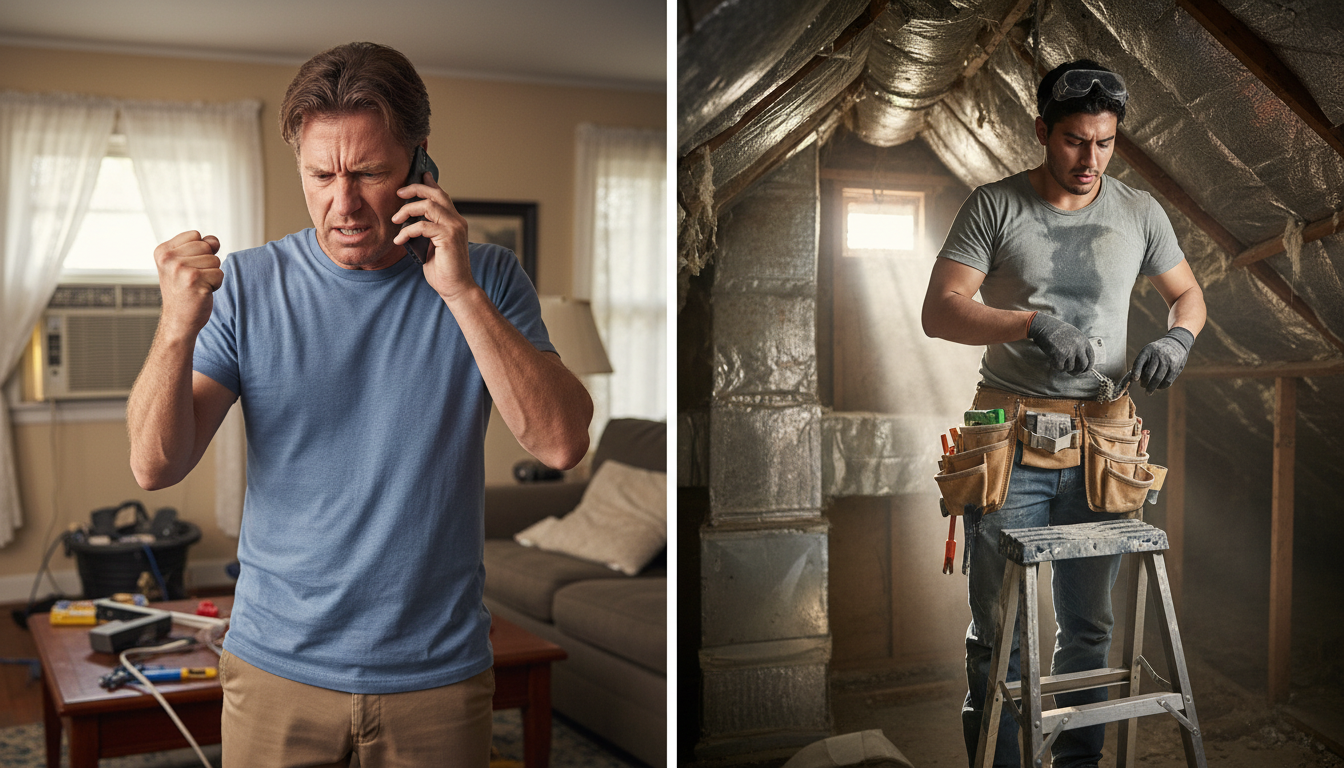
You already know this. You've seen the missed call notifications pile up during peak season. You've watched your best installer try to quote a job while kneeling in an attic. You've listened to your office manager—who's also running payroll and ordering parts—answer the phone with "HVAC, please hold" before the caller even states their problem.
Here's what most articles won't tell you: The issue isn't volume. It's qualification. Your team answers plenty of calls. They're just terrible at separating the $200 tune-up requests from the $8,000 system replacement prospects. Every call gets treated the same, so your calendar fills with low-margin work while the big jobs—the ones that actually pay your overhead—slip through because nobody built urgency or asked the right diagnostic questions.
Why HVAC Call Handling Determines Your Revenue Mix
HVAC customer service calls fall into three categories: routine maintenance, repair diagnosis, and emergency replacement. The third category—emergency replacement—represents 15–20% of inbound volume but 60–70% of your gross profit for the month. Skilled HVAC call handling identifies these high-intent callers in the first 90 seconds and treats them differently. Unskilled handling treats a "my AC isn't cooling well" call the same as a "my AC died overnight and it's 95 degrees" call, even though one will wait three days and the other is calling competitors right now.
Research from InsideSales.com shows that response time is the single strongest predictor of contact rate. Companies that respond within five minutes are 100 times more likely to connect with a lead than those responding after 30 minutes. In HVAC, this gap is even sharper during emergencies. A homeowner with no heat on a 20-degree night will book the first company that answers, sounds reassuring, and offers a two-hour arrival window. They won't wait for a callback.

What Happens When a Technician Answers Your Phone
Your field techs are excellent at diagnosing compressor failure. They're miserable at phone intake. A technician answering mid-install will say "We can probably get someone out Thursday" without asking system age, whether the homeowner has backup heat, or if they've already gotten quotes. He's trying to get back to work. The caller hears indifference and moves to the next company.
Worse, techs under-qualify. They don't probe. A homeowner says "my furnace is making a noise," and the tech schedules a $120 diagnostic without asking how old the system is or whether it's heating at all. You send a truck for a minor belt issue when the furnace is 22 years old and the homeowner was prepared to discuss replacement. You've now anchored the conversation at $120 instead of $6,000.
What Happens When Calls Go to Voicemail During Peak Season
Your voicemail promises a callback "within the hour." That's irrelevant. According to Plumbing-Heating-Cooling Contractors Association (PHCC), 78% of customers choose the first responder during HVAC emergencies. The homeowner with a leaking air handler isn't waiting 60 minutes to hear back from you. They've already booked with the company that picked up live, asked smart questions, and confirmed an arrival time before lunch.
Even when you do call back, the prospect is colder. They've talked to two other companies. You're now competing on price instead of urgency. You've lost the psychological advantage of being the first voice of reassurance during a stressful moment.
What High-Ticket Jobs Require in the First 60 Seconds
Winning HVAC replacement jobs starts with how the phone gets answered. High-value callers need three things immediately: acknowledgment of urgency, evidence of availability, and confidence that you understand the problem. A skilled HVAC receptionist delivers all three before the caller finishes describing symptoms. They say "A furnace going out in this cold is stressful—let's get someone to you today. How old is the system?" Instead of "We're really busy, but I can check the schedule."
The difference is intent-reading. Experienced call handlers listen for replacement indicators: system age over 12 years, repeated recent repairs, complete failure rather than degraded performance, mention of comfort issues in multiple rooms. When they hear these signals, they shift the conversation from "repair appointment" to "diagnostic and options discussion." They book longer windows. They mention financing before the caller asks. They position your company as the solution provider, not just another bidder.
The Questions That Separate $300 Calls From $6,000 Calls
- "How old is your current system?" (Over 10 years? Replacement conversation.)
- "Is this the first time it's failed, or have you had other issues recently?" (Repeat repairs? Escalate urgency.)
- "Do you have any heat/cooling at all, or is it completely out?" (Complete failure? Same-day priority.)
- "Are you comfortable waiting a few days, or is this affecting your family right now?" (Urgency test.)
Generic answering services ask none of these. Your field techs don't have time to ask these. Your overwhelmed office manager forgets to ask these when six other calls are holding. But these questions are the entire difference between a booked calendar and a profitable calendar.
BookAllLeads operates as your full front office team—six roles including intake specialists trained specifically for trades like HVAC. Every caller gets a live person who knows the difference between a tune-up inquiry and a system replacement emergency, asks the diagnostic questions that qualify job size, and books appointments based on actual urgency and revenue potential. You get a built-and-managed team live in five days, no software to learn, no contracts locking you in. Just a front office that treats your phone like the revenue engine it is. You can see how it works and what it costs in about 90 seconds.
The Real Cost of Mediocre Phone Handling
Track this for one week: every missed call, every voicemail, every time a tech answered while on a ladder. Now multiply by your average replacement job value. Most HVAC owner-operators we talk to realize they're losing $8,000–$15,000 per week in unbid work—not because they lack capacity, but because their phone handling failed before the sales process even started.
The U.S. Bureau of Labor Statistics reports that HVAC technicians earn a median hourly wage of $25.40. If a tech is answering phones instead of turning wrenches, you're paying $25/hour for a task that generates zero direct revenue and actively costs you high-ticket opportunities. Meanwhile, that same tech is either delaying the job he's on or giving poor phone service because he's distracted. You lose twice.
Then there's reputation cost. Homeowners with emergencies who can't reach you don't just call someone else—they tell neighbors, leave reviews mentioning your unavailability, and never call back. A single bad phone experience during a stressful moment creates a vocal detractor who costs you referrals for years.

The Compounding Effect During Peak Season
May through September and November through February—your revenue depends entirely on phone performance during these months. When callbacks stretch to two hours, you don't just lose that one caller. You lose ten, because your competitors' calendars fill up and the homeowner panic-calling at 8 PM on a Sunday reaches you on Tuesday. By then, they've either hired someone else or their problem suddenly "isn't that bad" anymore (translation: they already got three quotes and you're too late).
If you want to see exactly what poor call handling costs your business, use our calculator to model missed call impact against your average job values. Most HVAC companies realize they're giving away one full system replacement per week just from phone misses.
What "Better Phone Handling" Actually Looks Like for HVAC
Better doesn't mean faster pickup times alone—it means smarter intake, better qualification, and revenue-focused scheduling. A skilled front office team for HVAC answers every call live, builds urgency around genuine emergencies, qualifies system age and problem severity before booking, and fills your calendar with the right mix of maintenance, repair, and high-margin replacement diagnostics. They know when to offer same-day service and when to schedule three days out. They mention financing options for replacement-range jobs before the caller asks about price. They position your technicians as diagnosticians, not just repair hands.
This requires trained people, not software. It requires someone who understands HVAC terminology, seasonal urgency patterns, and the questions that uncover a homeowner's real timeline. It requires availability after hours, because 40% of HVAC emergency calls happen outside normal business hours when systems fail overnight or on weekends.
Why Most Answering Services Fail HVAC Companies
Generic answering services take messages. That's it. They can't qualify leads, can't ask diagnostic questions, can't differentiate between a $150 service call and a $7,000 replacement opportunity. They certainly can't handle intake, follow-up, payment collection, and scheduling like a real front office. You end up with a list of names and numbers—no context, no urgency ranking, no qualification. Your office manager still has to call everyone back and do the actual intake work.
Even "HVAC-specialized" answering services typically just route calls or schedule based on availability without understanding job economics. They'll book a $100 filter change in your only remaining same-day slot while a $6,000 heat pump replacement emergency goes to next Tuesday. They optimize for call volume, not revenue.
How Top-Performing HVAC Companies Handle Their Phones
The highest-grossing HVAC contractors we've studied don't let field staff touch phones. Ever. They staff dedicated intake roles—often two or three people during peak season—who do nothing but answer, qualify, and book. These companies track conversion rate by call handler, measure average job value per booked appointment, and fire people who book lots of appointments but generate low revenue.
They script the first 60 seconds but train flexibility after that. They empower their front office to offer same-day premiums for genuine emergencies and to pre-quote diagnostic fees with replacement credit. They've learned that phone handling isn't a cost center—it's the highest-leverage revenue role in the entire company.
But most owner-operators with 5–25 employees can't afford to hire, train, and manage a dedicated front office team. The salary cost alone runs $40,000–$60,000 per role, and you need coverage from 7 AM to 9 PM seven days a week during peak season. That's multiple people. The alternative—letting calls go to voicemail or having techs answer between jobs—costs even more in lost revenue, but it's a hidden cost that doesn't show up on P&L until you track it deliberately.
Frequently Asked Questions
What's the difference between an HVAC answering service and a full front office team?
An answering service takes messages or routes calls. A front office team qualifies leads, books appointments based on job value and urgency, handles follow-up, collects payments, and manages your schedule like an in-house office manager would. One is reactive; the other is revenue-focused.
How quickly does better call handling actually increase revenue?
Most HVAC companies see measurable increases within the first billing cycle—usually 10–20% more booked jobs and a higher percentage of replacement diagnostics versus low-margin service calls. The impact is immediate because you stop losing calls to voicemail and competitors.
Can my office manager just handle calls if we get less busy?
Office managers already handling payroll, ordering, and scheduling can't give calls the attention that converts high-ticket leads. They answer reactively, don't probe for urgency, and often sound rushed. Callers sense it. Dedicated call handling roles exist because phone quality directly controls revenue—it's not a task you squeeze between other duties.
Do after-hours calls really matter for HVAC companies?
Absolutely. Systems fail overnight and on weekends. A homeowner with no heat at 11 PM on a Saturday will call until someone answers. If your after-hours calls go to voicemail, you've guaranteed that someone else gets the emergency replacement job. After-hours coverage is non-negotiable for high-value HVAC work.
What should an HVAC receptionist ask during the first call?
System age, symptom specifics (complete failure or reduced performance), previous repair history, urgency level (comfort vs. emergency), and availability for appointments. These questions separate $200 service calls from $6,000 replacement opportunities and allow you to prioritize your calendar by revenue potential.
How do I know if my current phone handling is costing me jobs?
Track three metrics: missed call rate, callback time for voicemails, and average job value per booked appointment. If you're missing more than 10% of calls, taking longer than 10 minutes to return voicemails, or booking mostly low-margin service work, your phone handling is directly costing you high-ticket jobs.
Stop Losing High-Ticket Jobs to Companies That Just Answer Faster
Your technical skills, your equipment, your years of experience—none of it matters if homeowners with failing systems can't reach you or get underwhelming service when they do. The HVAC companies winning replacement jobs aren't necessarily better at installations. They're better at phones. They understand that the first 60 seconds of a call determines whether a prospect becomes a $6,000 client or a lost opportunity your competitor closes instead.
You can keep trying to answer calls between jobs, hoping your team picks up enough to stay competitive. Or you can treat your phone like the revenue engine it actually is—staffed by people who know how to qualify, build urgency, and book the jobs that actually move your business forward. If you're ready to stop losing high-ticket work to better phone handlers, explore how a full front office team changes your close rate, your revenue mix, and your stress level starting in less than a week.
John Edmonds is a native Texan and military combat veteran. He founded Book All Leads after identifying a critical gap in the service industry: business owners losing revenue not from lack of skill, but because no one was handling the calls, follow-ups, reviews, and payments while they were busy doing the work.
View LinkedIn Profile →