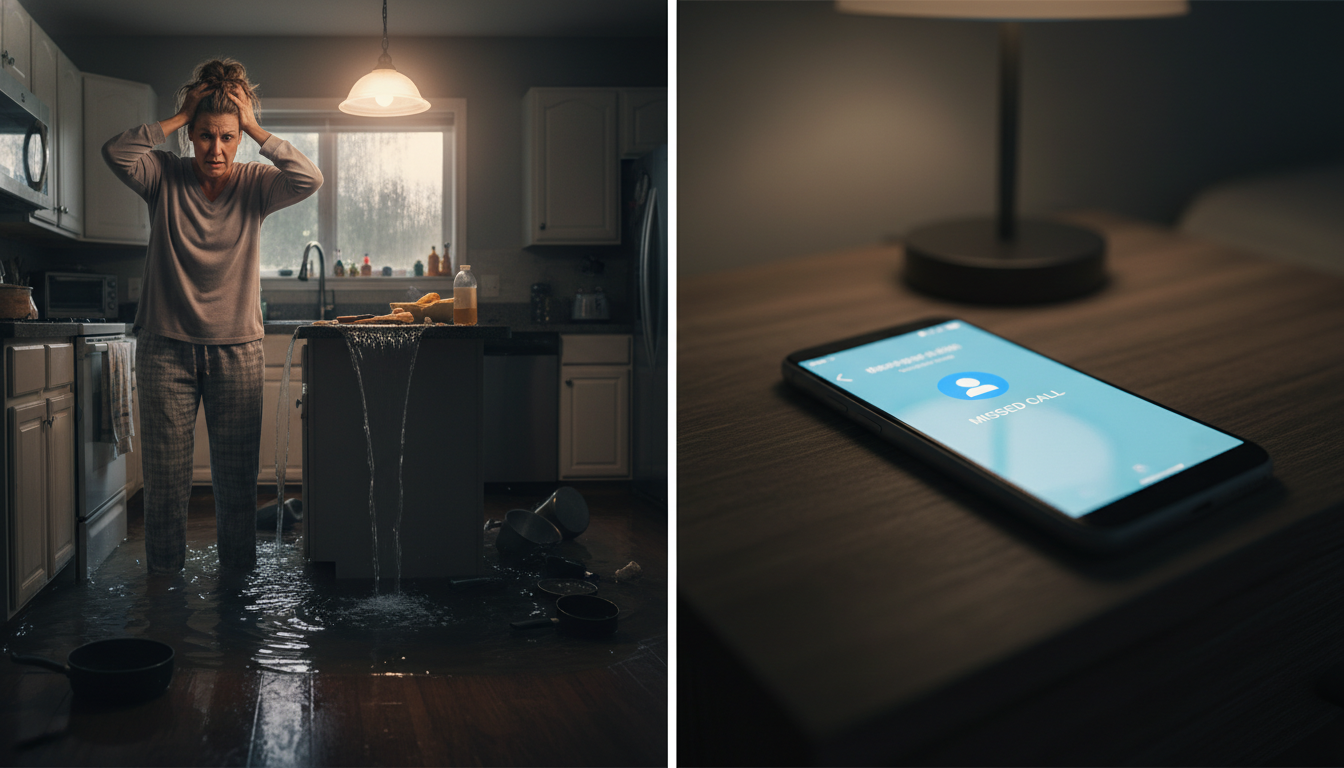
Plumbing emergency calls between 5 PM and 8 AM represent the highest-paying work you'll ever book—typically 2-3x your normal rates—yet most owner-operated plumbing companies miss 60-80% of these calls because nobody's available to answer. Every missed emergency call costs you $350-$800 in immediate revenue, and according to the Plumbing-Heating-Cooling Contractors Association (PHCC), the average plumbing business loses $47,000-$93,000 annually from after-hours calls that go to voicemail or a competitor who picks up first.
You built your plumbing business on your reputation and your hustle. But no matter how good you are at fixing burst pipes or clearing main line backups, you can't be on a job site and answering phones at the same time. And when someone's basement is flooding at 7 PM on a Tuesday, they're not leaving a voicemail—they're calling the next plumber until someone answers.
This article breaks down exactly why plumbing companies lose emergency work after business hours, how much revenue you're actually leaving on the table, and what top-performing plumbing businesses do differently to capture this high-margin work without working themselves to death.
The Problem: Your Most Profitable Calls Happen When You Can't Answer
Emergency plumbing calls peak between 6 PM and 10 PM—right when most owner-operators are having dinner, coaching Little League, or finally off the clock after a 12-hour day. These aren't courtesy calls asking about service area or pricing. These are panicked homeowners with burst pipes, backed-up sewage, or water heaters flooding their garage. They need help now, and they'll pay premium rates to whoever picks up first.
Here's the financial reality: A standard service call during business hours might net you $150-$250. That same emergency call at 8 PM? You're charging $350-$800 depending on your market, and customers don't negotiate. According to HomeAdvisor's True Cost Guide, emergency plumbing services command 150-200% premiums over standard rates, and conversion rates for answered emergency calls exceed 85%—people aren't price shopping when their house is flooding.
Yet most plumbing companies treat after-hours calls as an inconvenience rather than their most valuable revenue channel. They let calls roll to voicemail, use generic answering services that can't book jobs, or burn out trying to personally answer every call 24/7. The result? Competitors who solve this problem are eating their lunch.
What Happens to Missed Emergency Calls
When you miss an emergency plumbing call, here's what actually happens: The caller immediately dials the next plumber on their search results. Research from Invoca shows that 67% of callers won't leave a voicemail for service emergencies—they move on within 30 seconds. By the time you listen to that voicemail the next morning and call them back, another plumber has already dispatched a tech, diagnosed the problem, and collected payment.
You didn't just lose one emergency call. You lost:
- The immediate $350-$800 emergency service revenue
- The follow-up work once they see the full scope of damage (often $1,500-$4,000 in additional repairs)
- A potential lifetime customer relationship worth $8,000-$12,000 in repeat business
- The referrals that customer would have generated
Here's what most articles won't tell you: The plumber who answers isn't always the best plumber—they're just the first plumber. Homeowners in crisis mode default to whoever picks up the phone and sounds competent. If you're letting calls go to voicemail while your competitor's front office is answering on ring two, you're training your local market to call them first. Within six months, you'll notice your emergency call volume declining—not because demand dropped, but because customers stopped trying to reach you.
Why After-Hours Plumbing Leads Slip Through Your Fingers
Most plumbing companies lose after-hours emergency work for three specific reasons: they rely on personal cell phones they can't always answer, they use generic answering services that can't actually book jobs, or they burn out trying to be available 24/7 themselves. Each approach has fatal flaws that cost you revenue every single week.
The Personal Cell Phone Trap
You've trained customers to call your cell after hours, which sounds great until you realize you're glued to that phone 24/7. You can't shower, can't have dinner with your family, can't watch your kid's game without that phone buzzing. And when you're elbows-deep in a job, you miss those calls anyway. You've created a system where you're always on-call but rarely available when it matters.
The math doesn't work either. If you personally handle 100% of calls, you cap your business at your personal capacity. You can't hire and train techs to handle overflow because you're the bottleneck—every job flows through your phone. High-growth plumbing companies figured out years ago that owners who answer their own phones don't scale past $400K in annual revenue.
Generic Answering Services That Can't Close
Many plumbers try basic answering services—someone picks up, takes a message, and texts you the details. Sounds reasonable until you realize these services can't qualify leads, can't check your calendar, can't book jobs, and can't collect payment information. They're glorified voicemail that costs $200-$500 per month.
The caller experience is terrible too. Imagine your basement is flooding and you reach "a service that takes messages for ABC Plumbing." That screams "small-time operation that can't handle emergencies." Meanwhile, the next plumber they call has someone who knows their pricing, can confirm a 90-minute arrival window, and books the job on the spot. Who do you think gets that $600 emergency call?
How Much Revenue Are You Actually Losing?
Let's calculate your actual losses from missed emergency calls. The average plumbing company in a mid-sized market receives 15-25 after-hours emergency calls per month. If you're missing even 50% of those calls because you're unavailable, and each emergency call is worth $500 on average, you're losing $3,750-$6,250 monthly—or $45,000-$75,000 annually. That's not counting the follow-up work or lifetime customer value.

According to industry data from PHCC, plumbing companies that capture 90% or more of their after-hours calls average 28-35% higher annual revenue than competitors of similar size who let most evening calls go to voicemail. The difference isn't their technical skill—it's their front office capacity to answer, qualify, and book emergency work when competitors are offline.
Use our revenue calculator to estimate exactly how much you're leaving on the table based on your current call volume and answer rate.
The Compounding Effect of Lost Emergency Customers
Every missed emergency call has a multiplier effect. Research from Harvard Business Review shows that increasing customer retention by just 5% increases profits by 25-95%. When you capture an emergency customer, you typically earn their trust at the most stressful moment of their homeownership—which creates fierce loyalty.
Those emergency customers become your highest-value relationships. They call you first for water heater replacements, fixture upgrades, and remodeling work. They refer their neighbors after flooding events. One emergency call answered can generate $12,000-$18,000 in lifetime value. One emergency call missed means a competitor owns that relationship instead.
What Top-Performing Plumbing Companies Do Differently
The plumbing companies capturing 85-95% of their emergency calls don't rely on owners answering phones or generic message services. They've built or hired dedicated front office teams that handle calls 24/7, know their pricing and availability, book jobs in real-time, and collect payment details before dispatch. This isn't about technology—it's about having real people who represent your business professionally around the clock.
These front office teams answer every call within three rings, qualify the emergency, check tech availability, quote pricing with confidence, book the job, collect payment information, and send dispatch details to the tech—all while the customer is still on the phone. The entire process takes 3-5 minutes, and conversion rates exceed 80% because customers want help, not voicemail.
Building Your Own Front Office vs. Hiring One Fully Managed
You have two realistic options: hire, train, and manage your own front office team (minimum three people to cover 24/7 with backups), or hire a fully managed front office that handles everything. Building in-house costs $85,000-$140,000 annually once you factor in salaries, benefits, training, office space, and turnover. You'll also spend 8-12 weeks recruiting, training on your pricing and processes, and building backup coverage.
Fully managed front office teams like BookAllLeads provide six trained roles working 24/7—answering calls, booking jobs, following up on estimates, collecting payments, and managing your schedule—without you learning software or managing employees. You're live in five days, and you're paying for outcomes (booked jobs and collected revenue) rather than salaries and benefits. No contracts, so you're never locked in if it doesn't work.
For most plumbing companies doing $300K-$2M annually, the managed option delivers faster ROI because you're not spending three months building infrastructure—you're capturing revenue immediately while staying focused on the actual plumbing work.

The Real Cost of "Winging It" with Emergency Calls
Many plumbing business owners convince themselves they'll "figure it out" or "hire someone eventually" to handle after-hours calls. Meanwhile, they're bleeding $4,000-$8,000 monthly in missed emergency revenue, training their local market to call competitors first, and capping their growth because they personally bottleneck every job.
The invisible cost is worse: burnout. When you're on-call 24/7, you never fully unplug. You're half-present at family dinners, anxious during vacations, and exhausted by the constant expectation that you'll drop everything when your phone rings. That's not sustainable, and it's not necessary. You became a plumber to solve problems and build a business—not to be permanently tethered to a cell phone.
High-performing plumbing companies treat their front office as essential infrastructure, like their truck fleet or tool inventory. They wouldn't send a tech to a burst pipe without a pipe wrench—why would they let emergency calls go unanswered when that's their most profitable revenue channel?
How to Start Capturing Your After-Hours Emergency Revenue
First, audit your current call answer rate. Check your phone records for the past 60 days and calculate what percentage of calls between 5 PM and 8 AM you actually answered and converted to booked jobs. Most plumbing owners are shocked to discover they're missing 60-75% of evening and weekend opportunities.
Next, calculate your actual losses. Multiply missed after-hours calls by your average emergency service ticket ($400-$700 for most markets), then multiply by 12 months. That number represents your annual opportunity cost—revenue you're qualified to earn but losing to competitors or inaction.
Finally, decide whether to build in-house or hire a fully managed front office. If you're doing under $500K annually, managed front office teams deliver faster ROI because setup takes days instead of months, and you're not managing employees. If you're above $1M and plan to scale to $3M+, you may eventually build in-house—but most businesses start with managed teams to prove the model and capture revenue immediately.
Whatever you choose, make the decision quickly. Every week you wait costs you $1,000-$1,500 in missed emergency revenue, and every emergency customer you lose builds loyalty with a competitor instead.
Real Example: How One Plumbing Company Recovered $73,000 in Lost Revenue
Mike runs a three-truck plumbing operation in a mid-sized Midwest city. He's an excellent plumber with a solid reputation, but he was frustrated watching his business plateau around $420,000 annually. He knew he was missing calls—his voicemail was constantly full—but didn't realize how much revenue he was leaving on the table.
After tracking his calls for 60 days, Mike discovered he was receiving 22 after-hours emergency calls per month but only converting six into booked jobs—a 27% capture rate. The other 16 calls either went to voicemail (which callers ignored) or reached him while he was on another job (so they hung up and called someone else). At an average of $585 per emergency call, he was losing $9,360 monthly—$112,000 annually.
Mike hired a fully managed front office team to handle all incoming calls 24/7. Within the first month, his after-hours answer rate jumped to 91%, and his conversion rate on answered calls hit 78%. He went from booking six emergency calls per month to booking 17—nearly a 3x increase. Over the following year, those captured emergency calls generated an additional $73,000 in revenue, and 40% of those emergency customers became repeat clients for standard service work.
The biggest surprise? Mike finally took a vacation without his phone buzzing every two hours. His front office handled everything—answered calls, booked jobs, dispatched his techs, and collected payments. He came back to a full schedule and zero missed opportunities.
Frequently Asked Questions About Plumbing Emergency Calls
How quickly do I need to answer emergency plumbing calls to convert them?
Emergency callers expect an answer within 30 seconds and will move to the next plumber within 60 seconds if they reach voicemail. According to InsideSales.com, your odds of converting a lead drop by 80% if response time exceeds five minutes. For true emergencies like burst pipes or sewage backups, customers aren't leaving voicemails—they're calling until someone picks up. You need live answer capability within three rings to capture these calls reliably.
Should I charge more for after-hours emergency plumbing service?
Absolutely. Emergency plumbing calls between 5 PM and 8 AM, plus weekends and holidays, should command 1.5x to 2x your standard rates—sometimes higher for middle-of-the-night calls. Customers understand they're paying for immediate availability and after-hours convenience. If you're not charging premium rates for emergency work, you're undervaluing your time and training your market to expect 24/7 availability at regular pricing.
Can generic answering services actually book plumbing jobs or just take messages?
Most basic answering services only take messages—they can't quote pricing, check your availability, book jobs into your calendar, or collect payment information. They answer the phone so it doesn't ring forever, but the caller still has to wait for you to call back, which defeats the purpose for emergencies. You need a front office team trained on your specific pricing, service area, and booking processes to actually convert calls into booked jobs while the customer is on the phone.
How many after-hours calls should a typical plumbing company expect per month?
Most plumbing companies in mid-sized markets receive 15-30 after-hours emergency calls per month, depending on your local population, reputation, and marketing presence. Winter months (frozen/burst pipes) and early spring (sump pump failures) see higher volume. If you're receiving fewer than 10 after-hours calls monthly, you likely have a marketing or visibility problem—customers don't know you offer 24/7 emergency plumbing service. If you're receiving 20+ calls but only booking 4-6 jobs, you have an answer rate or conversion problem.
What's the lifetime value of an emergency plumbing customer versus a standard service call customer?
Emergency customers who receive excellent service during a crisis become fiercely loyal and are worth 2-3x more than customers acquired through standard service calls. An emergency customer typically generates $12,000-$18,000 in lifetime value through repeat service calls, fixture replacements, water heater upgrades, and referrals. Standard service call customers average $4,000-$6,000 lifetime value. The difference is trust—when you solve someone's 9 PM basement flooding emergency, you become their plumber for life.
How do I know if I'm losing significant revenue from missed after-hours calls?
Pull your phone records for the past 60-90 days and separate calls by time of day. Calculate what percentage of calls between 5 PM and 8 AM you answered and converted into booked jobs versus missed, sent to voicemail, or answered but couldn't book because you were on another job. If your after-hours answer and conversion rate is below 70%, you're leaving serious money on the table—likely $40,000-$80,000 annually for a typical residential plumbing operation. Use our calculator to estimate your specific losses based on your call volume.
Stop Losing Your Most Profitable Work
Emergency plumbing calls represent your highest-margin revenue and your most loyal customers, yet most plumbing companies miss 60-80% of these opportunities because they don't have reliable front office coverage after 5 PM. Every missed emergency call costs you $350-$800 immediately, plus $12,000-$18,000 in lifetime value. Over a year, that adds up to $50,000-$100,000+ in lost revenue that you're fully qualified to earn.
You don't need to work longer hours or personally answer every call. You need a front office team handling calls 24/7—answering within three rings, booking jobs professionally, collecting payment details, and dispatching your techs. Whether you build that team in-house or hire a fully managed front office, the decision to stop losing emergency revenue needs to happen now.
Every week you wait costs you another $1,200-$2,000 in missed emergency work and pushes customers toward competitors who've already solved this problem. Learn how BookAllLeads AI Business Team can handle every call, follow-up, and booking while you focus on the work only you can do.
John Edmonds is a native Texan and military combat veteran. He founded Book All Leads after identifying a critical gap in the service industry: business owners losing revenue not from lack of skill, but because no one was handling the calls, follow-ups, reviews, and payments while they were busy doing the work.
View LinkedIn Profile →