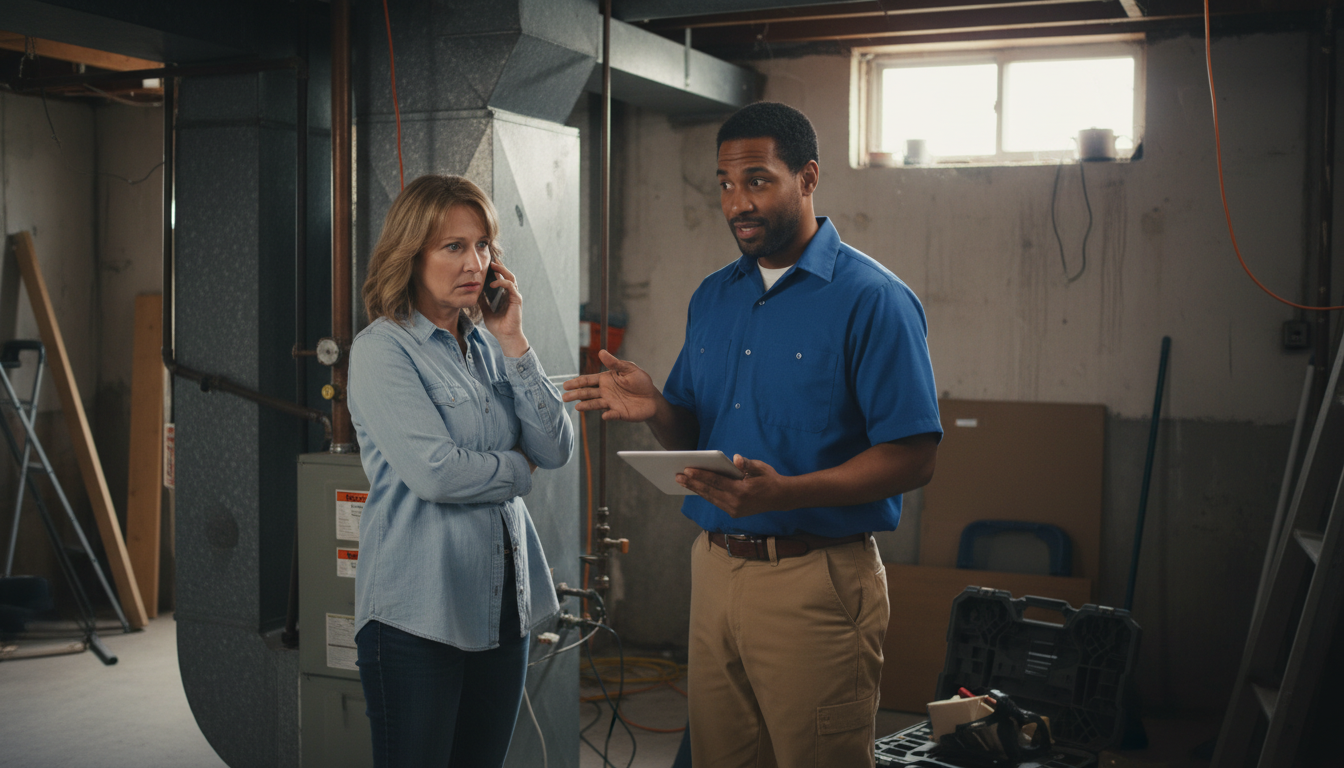
Your HVAC marketing isn't converting calls into booked jobs because of what happens in the 60 seconds after the phone rings — not your ads, your website, or your SEO. Most HVAC contractors lose 30-50% of their inbound leads during the call itself through slow pickup times, inconsistent qualifying questions, unclear pricing communication, or failure to ask for the appointment. The disconnect between generating leads and capturing revenue happens at the front desk, not in your marketing funnel.
Why HVAC Companies Win Leads But Lose Jobs
You're spending $800-$1,500 per month on Google Ads. Your website's getting traffic. The phone's ringing. But when you look at your actual booked jobs versus inbound calls, the math doesn't add up. You're converting maybe half of what comes in — sometimes less.
The problem isn't your lead quality. It's not your pricing. It's the gap between the call and the calendar.
According to Bureau of Labor Statistics data, HVAC contractors report average project values between $3,500-$7,200 for residential system replacements. If you're losing even three qualified calls per week to poor phone handling, that's $45,000-$90,000 in annual revenue walking away before you even knew it was there.
Here's what most articles won't tell you: Your conversion problem isn't usually about what you say on the call — it's about whether you answer at all, and how fast. Research from InsideSales.com found that response times over five minutes reduce conversion rates by 400%. In HVAC, where emergency calls drive 40-60% of revenue during peak season, five minutes might as well be five hours. Your prospect has already called two more companies.
What Kills Your HVAC Call Conversion Rate
Four specific failure points destroy your booking rate: missed calls during job sites visits, inconsistent call handling between your best and worst team members, no follow-up system when calls go to voicemail, and zero ability to book jobs after 5 PM when half your emergency calls come in. These aren't small leaks — they're gaping holes in your revenue bucket.
The Missed Call Problem You Can't See
You're on a ladder installing a condenser unit. Your phone buzzes in your pocket. You can't answer — you're literally holding a refrigerant line. That call goes to voicemail. The homeowner doesn't leave a message. They call the next company.
Industry surveys from the Air Conditioning Contractors of America show that HVAC contractors miss 35-42% of inbound calls during peak season when technicians are in the field. You can't calculate your losses on calls you don't know you missed. Your phone log shows the number, but it doesn't show you the $6,400 AC replacement they needed today.
Why Voicemail Kills HVAC Sales
Most HVAC owners think voicemail works as a safety net. It doesn't. When someone's AC dies in July, they're not waiting for callbacks. They're moving down their list until someone picks up.
Only 4-6% of HVAC service calls that go to voicemail convert to booked jobs — even if you call back within an hour. The urgency window closed. They already found someone else.
Your Best Techs Aren't Your Best Booking Agents
Your lead tech books 70% of the calls he takes. Your newest guy books 30%. Both are answering the same phone, talking to the same type of customer, quoting similar work. The difference? Your lead tech asks for the appointment three times during the call. Your new guy answers questions and waits for the customer to volunteer their schedule.
Inconsistent call handling is invisible until you measure it. You assume everyone's booking at roughly the same rate. They're not.

The Real Cost of Poor HVAC Call Conversion
If you're spending $1,200 monthly on marketing and generating 40 inbound calls, industry-average HVAC booking rates sit around 45-55%. That means you're naturally losing 18-22 qualified opportunities every month. At an average job value of $2,800 (mixing service calls with installations), you're walking away from $50,400-$61,600 in monthly revenue — $604,800-$739,200 annually.
Now increase your conversion rate to 75%. Same ad spend. Same lead volume. You just added $168,000-$201,600 in annual revenue without spending another dollar on marketing.
That's the gap most HVAC contractors never measure. They celebrate lead volume and ignore conversion efficiency. You can calculate your losses based on your actual call volume and current booking rate — the numbers usually shock people.
How the Best HVAC Companies Handle Inbound Calls
High-converting HVAC companies don't rely on heroic effort or perfect execution from exhausted field techs. They build a front office operation that treats every inbound call like the $4,000-$8,000 revenue opportunity it represents: live answer within three rings, consistent qualifying script across every call, immediate booking with calendar access, follow-up on every voicemail within 90 seconds, and after-hours coverage that doesn't depend on the owner's cell phone.
That's not a technology problem. It's a people problem. You need someone — or a full team — whose only job is capturing revenue from inbound calls.
Most HVAC contractors try to solve this by hiring a part-time receptionist or forcing their office manager to juggle calls between invoicing, scheduling, and supplier orders. That works until call volume spikes, someone calls in sick, or your office manager finally quits because she's doing four jobs for the price of one.
BookAllLeads operates as your full front office team — six specialized roles working 24/7 to answer calls, qualify leads, book appointments, and follow up on every opportunity. No software for you to learn. No hiring, training, or managing receptionists. We're live in five days, and you're only paying for the outcome: booked jobs. It's the difference between hoping your calls convert and knowing they will.
What a Proper Call Qualification Process Looks Like
Every HVAC call should follow the same structure: greeting with company name and caller's name, identifying the immediate problem and timeline, qualifying for urgency and budget fit, offering appointment slots within 24-48 hours, confirming appointment details via text, and logging the call with full notes for your tech.
That six-step process takes 3-4 minutes. Your best team members do it instinctively. Your weakest team members skip half the steps and wonder why customers don't show up.
Why After-Hours HVAC Calls Are Your Highest-Value Opportunities
Emergency service calls — the ones that come in at 9 PM on a Saturday — convert at 80-90% when answered live. The urgency is real. The buyer is motivated. They'll pay premium pricing for immediate response.
If your after-hours system is "call my cell and leave a voicemail," you're losing the easiest money in your business.

How to Fix Your HVAC Booking Rate This Month
Start by measuring your current performance: track total inbound calls for two weeks, count how many convert to booked appointments, and calculate your booking percentage. Most HVAC owners guess they're at 60-70%. The data usually shows 40-50%. Knowing your real number gives you a baseline.
Next, audit your missed calls. Pull your phone records and identify every call that went to voicemail or rang more than four times. Call those numbers back and ask if they still need service. You'll recover 10-15% as immediate jobs — and you'll realize how much you're bleeding.
Then fix your call handling process. Write a simple script for qualification questions. Make sure everyone who answers your phone asks for the appointment, confirms the time slot, and sends a confirmation text. Train your team to book the call, not just answer questions.
Finally, solve the availability problem. You can't be on a roof and answering phones simultaneously. You need dedicated coverage — either an internal hire or a professional team that handles this as their core function. The math is simple: if better call coverage adds 10 jobs per month at $3,500 average value, that's $35,000 in monthly revenue. What would you pay for that outcome?
Real-World Example: How One HVAC Company Recovered $180,000
A residential HVAC contractor in Phoenix was spending $2,400 monthly on Google Ads during cooling season. Call tracking showed 62 inbound calls per month. He assumed his booking rate was "pretty good" — maybe 55-60%.
When we actually measured it, his team was booking 28 jobs from those 62 calls. A 45% conversion rate. He was losing 34 qualified opportunities every month.
We implemented live call coverage with consistent qualification, immediate booking, and text confirmations. Within 90 days, his booking rate climbed to 71% — 44 jobs from the same 62 monthly calls. That's 16 additional jobs per month at an average value of $3,100. Annual impact: $595,200 in revenue instead of $1,041,600. He recovered $446,400 in previously lost revenue without changing his ad spend by a single dollar.
The difference wasn't his leads. It was what happened when the phone rang.
Frequently Asked Questions
What's a good booking rate for HVAC calls?
Industry benchmarks show that well-run HVAC companies convert 65-75% of qualified inbound calls to booked appointments. Companies below 50% have a front office problem, not a lead quality problem. If you're tracking total calls including spam and wrong numbers, expect 55-65%. The key is measuring consistently and improving from your baseline.
How fast should I answer HVAC service calls?
Answer within three rings or 15 seconds maximum. Data shows that every additional ring reduces conversion probability by 8-12%. For emergency calls during peak season, answering within two rings can be the difference between booking a $6,000 replacement and losing it to a competitor. Speed to answer is the single highest-impact factor in HVAC call conversion.
Should I use voicemail for after-hours HVAC calls?
No. After-hours calls are typically emergencies with 80-90% conversion rates when answered live. Voicemail converts under 10% because customers immediately call the next company. If you can't answer live 24/7, you need either an answering service trained on HVAC qualification or a dedicated team covering nights and weekends. The revenue loss from missed after-hours calls typically exceeds the cost of live coverage within the first month.
How do I know if my team is booking calls effectively?
Track three metrics weekly: total inbound calls, booked appointments, and show rate for those appointments. Calculate your booking percentage (appointments ÷ calls) and your fulfillment rate (completed jobs ÷ appointments). If your booking rate is below 60% or your show rate is below 75%, you have a call handling or confirmation problem. Record calls (with proper disclosure) and listen for whether your team is actually asking for the appointment or just answering questions.
What questions should I ask on every HVAC sales call?
Every call needs six questions: What's happening with your system right now? When did this start? Is your home uncomfortable currently or is this a maintenance inquiry? What type of system do you have and how old is it? Have you had it serviced recently? And most importantly: I have availability tomorrow at 2 PM or Thursday at 10 AM — which works better for you? That last question books the appointment. Everything before it qualifies whether the call is worth booking.
Is it worth paying for after-hours answering for HVAC calls?
Absolutely, especially during cooling and heating season. A single after-hours emergency call that converts to a system replacement pays for 3-6 months of answering service coverage. If you're getting even two emergency calls per week outside business hours, live coverage pays for itself immediately. The question isn't whether it's worth it — it's whether you can afford to keep losing those calls to competitors who do answer.
Your Marketing Works — Your Front Office Doesn't
You've already solved the hardest part: getting the phone to ring. Your HVAC marketing is generating leads. Your brand is visible. Customers are calling. The breakdown happens in the 60 seconds after that call comes in.
Fixing your call conversion rate isn't about spending more on ads or redesigning your website. It's about treating every inbound call like the $3,000-$8,000 revenue opportunity it represents. That means live answers, consistent qualification, immediate booking, and relentless follow-up.
Most HVAC contractors know this intellectually but never fix it operationally. They stay stuck at 45-50% booking rates because building a real front office feels overwhelming when you're already running jobs, managing crews, and trying to grow.
You don't need to do it alone. You need a team that makes this their only focus. See how a fully managed front office team can double your booking rate without adding to your plate. Learn how we work.
John Edmonds is a native Texan and military combat veteran. He founded Book All Leads after identifying a critical gap in the service industry: business owners losing revenue not from lack of skill, but because no one was handling the calls, follow-ups, reviews, and payments while they were busy doing the work.
View LinkedIn Profile →